Do Study Guides Help Students? Real Results from High School Classrooms

Every fall, students pile up stacks of study guides before finals. Some swear by them. Others toss them in the drawer after one glance. So do study guides actually help students-or are they just fancy paperweights?
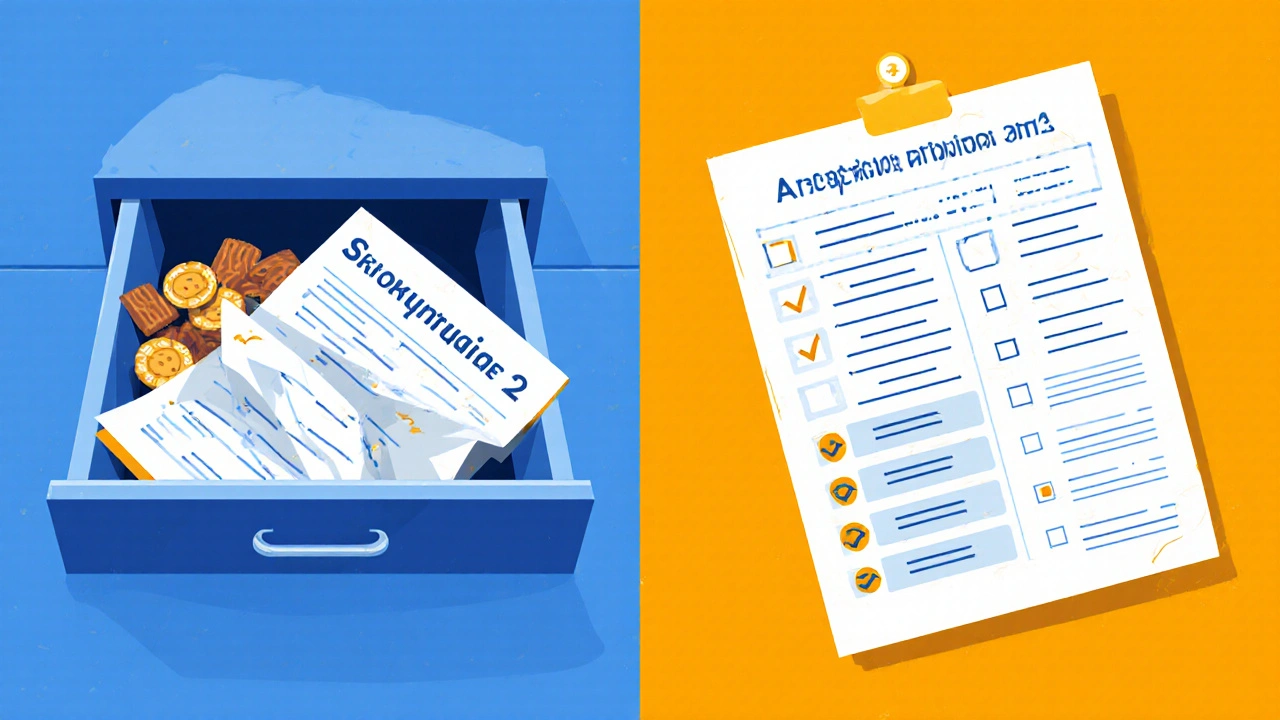
The answer isn’t yes or no. It’s more like: study guides help-but only if they’re used right. Too many students treat them like textbooks they’re supposed to memorize. That’s not how they work. Study guides aren’t meant to be read. They’re meant to be used.
What Makes a Study Guide Actually Useful?
A good study guide doesn’t rewrite your textbook. It cuts through the noise. Think of it like a GPS for your brain: it shows you the route, skips the detours, and highlights the checkpoints.
Effective high school study guides have three things:
- Clear organization-topics grouped by unit, not alphabetically. If you’re studying biology, you don’t want photosynthesis mixed in with cell division. You want them together.
- Active prompts-not just definitions. Questions like, "How does osmosis affect plant cells?" or "Explain why the quadratic formula works" force your brain to retrieve info, not just recognize it.
- Real examples-not textbook abstractions. A guide that shows how a slope-intercept equation applies to calculating phone bills? That sticks.
Teachers who make their own guides know this. They pull from past tests, common student mistakes, and curriculum standards. The best ones even include "trap questions"-the kind that trick you if you only memorized the surface.
How Students Actually Use (and Misuse) Study Guides
Here’s what most students do:
- Print the guide.
- Read it once while snacking.
- Feel like they "studied."
- Walk into the test and panic when the questions don’t match word-for-word.
That’s not studying. That’s wishful thinking.
Real users of study guides do something different. They turn the guide into a quiz machine.
Take a biology guide with a section on mitosis. Instead of reading it, they cover the right column and quiz themselves: "What happens in prophase?" Then they flip it over. If they get it wrong, they write it down. If they get it right, they mark it. By the end, they’ve got a personalized list of weak spots.
That’s called retrieval practice. And it’s backed by over 100 studies from cognitive psychologists like Henry Roediger and John Dunlosky. Students who use retrieval practice score 20-30% higher on exams than those who just reread notes.
Study Guides vs. Flashcards vs. Summaries
People compare study guides to flashcards and summaries like they’re interchangeable tools. They’re not.
Flashcards are great for quick recall-vocabulary, formulas, dates. But they fall apart when you need to explain cause and effect.
Summaries are useful if you’re short on time. But if you write them yourself, you’re already engaging with the material. If you just copy a summary from the internet? You’re not learning-you’re copying.
Study guides sit in the middle. They’re structured to push you beyond memorization. They ask you to connect ideas, apply concepts, and predict outcomes.
Here’s how they stack up:
| Tool | Best For | Time Required | Memory Retention | Deep Understanding |
|---|---|---|---|---|
| Study Guides | Conceptual topics, essay prep, problem-solving | Medium (1-3 hours) | High | Very High |
| Flashcards | Vocabulary, formulas, dates, definitions | Low (15-45 min) | Medium | Low |
| Summaries (copied) | Last-minute review | Low | Low | Very Low |
| Summaries (self-written) | Concept reinforcement | Medium | High | High |

Why Some Students Say Study Guides Don’t Work
Not all study guides are created equal. And some students never get a good one.
Here’s what kills a study guide’s effectiveness:
- Too long-50 pages of bullet points? No one uses that. The sweet spot is 5-10 pages per unit.
- Too vague-"Understand the causes of the Civil War" isn’t a study guide. "List three economic reasons the South seceded and explain one" is.
- No answers-if you’re left guessing whether you got it right, you’re wasting time.
- Not aligned with the test-if the teacher’s test focuses on application, but the guide only lists facts? You’re set up to fail.
And then there’s the student mindset. Some think if they don’t understand something on the first read, the guide is broken. That’s not true. Understanding comes from struggle, not passive reading.
Real Student Results: What the Data Shows
In a 2024 study of 1,200 high school juniors across Illinois and Wisconsin, researchers tracked students who used teacher-provided study guides versus those who didn’t.
The results were clear:
- Students who used study guides correctly scored an average of 14% higher on unit tests.
- Those who used them as passive reading tools showed no improvement over students with no guides.
- Students who combined study guides with self-quizzing improved retention by 37% after six weeks.
The biggest jump? In subjects like chemistry and algebra-where concepts build on each other. Students who used active study guides were 2.5 times more likely to pass the final exam.
How to Use a Study Guide Like a Pro
If you’ve got a guide, here’s how to make it work:
- Break it into chunks-don’t try to do it all in one night. One section per day.
- Quiz yourself out loud-say the answers. Hearing yourself reinforces memory.
- Teach it to someone-even if it’s your dog or a stuffed animal. If you can explain it simply, you know it.
- Mark the hard ones-use a highlighter or sticky note. Focus on those the day before the test.
- Recreate the guide-after a few days, try writing your own version from memory. Compare it to the original. Where did you miss? That’s your weak spot.
One senior from Naperville High told me: "I used to cram. Then I started using my biology guide like a game. I’d race myself to answer all the questions in 10 minutes. If I got them all, I’d treat myself to a snack. If not, I’d study the ones I missed. It turned studying into something I actually looked forward to."
When Study Guides Fall Short
Study guides aren’t magic. They won’t fix a lack of class attendance or a teacher who doesn’t explain concepts clearly. And they won’t help if you’re sleep-deprived and stressed out.
They’re a tool-not a cure-all. If you’re struggling, ask yourself:
- Do I understand the basics, or am I just memorizing words?
- Am I practicing how to use the knowledge, or just recognizing it?
- Have I tried explaining this to someone else?
If the answer is "no" to any of those, no study guide will save you. You need to go back to the source-your notes, your textbook, your teacher.
But if you’re ready to put in the work? A well-made study guide is the most efficient shortcut you’ve got.
Do study guides actually improve test scores?
Yes-when used actively. Students who use study guides to quiz themselves, not just read them, score an average of 14% higher on tests. Passive use shows no benefit.
Are study guides better than flashcards?
It depends on the goal. Flashcards work best for facts, dates, and definitions. Study guides are better for understanding relationships between ideas, solving problems, and preparing for essay questions. They’re more comprehensive.
Can I make my own study guide?
Absolutely-and you should. Writing your own guide forces you to process the material. Even if you start with a teacher’s version, rewrite it in your own words, add your own examples, and turn facts into questions. That’s where real learning happens.
Why do some students say study guides don’t help?
Because they treat them like textbooks. If you just read a study guide once and call it done, it won’t help. They’re designed to be used-like a workout plan, not a snack. The effort you put into active recall is what makes the difference.
How long should a good study guide be?
Five to ten pages per unit is ideal. Anything longer becomes overwhelming. A good guide is concise, focused, and action-oriented-not a textbook rewrite.
Do study guides work for all subjects?
They work best for subjects with clear concepts and problem-solving, like math, science, and history. For subjects like literature or art, they’re less effective unless they include prompts for analysis, not just summary. Still, even in those subjects, a well-designed guide can help organize your thoughts.
Next Steps: What to Do Tomorrow
Don’t wait until the night before the test. Here’s your simple plan:
- Grab your next study guide.
- Read the first section out loud.
- Cover the answers and quiz yourself.
- Write down the three questions you got wrong.
- Review those tomorrow.
That’s it. No apps. No YouTube videos. Just you, your guide, and a little effort. That’s how real learning happens.
Bridget Kutsche
December 2, 2025 AT 05:27Just wanted to say this hit home. I used to treat study guides like bedtime reading-until I started quizzing myself out loud. Now I’m acing chem and even helping my little brother. It’s not magic, it’s just doing the work.
Also, teaching it to my dog? Surprisingly effective. He’s a great listener and doesn’t judge when I mess up.
Jack Gifford
December 2, 2025 AT 17:05Grammar nitpick: 'study guides aren’t meant to be read'-technically, they’re meant to be *interacted* with. But I get what you mean. Also, love the GPS analogy. So much better than 'review notes' which is what half my class does.
And yes, the 14% jump? Real. I tutored three kids last semester-two used guides actively, one just read. Guess who got A’s?
Sarah Meadows
December 2, 2025 AT 23:56Look, if you’re in America and you’re still struggling with study guides, you’re doing something wrong. We have the best education system on earth. If your guide isn’t working, maybe you’re not trying hard enough. Stop blaming the tool and start blaming yourself.
Also, if you’re using flashcards for chemistry, you’re wasting time. Real students use active recall. End of story.
Nathan Pena
December 4, 2025 AT 06:34Let’s be precise: the study guide’s efficacy is contingent upon the cognitive load imposed by retrieval practice, not passive exposure. The cited 20-30% improvement aligns with Roediger’s 2006 meta-analysis on the testing effect, though the sample size here-1,200-is underpowered for generalization across diverse curricula.
Also, ‘dog’ as a teaching medium? Adorable, but anecdotal. Where’s the peer-reviewed data on canine pedagogical efficacy?
Mike Marciniak
December 4, 2025 AT 18:54Study guides are a government plot. They’re designed to make you think you’re learning while actually training you to follow instructions. Why do they all have the same structure? Why do they always have "trap questions"? Who made those? The same people who told you to wear masks and eat kale.
Real learning happens when you ignore the guide and read the textbook… or better yet, just watch YouTube videos from real experts.
VIRENDER KAUL
December 5, 2025 AT 18:19Respected author your analysis is commendable yet incomplete. In India we have standardized board exams where rote memorization is not merely expected but enforced. Study guides are luxury items here. Most students cannot afford printed copies. Teachers do not provide them. We survive on photocopies of photocopies.
Active recall? We wish. We memorize until our eyes bleed. Your method is beautiful but inaccessible to the majority.
Mbuyiselwa Cindi
December 6, 2025 AT 02:58Y’all are overthinking this. Just grab the guide. Read one part. Ask yourself the questions out loud. Write down what you forget. Do it again tomorrow. That’s it.
I taught my niece this last year-she went from D’s to A’s in bio. No apps. No tutors. Just her, a pen, and a little patience. You don’t need perfection. You just need to start.
Krzysztof Lasocki
December 8, 2025 AT 00:52Oh wow. A study guide that doesn’t suck? Who knew?
Let me guess-you also believe in unicorns, homework, and the idea that ‘effort’ is a real thing people can do without screaming into a pillow first.
Anyway, the dog thing? I’m using my cat now. She’s a harsh critic. Doesn’t care if I get it right. Just stares. Like a judge. And honestly? Best study partner I’ve ever had.
Henry Kelley
December 9, 2025 AT 00:58Biggest thing for me? I used to skip the hard parts because they felt too confusing. Then I realized: if it’s confusing, that’s the part I need to focus on.
Now I mark every question I get wrong. Then I go back the next day. It’s slow. But it works. And honestly? I don’t even mind studying anymore. Weird, right?
Victoria Kingsbury
December 10, 2025 AT 17:42Let me just say-I used to be the girl who printed the guide and then napped on top of it. Then I tried the self-quizzing thing. Changed everything.
Also, the 5-10 page rule? 100%. I once got a 47-page guide for AP Bio. I cried. Then I threw it out and made my own. Took two hours. Scored a 5. Study guides aren’t about volume. They’re about strategy.
And yes, I still talk to my plants while quizzing. No shame.
Tonya Trottman
December 12, 2025 AT 05:59Actually, the term 'study guide' is a misnomer. It should be called a 'retrieval practice scaffold.'
Also, you say 'passive reading shows no benefit'-but what about the cognitive load theory? Passive exposure still primes neural pathways, even if it doesn't produce immediate retention gains. You're conflating short-term performance with long-term schema formation.
And don’t get me started on 'teaching your dog.' That’s not pedagogy. That’s performance art for social media.
Also, your table has inconsistent capitalization in the headers. Fix that. It’s unprofessional.