High Schools: The Gateway to Higher Education

High schools aren’t just where teens spend four years between middle school and college-they’re the real starting line for everything that comes after. If you’re not thinking about college while you’re in high school, you’re already behind. Not because high school is a test you have to pass, but because it’s the only place where you build the skills, habits, and credentials that colleges actually care about.
What Colleges Actually Look For
Colleges don’t just want good grades. They want students who’ve shown they can handle real work. A 3.8 GPA matters, but so does what you did outside the classroom. A student who took AP Biology, led the science club, and volunteered at a local clinic will stand out more than someone with a 4.0 who did nothing but study.
Admissions officers see thousands of applications. They’re looking for patterns-not just one great essay or one trophy. They want to see growth. Did you start slow and get stronger? Did you take on more responsibility each year? Did you push yourself beyond what was required? That’s what they remember.
Take the case of a student from Charlotte, North Carolina. She got a B in Algebra II her sophomore year. Instead of dropping the class, she signed up for after-school tutoring, retaken the class the next year, and ended up with an A. That’s the kind of story that sticks. It shows grit. It shows initiative. Colleges notice that.
The Curriculum That Actually Prepares You
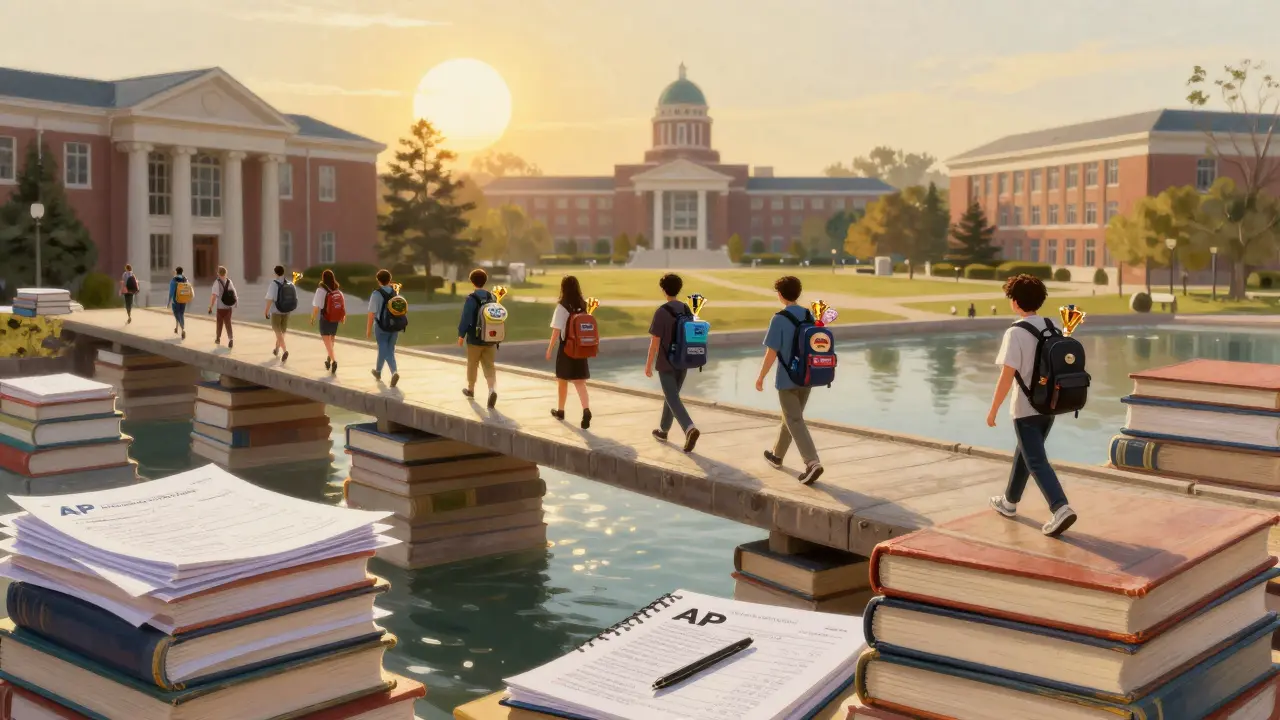
Not every high school class is created equal when it comes to college readiness. Basic math and English? Necessary. But if you’re aiming for college, you need more. Advanced Placement (AP) courses, International Baccalaureate (IB) programs, dual enrollment classes-these aren’t extras. They’re the foundation.
AP courses like Calculus, Chemistry, and U.S. History give you college-level work while still in high school. Passing the AP exam can earn you college credit, which saves time and money later. Dual enrollment lets you take actual college classes at a local community college while still in high school. In North Carolina, over 120,000 high school students took dual enrollment courses in 2024. That’s not a trend-it’s becoming the norm.
And don’t ignore electives. A student who takes graphic design, journalism, or coding doesn’t just fill a schedule. They build skills colleges can’t teach in orientation week. Writing for the school paper teaches clarity. Coding a website teaches problem-solving. These aren’t hobbies-they’re preparation.
Graduation Requirements Are Just the Starting Point
Most states require 20-24 credits to graduate. That’s a minimum. It’s not a target. If you only take the bare minimum, you’re not getting ready for college-you’re just checking boxes.
For example, in North Carolina, you need four years of English and three years of math. But most four-year colleges expect four years of math, including Algebra II or higher. Same with science: three years are required, but competitive schools want lab-based courses in biology, chemistry, and physics. You’re not being punished for going beyond the minimum. You’re being rewarded for showing you’re ready.
And don’t forget foreign language. Many colleges require two years, but top schools expect three or four. Spanish? French? Mandarin? It doesn’t matter which one, as long as you stick with it. Colleges see language study as a sign of intellectual curiosity.

Extracurriculars: More Than Resume Filler
Joining the debate team, playing soccer, or working part-time at a grocery store isn’t just about looking busy. It’s about showing colleges you can manage time, lead, and follow through.
Colleges don’t care how many clubs you joined. They care about depth. One student spent three years organizing a weekly food drive at her church. Another started a podcast about mental health for teens. These aren’t flashy. But they’re real. They show commitment. They show empathy. They show someone who sees a problem and tries to fix it.
Leadership matters more than titles. If you’re the only one who shows up to practice every day, you’re leading. If you tutor younger students after school, you’re leading. You don’t need to be president of something to be valuable.
Standardized Tests: Still Part of the Game
SAT and ACT scores aren’t everything. But they’re still part of the picture. Many colleges are test-optional now, but if your scores are strong, they help. If they’re weak, they can hurt.
The average SAT score for admitted students at public universities in the U.S. is around 1150. At selective schools, it’s 1350 or higher. That doesn’t mean you need to score 1400 to get in. But if your GPA is 3.2 and your SAT is 980, you’re making it harder than it needs to be.
Here’s the truth: test prep works. A student who studies 10 hours a week for three months typically improves by 150-200 points. That’s not magic. It’s practice. Free resources like Khan Academy’s SAT prep, used by over 10 million students, are just as effective as expensive tutors.
Building a Plan-Step by Step
Here’s what a realistic four-year plan looks like:
- Freshman year: Focus on adjusting. Get good grades. Take challenging classes. Start exploring clubs. Don’t panic if you’re not sure what you want to study yet.
- Sophomore year: Start thinking about AP or dual enrollment. Take the PSAT. Begin researching colleges. Talk to your guidance counselor.
- Junior year: This is the most important year. Take the SAT or ACT. Apply for summer programs. Narrow down your college list. Start drafting your personal statement.
- Senior year: Finalize applications. Meet deadlines. Ask for recommendations early. Submit FAFSA. Don’t wait until January to start.
That’s it. No magic formula. Just consistency. The student who shows up every day, does the work, and asks for help when needed will almost always get where they’re trying to go.
What Happens When You Skip the Prep
Not every student makes it to college. Some drop out. Some go to community college unprepared. Some take remedial classes-classes they should’ve taken in high school-and pay for them anyway.
In 2023, 60% of community college students needed at least one remedial course in math or English. That’s not because they’re not smart. It’s because they weren’t challenged enough in high school. Remedial classes don’t count toward a degree. They cost money. They delay graduation. They drain motivation.
High school is your last chance to fix that before it’s too late.
Final Thought: It’s Not About Getting In. It’s About Succeeding.
Getting into college isn’t the finish line. It’s the starting gate. The real test is what happens after you walk onto campus. And the students who do best aren’t the ones with the highest scores. They’re the ones who learned how to manage their time, ask for help, and keep going when things got hard.
High school is where you learn that. Not just from textbooks. From showing up. From failing and trying again. From choosing to do the hard thing-even when no one’s watching.
That’s the real gateway. Not the diploma. Not the acceptance letter. It’s the habits you build before you ever set foot on a college campus.
Do I need to take AP classes to get into college?
No, AP classes aren’t required, but they help. Colleges want to see that you challenged yourself. If your school doesn’t offer AP, take dual enrollment, online college courses, or independent study projects. What matters is that you pushed beyond the basics.
Can I still get into a good college with a low GPA?
Yes, but you’ll need to make up for it elsewhere. Strong test scores, impressive extracurriculars, a compelling personal essay, or a major improvement in grades over time can offset a lower GPA. Colleges look at your whole story-not just one number.
How important are extracurricular activities?
Very. But not because you need a long list. Colleges care about depth, not quantity. One meaningful activity you stuck with for years matters more than five clubs you joined for a semester. Show commitment, leadership, or impact.
Is it too late to start preparing in senior year?
It’s harder, but not impossible. Focus on your application essays, finalize your list of colleges, and make sure your transcripts reflect your best work. If you haven’t taken the SAT/ACT yet, take it now. Many schools accept applications through early spring. Don’t give up.
What if my high school doesn’t offer advanced courses?
Many students face this. Use free online resources like Khan Academy, Coursera, or edX to take college-level courses. Get certified. Or enroll in a local community college for dual credit. Colleges know not every school has the same resources-they look for initiative, not perfection.
Donald Sullivan
December 31, 2025 AT 09:37Wow, another one of those ‘if you don’t take 17 APs and volunteer at a hospital while running a startup’ lectures. Newsflash: not everyone has access to AP classes, tutors, or parents who care. You’re not ‘behind’ if you’re working 30 hours a week to help your family pay rent. Stop acting like college is a reward for privilege.
Taylor Hayes
December 31, 2025 AT 17:18I get where you're coming from, but I’ve seen too many kids burn out trying to check every box on this list. It’s not about stacking achievements-it’s about finding what matters to you. I had a student who started a book club for incarcerated teens because she loved stories. No APs, no trophies. Got into a top school because she wrote about how books saved her from silence. Depth > resume padding.
Sanjay Mittal
January 2, 2026 AT 09:23In India, we call this ‘college prep culture’-it’s the same everywhere. But here’s the thing: dual enrollment isn’t always accessible. Even in big cities, government schools don’t have counselors who know how to navigate this. The real issue isn’t the student-it’s the system. Maybe we should fix that instead of blaming kids for not playing the game perfectly.
Mike Zhong
January 2, 2026 AT 16:25Let’s be honest: this whole post is just a glorified sales pitch for the college industrial complex. You’re selling anxiety as advice. ‘Build habits before college’? Sure. But what if the goal isn’t college at all? What if the real gateway is learning to think for yourself-not memorizing what admissions officers want to hear? The diploma doesn’t make you wise. The questions you ask do.
Jamie Roman
January 4, 2026 AT 13:42I remember being a sophomore and thinking I had to be perfect-4.0, AP everything, student council president, volunteer at the animal shelter, tutor underprivileged kids, play varsity soccer, and still have time to sleep. I didn’t. I got a C in chemistry, quit the soccer team after a concussion, and spent my free time reading sci-fi novels. I didn’t get into the Ivy League. I went to a state school, worked part-time, and graduated with zero debt. Four years later, I’m working in tech and I’ve never once needed to explain why I didn’t take AP Physics. The system rewards hustle, but life rewards resilience. And sometimes, resilience means saying no to the grind.
Salomi Cummingham
January 4, 2026 AT 16:31I cried reading this. Not because it’s perfect-but because it’s the truth I wish someone had told me when I was 15. I grew up in a town where the high school didn’t have a single AP class. My mom worked two jobs. I took the bus to the library every day after school to use their free Wi-Fi to study for the SAT. I got a 1080. My GPA was 3.1. I got into a decent university because I wrote about how I learned to type on a broken keyboard with one finger because I couldn’t afford a new laptop. They didn’t admit me for my scores. They admitted me because I didn’t give up. This post? It’s not about perfection. It’s about showing up when no one’s watching. And that? That’s the real magic.
Johnathan Rhyne
January 5, 2026 AT 14:00‘Colleges want growth’? Nah. They want a polished, sanitized version of a kid who’s been prepped by a $200/hour consultant. And ‘AP classes aren’t required’? Sure, technically. But if you’re not taking them, you’re basically handing the admissions officer a ‘I don’t care’ sign. Also, ‘remedial classes don’t count toward a degree’? DUH. That’s why they’re called REMEDIAL. And ‘Khan Academy is as good as a tutor’? Only if you’re the kind of person who doesn’t need human interaction to learn. Grammar check: ‘you’re not being punished for going beyond the minimum’-should be ‘you’re not punished.’ You’re welcome.
Jawaharlal Thota
January 6, 2026 AT 15:43As someone who grew up in a village with no internet and only one teacher for all grades, I can say this: the system is rigged, but not unbeatable. I didn’t know what AP was until I was 17. I taught myself calculus from a library book. I wrote essays on recycled paper because we couldn’t afford notebooks. I got into a university in Delhi not because I had perfect scores, but because I showed up every day and never stopped asking questions. If you’re reading this and feel behind-don’t panic. Start where you are. Use what you have. Do what you can. That’s all anyone ever needs.
Nathan Jimerson
January 7, 2026 AT 21:17You don’t need to be perfect. You just need to keep going. One step. Then another. That’s how people get where they’re going.
Sandy Pan
January 9, 2026 AT 07:41What if the real gateway isn’t college at all? What if high school is just a mirror-showing us what we’ve been taught to value: productivity, credentials, compliance? And what if the real education happens when you walk away from the script? When you choose art over algebra because it heals you? When you quit the debate team because you realized you were just performing for approval? Maybe the most rebellious thing you can do isn’t taking AP classes-it’s refusing to let anyone define your worth by a GPA or a test score.
Eric Etienne
January 10, 2026 AT 08:23Bro, you’re telling teens they’re ‘behind’ if they don’t do all this? That’s not advice, that’s emotional abuse. Most of these kids are just trying to survive. And now you’re making them feel like failures for not being Elon Musk by 18? Get a grip.