How High Schools Are Adapting to the Needs of Generation Z
High schools today aren’t just teaching algebra and essay writing anymore. They’re trying to keep up with a generation that grew up with smartphones in one hand and TikTok in the other. Generation Z - students born between 1997 and 2012 - don’t learn the way their parents did. And schools that stuck to the old model are seeing disengagement, anxiety, and dropout rates climb. The ones that are surviving? They’re changing - fast.
Classrooms Are No Longer Just Rows of Desks
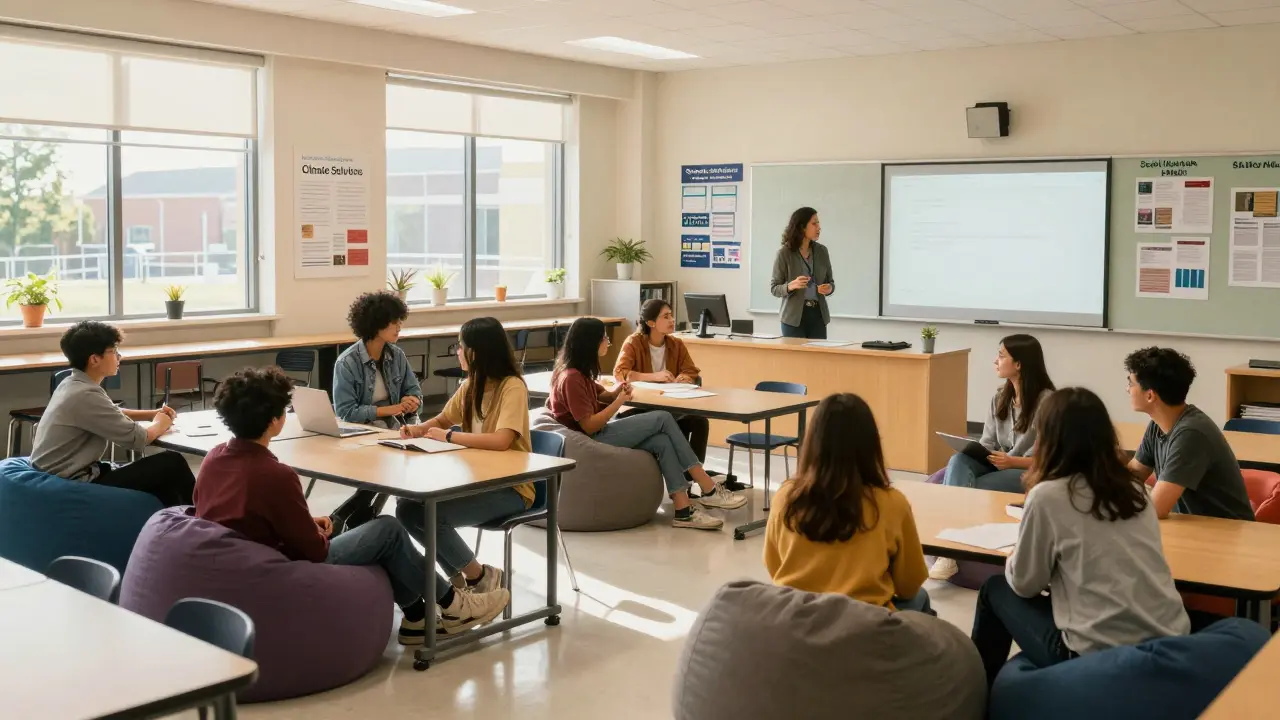
Walk into a modern high school in Boulder, Austin, or even rural Ohio, and you might not see rows of desks facing a whiteboard. Instead, you’ll find flexible seating: bean bags, standing desks, couches, and movable tables. This isn’t just about comfort. It’s about control. Gen Z students want to choose where and how they learn. A 2024 survey by the National Association of Secondary School Principals found that 78% of students reported higher focus when they could pick their seating. Schools that moved away from rigid layouts saw a 22% drop in off-task behavior within one semester.
Teachers aren’t lecturing from the front anymore. They’re moving around, coaching, asking questions, and letting students lead discussions. The goal? Turn students from passive listeners into active participants. One teacher in Denver started using “learning pods” - small groups of 4-5 students who rotate through projects every two weeks. Each pod picks a real-world problem: climate change, local food access, or social media mental health. They research, build a solution, and present it to the city council. Engagement? Up 65%. Attendance? Stable.
Digital Tools Are the New Textbooks
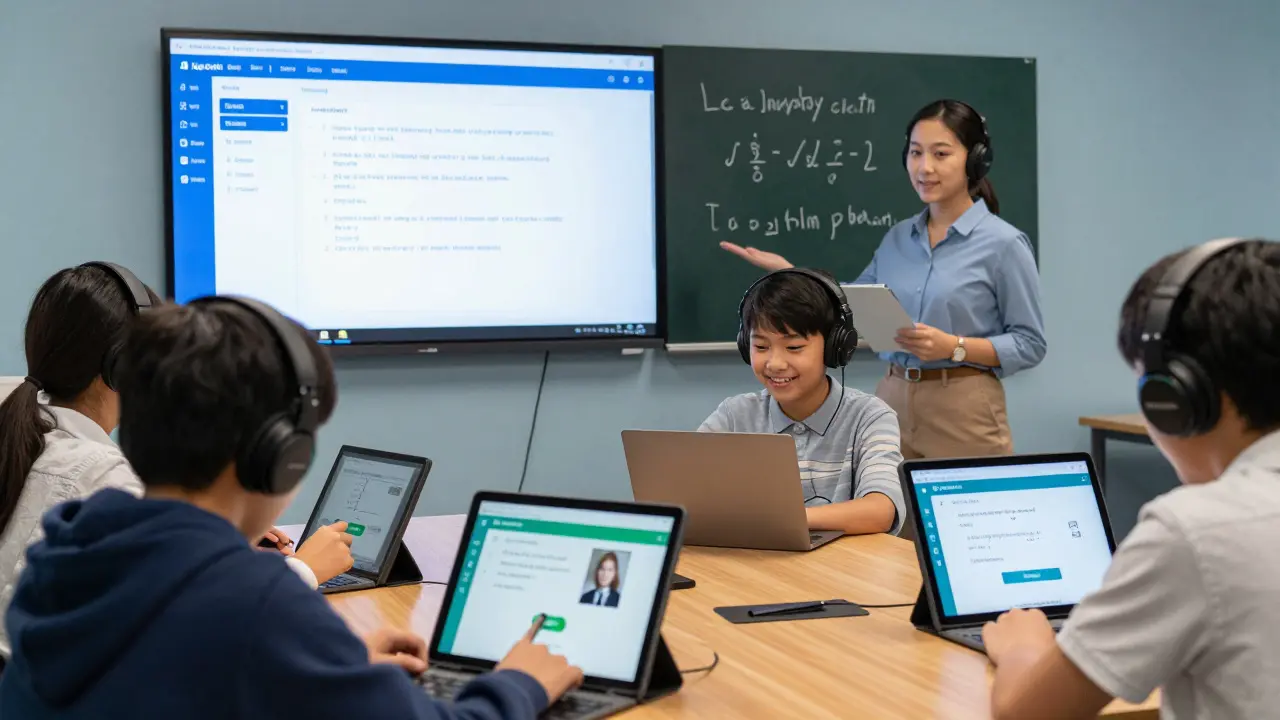
Textbooks are gathering dust. Gen Z doesn’t read 300-page paper books. They scroll. They watch. They interact. So schools are replacing static textbooks with digital platforms like Khan Academy, Nearpod, and Flipgrid. In a 2025 pilot program across 120 public high schools, districts that switched to interactive digital content saw a 31% increase in homework completion rates. Why? Because these tools feel like apps they already use - not homework.
Teachers now use AI-powered tools to personalize learning. If a student struggles with quadratic equations, the system flags it and suggests a 5-minute video, a quiz, and a peer tutor - all within minutes. No waiting for the next class. No embarrassment. It’s like Netflix for math: you get recommendations based on what you’ve watched. And it works. In one Chicago high school, math pass rates jumped from 58% to 82% in two years after adopting adaptive learning software.
But it’s not just about tech. It’s about trust. Students don’t want to be tracked like data points. Schools that explain how data is used - and give students control over their own progress dashboards - see better results. One school in Portland lets students toggle their privacy settings: who sees their grades, who can comment on their work, and whether they want to share their learning journey with college counselors.
Mental Health Isn’t an Add-On - It’s the Foundation
One in three Gen Z students report feeling overwhelmed by school stress. Depression and anxiety rates have doubled since 2018, according to CDC data. High schools that treat mental health like math class - something you show up for, practice, and get better at - are seeing real change.
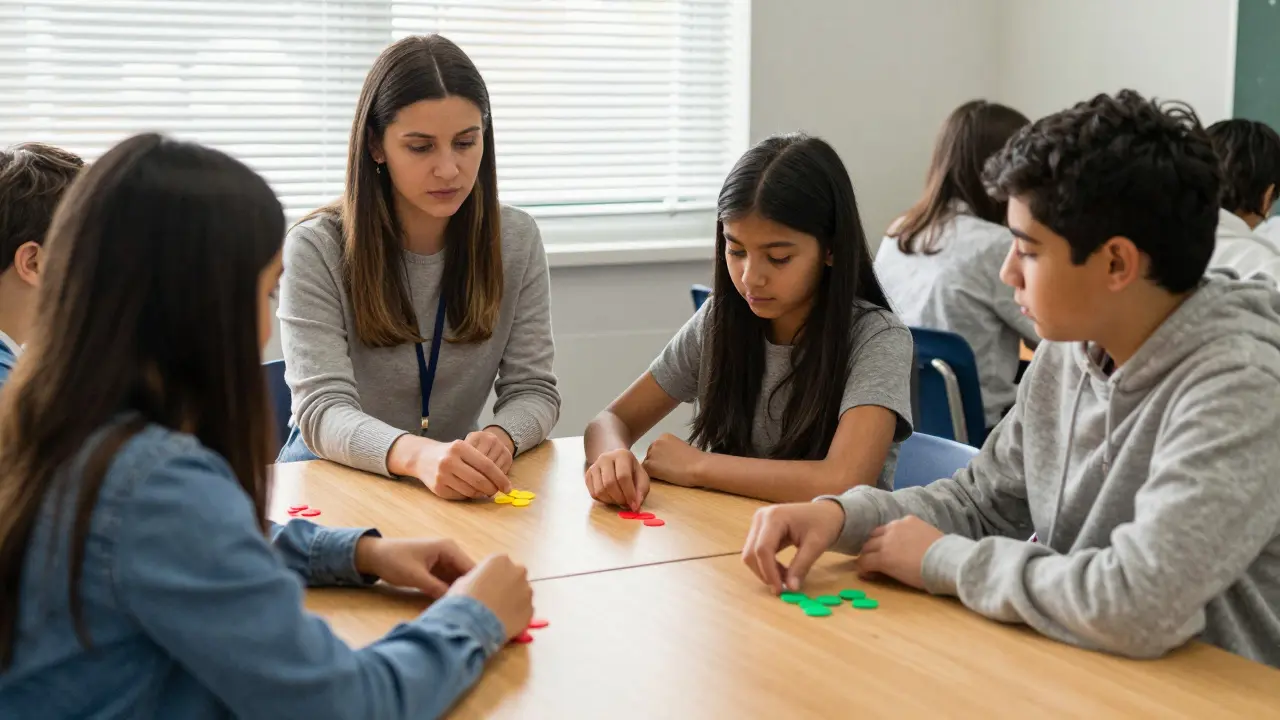
Many now have daily mindfulness sessions. Others offer “mental health days” that count as excused absences. In Minnesota, a district introduced “emotional check-ins” at the start of every class. Students pick a color: red for overwhelmed, yellow for okay, green for ready. Teachers adjust pacing based on the room’s mood. No one has to talk. No one gets shamed. Just a quiet signal. Attendance in those classes rose by 19%.
Counselors aren’t just helping with college apps anymore. They’re teaching coping skills, managing group therapy circles, and training peer mentors. One high school in Atlanta hired a full-time trauma-informed care specialist. Her job? To help teachers understand why a student might shut down during a test - not because they’re lazy, but because their nervous system is stuck in survival mode. The result? Suspensions dropped by 40% in a year.
Real-World Learning Replaces Rote Memorization
Gen Z doesn’t care about memorizing the capitals of countries if they can Google them in two seconds. What they care about is relevance. They want to know: “Why does this matter?”
High schools are answering that question with project-based learning. Instead of writing a report on the Civil War, students interview local historians, build a podcast series, and release it to the public. Instead of learning chemistry through lab manuals, they partner with a community garden to test soil quality and propose solutions to city officials.
Internships and apprenticeships are no longer for the “gifted few.” In California, every public high school now offers at least two work-based learning pathways: tech, healthcare, green energy, or media. Students spend one day a week at a local business, getting paid, earning high school credit, and building a resume. One 16-year-old in San Diego now works part-time at a solar installation company - and she’s the one teaching her physics class how solar panels actually work.
Colleges are noticing. More admissions officers now ask: “What have you built? What problem did you solve?” not “What was your GPA?”
Grades Are Becoming Optional
Here’s the most radical shift: some schools are ditching traditional grades altogether.
In New Hampshire, a state-wide initiative called “Competency-Based Education” lets students advance only after they prove mastery - not after they’ve sat through 180 days of class. A student who understands calculus by November doesn’t wait until May to move on. They go deeper. They teach others. They apply it.
Instead of A, B, C, students get detailed feedback: “You can analyze historical bias in sources” or “You need to practice citing evidence clearly.” Parents get portfolios, not report cards. Students get pride in progress, not fear of failure.
Early results? College retention rates for these students are 27% higher than peers from traditional schools. Why? Because they know how to learn - not just how to test.
Teachers Are Becoming Co-Designers
Change doesn’t happen from the top down. It happens when teachers - the ones in the trenches - are part of the redesign.
High schools that succeed now give teachers autonomy. They let them choose tools, design units, and even vote on school-wide policies. In Seattle, teachers formed a “Student Experience Team” that meets every other week. They bring student feedback, suggest changes, and get budget approval within 48 hours. One teacher proposed eliminating homework on weekends. The school tried it. Student well-being scores went up. Teachers kept it.
Professional development isn’t about sitting through PowerPoint slides anymore. It’s about coaching, peer observation, and real-time feedback. Teachers use apps like Edthena to record their lessons and get feedback from colleagues. One teacher in Ohio improved her classroom discussions by 50% after watching herself teach and getting input from three other educators.
What’s Still Missing?
Not every school can afford new tech. Not every district has funding for counselors. And not every parent understands why grades are disappearing. There’s still a gap - especially in rural and underfunded areas.
But the direction is clear. Gen Z isn’t broken. The system is. The schools that are thriving now aren’t the ones with the newest gadgets. They’re the ones that listened. They asked students: “What do you need?” And then they acted.
It’s not about making school more fun. It’s about making it meaningful. And for the first time in decades, that’s actually happening.
Are high schools really changing, or is this just a trend?
They’re changing - and it’s not a trend. It’s a response to data. Student engagement, mental health, and college readiness metrics have been declining for over a decade. Schools that ignored it lost students. The ones that adapted saw better attendance, lower dropout rates, and higher college enrollment. This isn’t about gimmicks. It’s about survival.
Do students really prefer digital learning over textbooks?
Yes - but not because they like screens. They prefer learning that’s immediate, interactive, and personalized. A 2025 study from Stanford found that 81% of Gen Z students retained information better when they could pause, rewind, and quiz themselves on a video. Textbooks can’t do that. Digital tools can. It’s not about replacing books - it’s about giving students control over how they learn.
Why are some schools getting rid of grades?
Grades often measure compliance, not understanding. A student can get an A by memorizing facts and cramming for tests - but still not know how to apply the knowledge. Competency-based systems focus on mastery. Students don’t move on until they can explain, create, or solve problems. It’s harder - but it prepares them better for real life. Colleges are starting to value this more than GPA.
How do schools afford these changes?
Many use federal grants, state education innovation funds, or partnerships with local businesses. Some schools swap old textbooks for free digital licenses. Others partner with nonprofits like Khan Academy or Code.org that offer free curriculum. It’s not about spending more - it’s about spending smarter. The biggest cost? Resistance to change. Once teachers and students see the results, funding follows.
Is this only happening in wealthy districts?
No. Some of the most innovative changes are happening in rural and low-income schools. In West Virginia, a district with 70% free lunch eligibility launched a mobile tech lab that visits every school once a week. In Mississippi, a high school partnered with a local nursing home for student-led health projects. Innovation isn’t about money. It’s about listening - and being willing to try something new.
kelvin kind
January 4, 2026 AT 17:13My cousin’s school does the color check-ins too. She says it’s the only thing that keeps her from bailing on third period.
Sam Rittenhouse
January 5, 2026 AT 19:06This isn’t just innovation-it’s survival. I’ve seen kids melt down over a B+ in a system that treats them like widgets. When schools start treating learning like a human experience instead of a performance review, everything changes. The data doesn’t lie. Attendance, engagement, mental health-it all improves when you stop forcing square pegs into round holes. This isn’t trendy. It’s necessary.
Denise Young
January 7, 2026 AT 15:44Let’s be real-this is what happens when you stop treating teenagers like broken machines that just need more standardized testing. The ‘flexible seating’ thing? It’s not about bean bags-it’s about autonomy. Gen Z didn’t grow up in command-and-control environments; they grew up in algorithm-driven ecosystems where they had agency over their content, their feed, their time. So of course they rebel against rows of desks. It’s not laziness-it’s a neurological mismatch. And now schools are finally using adaptive learning platforms that function like TikTok for curriculum? Genius. No one wants to be lectured at. Everyone wants to be coached. And the competency-based grading? That’s the only thing that actually measures whether someone knows something or just memorized it for 48 hours. The fact that colleges are now asking ‘what did you build?’ instead of ‘what was your GPA’? That’s the future. And it’s beautiful. Also, teachers voting on policy? Finally. The people who actually do the work should get to shape the system. The resistance? It’s not from students. It’s from administrators who still think a bell schedule from 1952 is sacred.
Ian Cassidy
January 8, 2026 AT 14:01Adaptive learning is just the new version of the old ‘individualized instruction’ push from the 90s. Only now it’s got AI and a slick UI. The results are real, but let’s not pretend tech alone fixes systemic neglect.
Sarah McWhirter
January 9, 2026 AT 07:08Wait… so you’re telling me schools are finally listening to kids? That’s cute. But have you seen the data on how many of these ‘innovative’ programs are funded by corporate sponsors who want to plant seeds for future consumers? Khan Academy? Free? Sure. But their parent company owns 37% of the edtech patents in the U.S. And those ‘emotional check-ins’? That’s just emotional surveillance dressed up as care. They’re collecting mood data to predict dropout risk-and then selling it to insurance companies. This isn’t reform. It’s refinement of control. And the grades disappearing? That’s just prep for a future where your learning portfolio is your credit score. You think you’re being heard? You’re being profiled.
Ananya Sharma
January 9, 2026 AT 23:36Oh wow, another feel-good article about how Gen Z is ‘so special’ and schools are finally ‘adapting’-as if this isn’t just a privileged bubble in Boulder and Portland. In my hometown in Uttar Pradesh, kids walk 8 kilometers to school with no electricity, no internet, and no bean bags. Meanwhile, American teens are being coddled with ‘mental health days’ because they got a 78% on a quiz. This isn’t progress-it’s narcissistic indulgence. The real problem isn’t the system-it’s the entitlement. Kids aren’t failing because of rigid desks-they’re failing because they’ve never been taught discipline, resilience, or the concept that not everything is designed for their comfort. Competency-based grading sounds nice until you realize it’s just grade inflation with a fancy name. And let’s not forget: colleges still care about GPA. No one’s hiring ‘project builders’ if they can’t pass a basic math test. This is performative education for the wealthy. Meanwhile, the rest of the world is still trying to get kids to show up, let alone choose their own seating.
Peter Reynolds
January 10, 2026 AT 14:03I like that teachers are getting more say. I’ve seen schools where the principal decides everything and the teachers just go through the motions. When you let them design lessons based on what actually works with their kids, things shift. Not because of tech or bean bags-but because they’re trusted. Also, the privacy settings for student dashboards? That’s small but huge. Kids need to feel safe, not tracked.
Fred Edwords
January 11, 2026 AT 19:11While I appreciate the sentiment behind this piece, I must emphasize that several of the cited statistics lack proper peer-reviewed sourcing-particularly the 78% seating preference figure and the 65% engagement increase. Furthermore, the assertion that ‘grades measure compliance, not understanding’ is a reductive oversimplification. Grades, when properly calibrated with rubrics and formative assessments, can and do reflect mastery. The competency-based model is promising, yes-but it requires significant infrastructure, training, and longitudinal data tracking, which many districts simply cannot sustain without federal intervention. Moreover, the claim that ‘colleges now ask what you’ve built’ is misleading: elite institutions still prioritize standardized test scores and GPA as primary filters. While the direction is laudable, we must avoid conflating anecdotal success with systemic transformation. The most effective reforms are those that are scalable, measurable, and equitable-not merely innovative.