How High Schools Shape Future Leaders
High schools aren’t just places where students learn algebra or memorize historical dates. They’re the first real training ground for leadership-not in boardrooms or political offices, but in hallways, sports teams, debate clubs, and group projects that feel life-or-death to a 16-year-old. The skills students build here don’t vanish when they graduate. They become the foundation of how they lead teams, manage conflict, speak up for others, and make decisions under pressure later in life.
Leadership Isn’t Taught in Textbooks
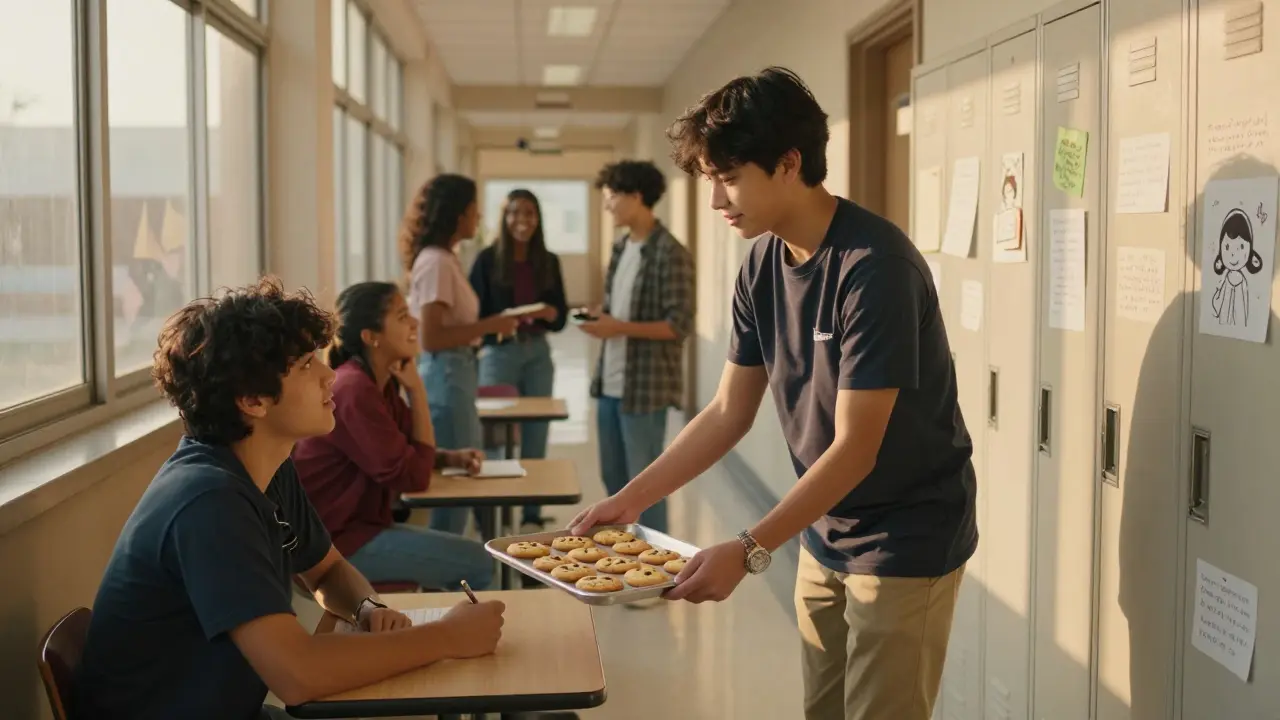
You won’t find a chapter in a history book titled "How to Lead a Fundraiser." Yet, that’s exactly what a student does when they organize a bake sale to help the school’s robotics team travel to nationals. Leadership isn’t about titles. It’s about taking initiative when no one else will. In high school, students learn this through trial and error. One student might fail at coordinating a talent show because they didn’t delegate tasks. Another might learn how to calm a heated argument between teammates by listening first. These aren’t lessons from a curriculum. They’re lessons from real stakes.
A 2023 study from the University of Michigan followed 1,200 graduates over five years. Those who held leadership roles in high school-whether as student council president, captain of the soccer team, or editor of the school paper-were 40% more likely to report feeling confident leading teams in their first job. Not because they had perfect resumes, but because they’d already been through the messy, unpredictable process of getting people to work together.
Structure Matters-But Not the Way You Think
Some schools think leadership means electing a student body president and calling it done. Others go further. The best programs don’t wait for students to apply for leadership roles. They create dozens of small, low-stakes opportunities for anyone to step up. A student who’s shy in class might lead a peer tutoring group. Someone who struggles with grades might run the school’s recycling initiative. Leadership becomes accessible, not exclusive.
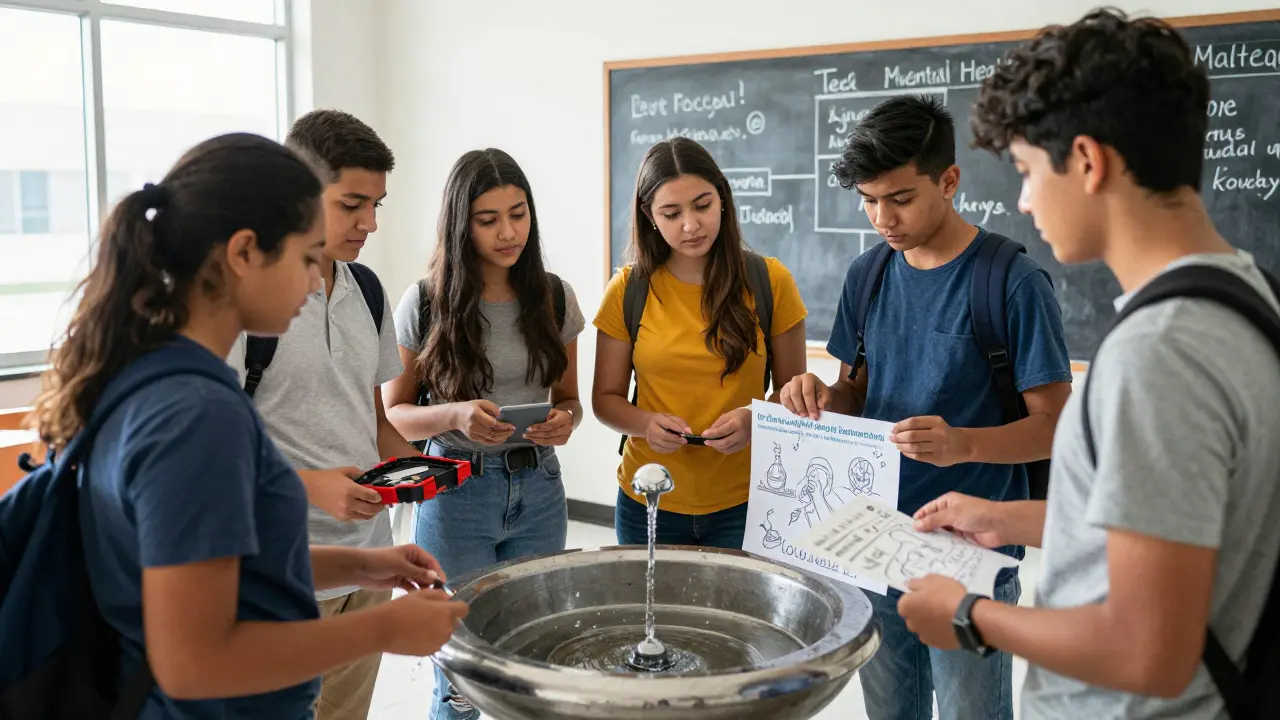
At Mesa Verde High in Arizona, every freshman is assigned to a "Leadership Lab" during advisory period. They don’t learn about leadership theory. They fix broken water fountains. They design posters for mental health week. They interview teachers about classroom challenges and present solutions to the principal. No grades. No competition. Just responsibility. By senior year, 78% of those students are leading at least one school project-without being asked.
Failure Is Part of the Curriculum
Real leaders don’t avoid failure. They learn from it. And high school is one of the last places where failing publicly doesn’t ruin your career. When a student’s campaign for class president flops because they didn’t listen to their peers, they don’t get fired. They get feedback. They get another chance next year.
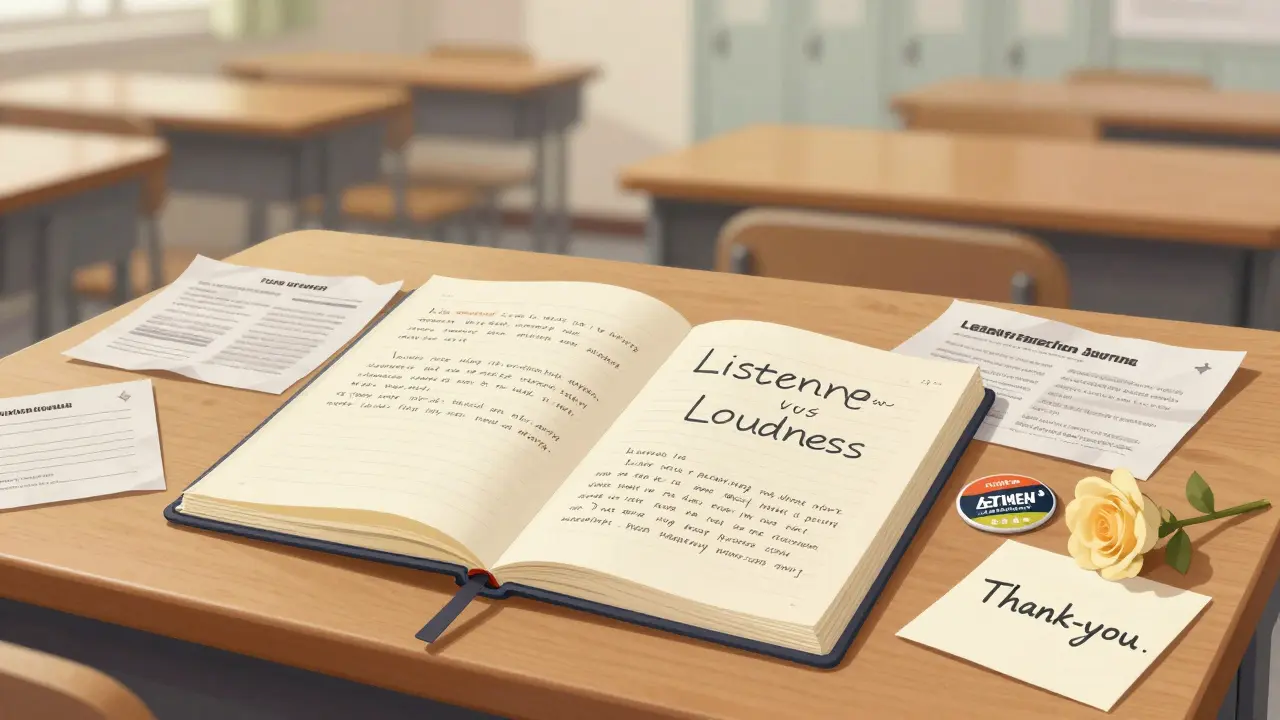
At North Star High in Oregon, teachers use a "Leadership Reflection Journal" after every group project. Students write down: What went wrong? What did you wish you’d done differently? Who helped you? What did you learn about yourself? One student wrote: "I thought being loud meant being in charge. Turns out, listening made people want to follow me."
That kind of insight doesn’t come from a lecture. It comes from doing, messing up, and trying again-with support.
The Quiet Leaders Nobody Notices
Leadership isn’t always the kid on stage. Sometimes it’s the student who stays after school to help a classmate understand fractions. Or the one who notices someone sitting alone at lunch and sits with them. Or the one who quietly organizes a donation drive for the local shelter without telling anyone.
These actions don’t show up on a resume. But they build something deeper: empathy, consistency, quiet courage. A 2024 survey of college admissions officers found that applicants who described these "invisible leadership" moments were more likely to be accepted into leadership-focused programs-not because they were the loudest, but because they showed emotional intelligence.
High schools that value only visible leadership miss half the story. The real test isn’t who wins the election. It’s who shows up when no one’s watching.
Teachers Are the Hidden Coaches
Most leadership growth doesn’t happen because of a school policy. It happens because one teacher noticed a student’s potential and gave them a chance. A science teacher who lets a student run the lab cleanup crew. A drama teacher who asks a quiet kid to direct the one-act play. A math teacher who lets a student lead peer study sessions.
These aren’t grand gestures. They’re small, daily decisions. But they matter. A Stanford study found that students who had even one teacher who treated them like a leader-by asking for their input, giving them responsibility, or trusting their judgment-were twice as likely to take on leadership roles later in life.
It’s not about being perfect. It’s about seeing potential before the student sees it themselves.
What Gets Measured Gets Done
Many schools still measure success by test scores and graduation rates. But if we want to raise future leaders, we need to measure something else: opportunity. How many students led a project? How many were given real decision-making power? How many had their ideas acted on?
At Lincoln High in Colorado, they track "Leadership Participation" alongside GPA. Every student’s transcript includes a section: "Led 3 school initiatives, including organizing the food drive that served 1,200 meals." That’s not just a line on a resume. It’s proof they learned how to move people toward a goal.
When schools start measuring leadership the same way they measure math scores, students start taking it seriously.
It’s Not About Making Presidents-It’s About Making Citizens
Not every student will become a CEO or a mayor. But every student will be asked to lead in some way-whether it’s managing a team at work, advocating for a cause, or raising a family. High school is where they learn that leadership isn’t about power. It’s about service. About listening. About showing up-even when it’s hard.
The best high schools don’t produce polished leaders. They produce resilient, thoughtful people who know how to handle uncertainty, how to lift others up, and how to keep going when things fall apart. That’s the kind of leadership the world needs-not the kind that looks good on a LinkedIn profile, but the kind that shows up when it matters most.
Amy P
February 1, 2026 AT 16:40Okay but have you ever seen a kid who ran the school’s lost-and-found for two years and never got a single thank-you? That’s leadership. No badge. No trophy. Just showing up every day because someone’s socks matter.
And yeah, that kid’s now a logistics manager at Amazon. No joke.
lucia burton
February 2, 2026 AT 05:12The structural underpinnings of adolescent leadership development are fundamentally rooted in experiential pedagogical frameworks that prioritize agency over authority. The longitudinal data from the University of Michigan cohort demonstrates a statistically significant correlation between early-stage organizational responsibility and subsequent workplace efficacy metrics, particularly in distributed team environments where emergent leadership trumps hierarchical designation.
Moreover, the absence of formalized evaluation rubrics in programs like Mesa Verde’s Leadership Lab actually enhances intrinsic motivation by decoupling performance from extrinsic reward systems, thereby fostering sustainable behavioral adaptation.
This is not anecdotal-it’s a systems-level insight into how social capital is cultivated in pre-adult ecosystems.
Zach Beggs
February 2, 2026 AT 16:49I remember being the guy who always stayed late to help set up for prom. Didn’t even get invited to the after-party. But I learned how to talk to vendors, handle last-minute disasters, and keep people calm when the DJ bailed.
Still use those skills at my job now. No one ever told me I was a leader. I just did what needed doing.
Kenny Stockman
February 4, 2026 AT 03:55Man, I wish my high school had done that Leadership Lab thing. I was the quiet kid who got picked last for every group project. But one teacher let me run the audio for the school play-just me and a mixer. No script, no spotlight. But I learned how to read the room, adjust levels on the fly, and make people feel heard without saying a word.
That’s leadership. No cape needed.
Antonio Hunter
February 4, 2026 AT 09:12There’s a deeper layer here that doesn’t get talked about enough: leadership isn’t just about what students do-it’s about what adults allow them to do. Too many schools treat leadership as a prize for the top 10%, when it should be a practice available to everyone. The real shift happens when teachers stop seeing students as empty vessels to be filled and start seeing them as co-architects of the environment.
At my old school, we had a student-led cafeteria committee that redesigned the lunch menu based on feedback. No adult signed off on it. The kids just did it. And the principal? He showed up at the first meeting with a clipboard and said, ‘I’m here to help.’ That’s the moment everything changed.
That’s not policy. That’s trust.
Paritosh Bhagat
February 5, 2026 AT 00:28Actually, the article has several grammatical inconsistencies. For instance, ‘They’re the first real training ground for leadership-not in boardrooms’-there should be a space after the hyphen. Also, ‘a student who’s shy in class might lead a peer tutoring group’-who’s should be who is in formal writing. And ‘They fix broken water fountains. They design posters...’-this is a sentence fragment chain, not proper syntax.
Also, the claim that 78% of students led projects ‘without being asked’ is statistically dubious without citing the survey sample size. And why is ‘invisible leadership’ capitalized? It’s not a proper noun.
Don’t get me wrong-I agree with the sentiment. But if we’re talking about leadership, let’s at least lead with precision.
Adithya M
February 5, 2026 AT 05:03You’re all missing the point. This whole thing is just virtue signaling wrapped in anecdotal fluff. Leadership isn’t about fixing water fountains or sitting with lonely kids. It’s about results. Who won the debate championship? Who got the grant? Who actually moved the needle?
Stop romanticizing ‘quiet’ leadership. Real leaders win. They don’t whisper. They command.
And if your school doesn’t produce winners, it’s failing.
Jessica McGirt
February 7, 2026 AT 03:32Adithya, your comment is aggressive and reductive. Leadership isn’t about winning trophies-it’s about creating conditions where others can thrive. The ‘quiet’ leaders you dismiss are the ones who keep teams sane during crises, who notice when someone’s drowning and pull them up without fanfare.
And no, not every leader needs to be loud to be effective. In fact, the most enduring ones rarely are.
Also, your tone isn’t helping the conversation. Just saying.
Donald Sullivan
February 7, 2026 AT 03:41My high school had zero leadership programs. I got kicked out of three clubs for ‘not being team-oriented.’ Turns out I just didn’t like being yelled at during practice.
Now I run a nonprofit that trains at-risk teens to lead community cleanups. No one ever told me I could. So I did it anyway.
Stop waiting for schools to teach leadership. Just go do it. That’s the only curriculum that matters.