How High Schools Shape Personality Development
High school isn’t just about passing algebra or memorizing dates for history class. It’s where a lot of who you become starts to take shape. The people you sit next to, the pressures you face, the clubs you join, the failures you survive - these aren’t just side effects of school. They’re the raw material of personality.
The Classroom Isn’t Just for Learning Math
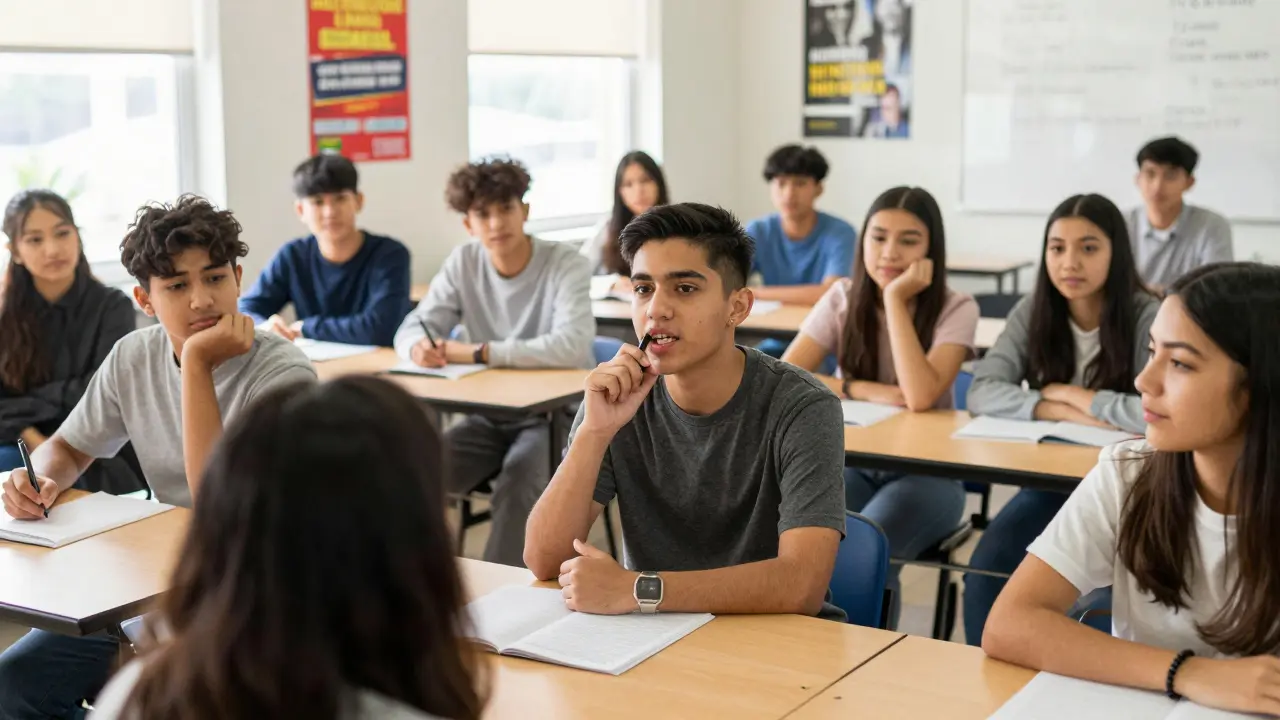
Most people think of high school as a place to get ready for college. But for many teens, it’s the first real test of who they are outside their family. A 2023 study from the University of North Carolina tracked over 12,000 students and found that those who participated in group-based activities - debate team, theater, student government - showed measurable increases in emotional regulation and self-confidence by senior year. Not because they won awards, but because they had to speak up, take risks, and deal with rejection in front of peers.
Think about it: when you’re 15, your teachers don’t treat you like a kid anymore. They expect you to manage deadlines, speak up in class, and handle criticism. That shift from being told what to do to being asked what you think? That’s where independence starts to grow.
Peer Pressure Isn’t Always Bad
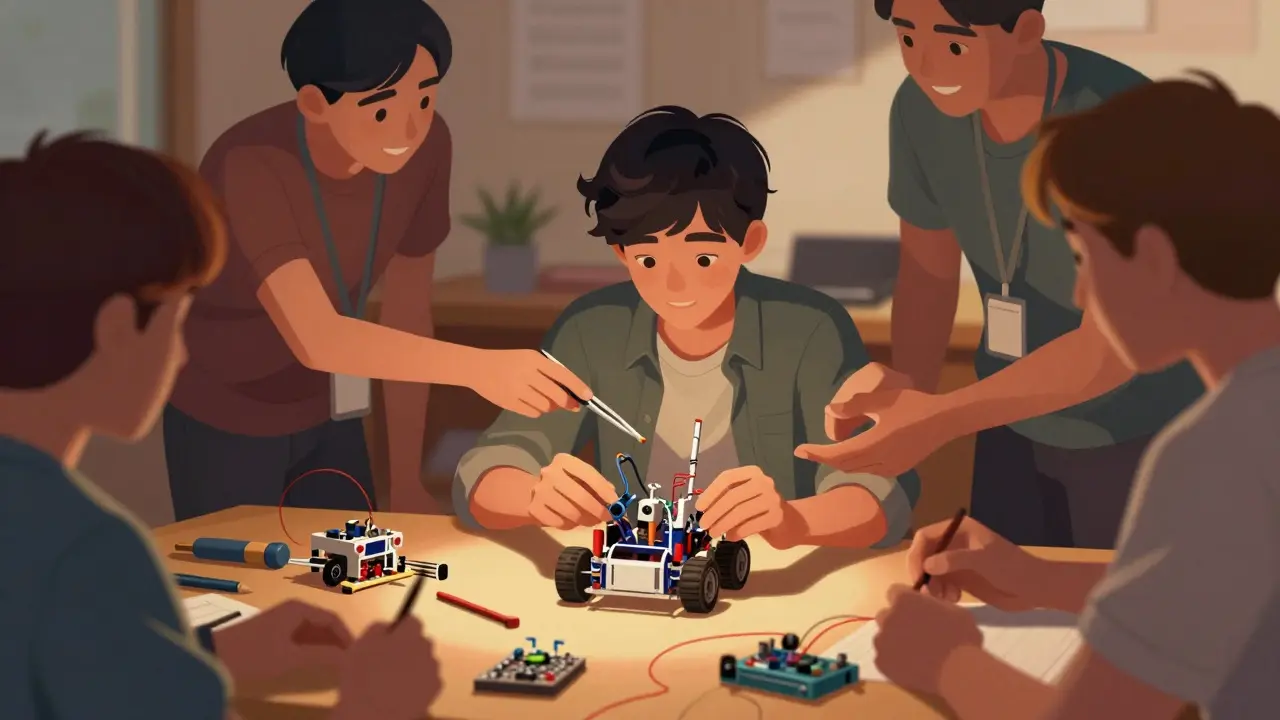
Everyone talks about peer pressure like it’s a bad thing. But pressure doesn’t have to mean bullying or drugs. Sometimes, it’s just the quiet pull of being around people who care about grades, art, or sports. A student who never thought of themselves as a writer might start journaling after seeing a classmate publish poetry in the school lit mag. Someone who was shy might join the robotics club because three friends signed up - and end up leading a team by junior year.
Researchers at Stanford call this "positive peer contagion." It’s not about copying bad habits. It’s about catching motivation. When you see someone else push through a tough project, it quietly tells you: you can too.
The Hidden Curriculum of School Rules
There’s a lot more being taught in high school than what’s on the syllabus. The way tardy policies are enforced. The way teachers handle conflict between students. The way certain kids are ignored while others get called on again and again. These aren’t accidents. They’re lessons - sometimes unfair, always influential.
A 2024 survey of 800 college freshmen found that students who described their high school as "fair but strict" were 40% more likely to report strong problem-solving skills than those who said their school was "chaotic" or "too lenient." Why? Because predictability teaches accountability. When rules are clear and applied consistently, students learn to plan, adapt, and own their consequences.
On the flip side, schools where favoritism or silence ruled left students either distrustful or overly cautious. One student told researchers, "I learned not to speak up unless I was sure I wouldn’t get in trouble." That’s not confidence. That’s survival.
Extracurriculars Are Personality Labs
Forget the idea that clubs are just resume boosters. For teens, they’re safe spaces to try on different versions of themselves. The quiet kid who joins the improv group doesn’t become an actor overnight. But they learn to hold space for others’ ideas. The athlete who starts tutoring younger students discovers patience they didn’t know they had.
A 2025 report from the National Association of Secondary School Principals showed that students who stayed in at least two extracurriculars for three years had higher levels of empathy and resilience than those who didn’t. Not because they were "well-rounded." But because they had to show up even when they didn’t feel like it. That’s discipline. That’s character.
Teachers as Mirrors, Not Just Instructors
Teachers don’t just grade papers. They reflect back who students think they are. When a teacher says, "I see you working harder this semester," it lands differently than "Good job." It tells the student: I notice you. And that’s powerful.
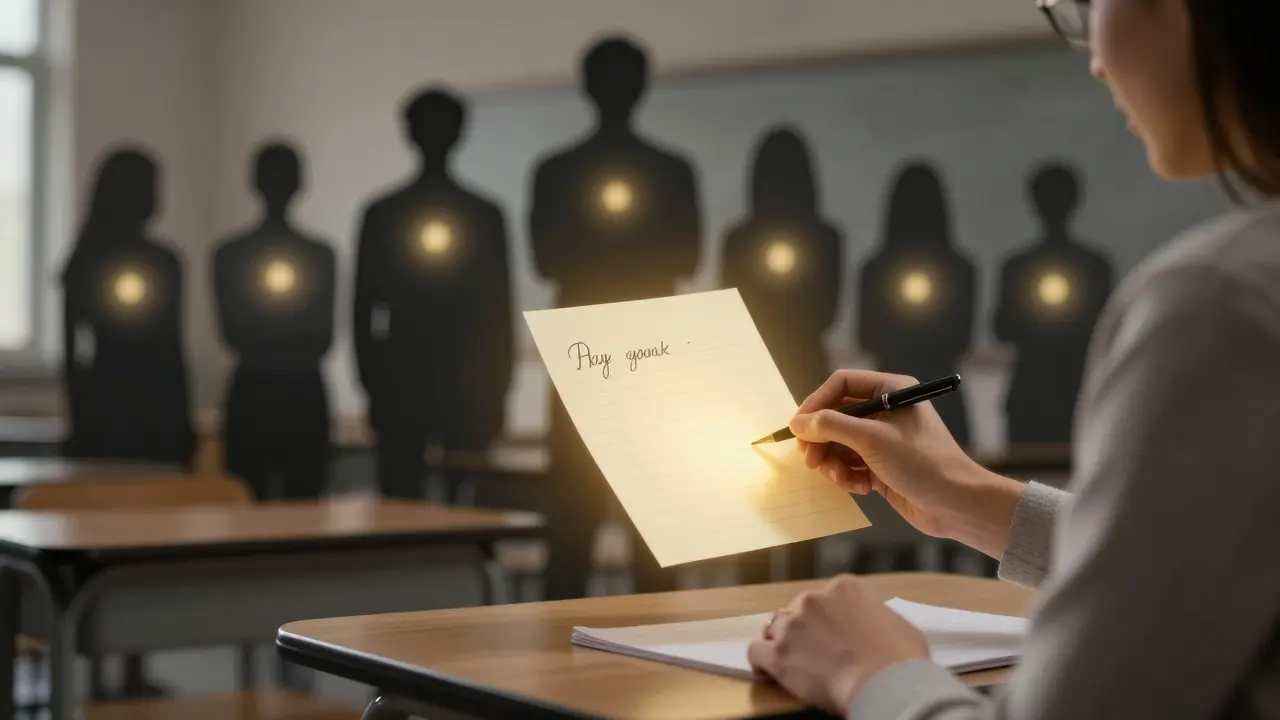
One teacher in a public high school in Ohio kept a simple habit: every Friday, she wrote one personal note to a different student. Not about grades. Just: "I liked how you helped Sam with the project." Or, "Your essay made me laugh." Over three years, she noticed that students who received those notes became more likely to speak up in class, ask for help, and take on leadership roles. They didn’t just feel seen. They started to believe they mattered.
Failure Is Taught, Not Just Experienced
Most teens get their first real taste of failure in high school. A failed test. A lost audition. A team cut. But what happens after matters more than the failure itself.
Schools that treat failure as a dead end teach students to hide. Schools that treat it as feedback teach resilience. One school in Minnesota replaced failing grades with "incomplete" until the student showed improvement. The result? Suspension rates dropped 32%. Anxiety levels among students fell. And graduation rates rose - not because kids got easier tests, but because they learned how to recover.
When failure is framed as part of learning, not punishment, students stop fearing mistakes. They start seeing them as data points. That shift changes everything.
What High School Doesn’t Teach - And Why It Matters
High schools rarely talk about emotional intelligence. They don’t train students to recognize manipulation, set boundaries, or handle rejection without shutting down. But those are the skills that shape adult relationships, careers, and mental health.
The students who thrive after high school aren’t always the ones with the highest GPAs. They’re the ones who learned how to ask for help. Who knew when to walk away. Who could apologize and mean it. Who didn’t confuse popularity with self-worth.
That’s not magic. That’s practice. And if your school didn’t give you that practice, you can still build it later. But it’s harder. That’s why high school matters - not because it’s perfect, but because it’s the first place most of us get to try, fail, and try again without losing everything.
It’s Not About the Diploma
The diploma gets framed as the goal. But the real outcome of high school? It’s the quiet, invisible growth - the way you learned to sit through a boring lecture without zoning out. The way you stood up for someone even when no one else did. The way you kept going after you were told "you’re not cut out for this."
Those aren’t just habits. They’re the foundation of who you become.
Vimal Kumar
March 3, 2026 AT 21:02High school was where I learned to listen more than I spoke. Not because I was shy, but because I saw how much people carried silently. The kid who always sat in the back, never raised his hand? Turns out he was raising three siblings after school. We never talked about it. But I started noticing things. Small kindnesses matter more than any award.
That teacher who wrote notes? She changed the whole vibe of the class. Not because she was special-she just chose to see us.
High school doesn’t teach emotional skills. But it gives you the space to learn them the hard way. And that’s the point.
Amit Umarani
March 5, 2026 AT 14:37Grammar nitpick: It’s ‘you’re not cut out for this,’ not ‘you’re not cut out for this.’ Missing apostrophe. Also, ‘data points’ is plural, so ‘it’s’ should be ‘they’re.’ Small things. But they matter.
Noel Dhiraj
March 6, 2026 AT 20:56I remember joining the school paper just because my friend said it was easy. Ended up writing for two years. Didn’t win anything. But I learned how to sit with silence. How to take a no. How to keep showing up even when no one read it. That’s the real curriculum. Not algebra. Not history. Showing up when it doesn’t feel like it matters.
vidhi patel
March 6, 2026 AT 21:16It is imperative to note that the author’s assertion regarding the efficacy of "positive peer contagion" is not empirically substantiated by peer-reviewed longitudinal studies. Furthermore, the citation of a "2025 report" from the National Association of Secondary School Principals lacks a DOI or institutional verification. This piece reads as anecdotal journalism masquerading as research. A serious discourse on adolescent development requires rigor, not sentimentality.
Priti Yadav
March 8, 2026 AT 01:10They’re all lying. The whole system is rigged. The "fair but strict" schools? They’re just the ones where the administration is better at hiding the favoritism. The notes teachers write? Probably coded messages to track who’s "on the list." You think that’s kindness? That’s surveillance. They’re conditioning us to crave validation from authority. Wake up.
Ajit Kumar
March 9, 2026 AT 20:18It is an incontrovertible fact that the structural conditions of modern high school environments-particularly the institutionalized suppression of individual autonomy through rigid timetables, standardized assessments, and performative extracurricular requirements-serve not as crucibles of personal development, but as mechanisms of social conformity. The notion that participation in debate or theater cultivates emotional regulation is not only reductive, but dangerously romanticized. One does not become resilient by speaking in front of peers; one becomes resilient by surviving systemic neglect. The real lesson of high school is that your worth is contingent upon compliance, not character.
Diwakar Pandey
March 10, 2026 AT 01:23My sister got kicked out of the choir for being "too quiet." She didn’t sing off-key. She just didn’t project. The teacher said she was "holding back the group." She stopped singing for five years. Then, last year, she sang in a karaoke bar with her coworkers. No one was watching. No one was grading. She cried afterward. I think that’s the real thing they miss. It’s not about being loud. It’s about being allowed to be quiet without punishment.
Geet Ramchandani
March 11, 2026 AT 01:10Let’s be real-this whole post is a feel-good fantasy designed to make privileged adults nostalgic for their own overstructured, middle-class high school experiences. The "quiet kid who joined improv"? That kid had parents who drove her there, tutors for her essays, and a therapist for her anxiety. The kid in the trailer park who got picked up for truancy three times? He didn’t get a note. He got suspended. And now he’s in a detention center. This isn’t about resilience. It’s about who gets to have a safe space to fail. The rest of us just get told to "try harder."
Pooja Kalra
March 11, 2026 AT 14:17There is an existential paradox at the heart of modern education: we demand self-actualization from adolescents while systematically denying them the ontological space to become. The institution of high school, as a bureaucratic apparatus, does not foster personality-it manufactures compliance under the guise of development. The "hidden curriculum" is not about fairness or accountability. It is the internalization of neoliberal subjectivity: you are a product. Your worth is measured in outcomes. Even failure is commodified. The teacher’s note? A microtransaction of emotional labor. We are not being shaped. We are being branded.
Sumit SM
March 13, 2026 AT 13:56Wait-so you’re saying the real lesson of high school isn’t calculus or Shakespeare-it’s learning how to not cry when someone says "you’re not cut out for this"? That’s it? That’s the whole point? We’re just training kids to be emotionally numb so they don’t break under capitalism? That’s not growth. That’s survival training. And if that’s the goal, why not just skip school and send them to boot camp? At least then they’d get free meals and a paycheck.
Jen Deschambeault
March 14, 2026 AT 03:34My daughter’s school replaced failing grades with "incomplete." I thought it was soft. Now I see it was genius. She didn’t just pass math-she learned how to ask for help. She didn’t just redo the test-she sat with her tutor every week. She didn’t just learn equations. She learned persistence. And now she’s in college, not because she was smart, but because she didn’t quit. That’s the diploma no one talks about.