How Many AP Classes Should I Take? A Realistic Guide for High School Students

Choosing how many AP classes to take isn’t about impressing colleges-it’s about setting yourself up for success without burning out. Too few, and you might miss out on real college credit and academic challenge. Too many, and you could end up with lower grades, zero sleep, and a shattered sense of balance. The truth? There’s no magic number. But there are smart ways to figure out what works for you.
What AP Classes Actually Do
Advanced Placement (AP) courses are college-level classes offered in high school. They’re not just harder versions of regular classes-they follow a national curriculum set by the College Board. At the end of each course, you take a standardized exam scored from 1 to 5. Most colleges grant credit or allow you to skip intro courses if you score a 4 or 5. That means you could enter college with 3-12 credits already earned, saving thousands in tuition and letting you graduate earlier.
But here’s the catch: not all colleges treat AP scores the same. A state school in your home state might accept a 3 for credit. A top private university might only accept 5s. And some don’t give credit at all-they just let you skip the class. You need to know what your target schools do before you overload your schedule.
How Many Is Too Many?
Let’s cut through the noise. You don’t need to take 10 APs to get into a good college. In fact, most students who get into selective schools take between 4 and 7 APs over their junior and senior years combined. The average student in a top 100 U.S. public high school takes around 5 APs total. What matters more than the number is consistency and performance.
Take this real example: Sarah took 7 APs in her junior year. She got three 4s and four 3s. Her GPA dropped from 3.9 to 3.4. She was exhausted. Her SAT score slipped. She didn’t have time to volunteer or even hang out with friends. She got into a solid state school-but she regretted the burnout. Meanwhile, Jamal took 4 APs, all in subjects he loved. He got 5s across the board, kept his GPA at 4.1, and still had time to lead the debate team. He got into his dream Ivy League school.
It’s not about quantity. It’s about quality of effort.
Use This Formula to Plan Your AP Load
Here’s a simple, no-fluff formula that works for most students:
- Start with your core subjects. If you’re planning to major in science or engineering, take AP Calculus and AP Biology or Chemistry. If you’re leaning toward humanities, AP English Lit and AP U.S. History are strong choices. Don’t take AP Physics if you hate math.
- Add one or two electives. Pick subjects you’re genuinely curious about-AP Psychology, AP Environmental Science, or AP Studio Art. These are often easier and still count for credit.
- Check your GPA. If your current GPA is below 3.5, don’t take more than 3 APs in a single year. Pushing too hard now can tank your transcript.
- Look at your extracurriculars. If you’re on the swim team, working 20 hours a week at a part-time job, or managing a school club, add APs slowly. Time is your real limit.
- Use the 2:1 rule. For every AP class, plan to spend 2-3 hours per week outside of class on homework, studying, and review. That means 5 APs = 10-15 extra hours per week. Is that sustainable?

What Colleges Actually Look For
Colleges don’t want you to take every AP available. They want to see that you challenged yourself appropriately for your school.
Here’s what admissions officers say: “We compare students to their peers at the same school. If your school only offers 6 APs, and you took all of them-that’s impressive. If your school offers 15, and you took 4, we’ll wonder why.”
So if your high school only offers 4 APs? Take all of them. If your school offers 12? Taking 5-7 over your last two years shows you pushed yourself without overextending. Taking 10+? You’re probably sacrificing sleep, mental health, or grades-and colleges notice that.
Also, colleges care about trend. If you took 2 APs in sophomore year, 4 in junior year, and 3 in senior year, that shows growth. If you took 6 APs in sophomore year and then dropped to 2? That raises red flags.
When to Skip an AP
Not every AP is worth it. Some are notorious for being low-yield:
- AP Human Geography - Easy A for many, but few colleges give credit for it.
- AP Environmental Science - Often taken as a “轻松课” (easy class), but if you’re not into science, it’s still a heavy workload.
- AP Spanish Literature - Only useful if you’re fluent. Native speakers often get more credit from SAT Subject Tests (if still offered) or dual enrollment.
- AP Studio Art - Great for portfolio schools, but not worth the time if you’re not applying to art programs.
Also skip APs if:
- You’re already taking dual enrollment at a local college.
- You’re struggling in the prerequisite class (e.g., don’t take AP Calculus if you barely passed Algebra II).
- The teacher has a 20% pass rate on the AP exam.
What to Do If You’re Already Overwhelmed
If you’re in the middle of the year and realizing you took too much:
- Drop the AP with the lowest priority. Talk to your counselor early-most schools allow drops before March.
- Focus on the exams you can still pass. Even one 4 or 5 can earn you credit.
- Don’t panic. One bad semester doesn’t ruin your college chances. Colleges understand that high school is hard.
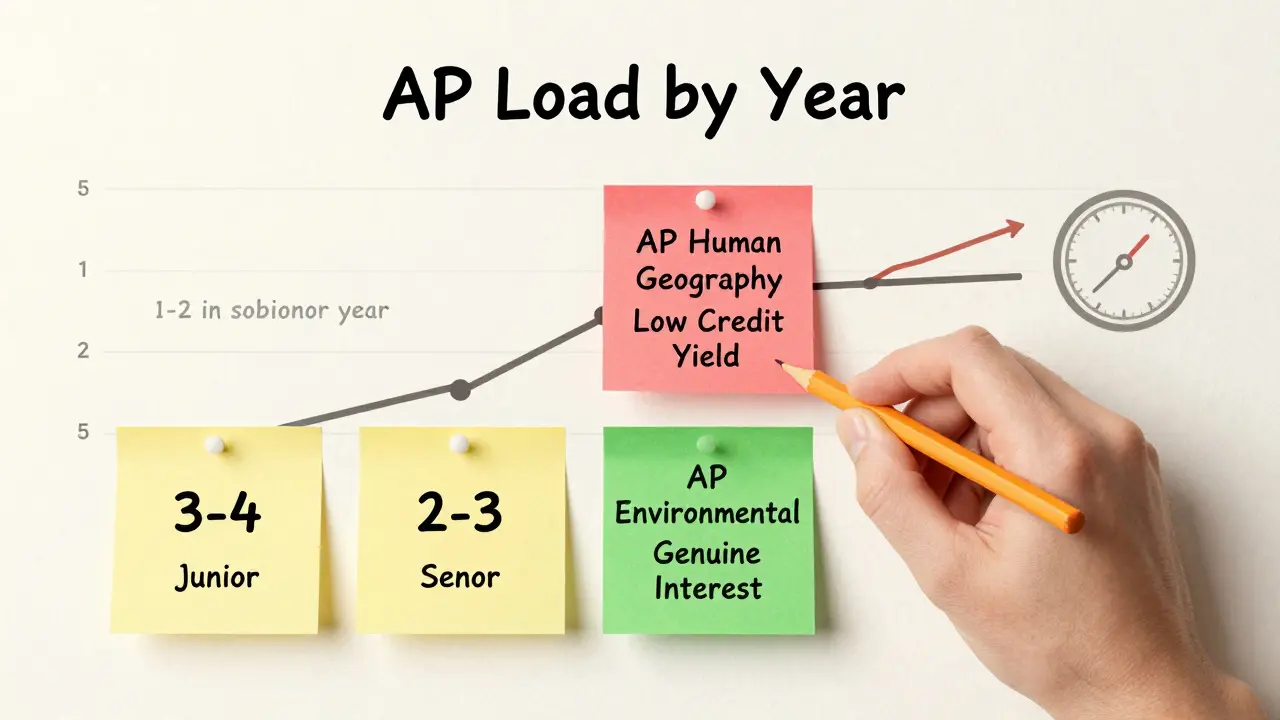
Realistic AP Load by Year
Here’s a practical breakdown based on real student data from U.S. public schools in 2025:
| Year | Recommended APs | Why This Works |
|---|---|---|
| Sophomore | 1-2 | Start with one core subject (like AP World History) and one elective. Builds confidence. |
| Junior | 3-4 | Peak year. Take your hardest core APs here (Calculus, Bio, Chem, English Lit). |
| Senior | 2-3 | Focus on subjects tied to your college major. Leave room for college apps and SAT/ACT prep. |
This pattern gives you 6-9 APs total-enough to show rigor, but not so many that you crash.
Final Rule: Your Health Comes First
AP classes are supposed to prepare you for college-not break you before you get there. If you’re sleeping less than 6 hours a night, crying over homework, or avoiding friends because you’re too tired? You’re taking too many.
Colleges don’t want perfect scores. They want resilient, balanced students who can manage stress, think critically, and keep showing up. That’s the real edge.
Take the APs that excite you. Skip the ones that just look good on paper. And remember: one great AP score is worth more than three mediocre ones.
Is it bad to take only 2 AP classes?
Not at all. If your school only offers 3-4 APs total, taking 2 is perfectly normal-and even impressive if you earn high scores. Many students from under-resourced schools take 1-2 APs and still get into top colleges. What matters is that you challenged yourself within your school’s context. Colleges compare you to your peers, not to students from elite private schools.
Can I take AP classes in 9th grade?
Yes, but it’s rare and usually not recommended. Most 9th graders aren’t ready for the pace and depth of AP courses. The only exceptions are AP Human Geography or AP World History, which are often offered as honors-to-AP bridges. Taking APs too early can hurt your GPA if you’re not prepared. Wait until 10th grade unless your school has a special program and you’ve tested above grade level.
Do AP classes boost my GPA?
Yes, but only if your school uses a weighted GPA scale. Most schools add 0.5 or 1.0 point to AP grades. So an A in an AP class becomes a 4.5 or 5.0 instead of a 4.0. That can help your GPA stand out. But if you get a C in an AP class, it might count as a 2.5 or 3.0-worse than an A in a regular class. Always weigh the risk before signing up.
What if I get a 3 on an AP exam?
A 3 is a passing score-and many colleges still give credit for it, especially public universities. For example, Arizona State University and University of Florida both grant credit for 3s in most AP subjects. Even if your dream school doesn’t accept 3s, showing you took the class and tried the exam still looks better than skipping it. Don’t panic if you get a 3. Focus on the next one.
Should I take APs if I’m not planning to go to college?
Yes-if you’re unsure. AP classes give you college-level experience, which helps whether you go to trade school, join the military, or enter the workforce. Many certifications and apprenticeships value AP credits because they prove you can handle rigorous material. Plus, AP scores can count toward scholarships or advanced standing in technical programs. Don’t write them off just because you’re not sure about college.
Kasey Drymalla
February 9, 2026 AT 16:45Dave Sumner Smith
February 10, 2026 AT 20:10Cait Sporleder
February 12, 2026 AT 06:01Paul Timms
February 13, 2026 AT 13:05Nathaniel Petrovick
February 14, 2026 AT 18:29Sally McElroy
February 16, 2026 AT 05:38Jason Townsend
February 16, 2026 AT 09:41Antwan Holder
February 18, 2026 AT 06:16Angelina Jefary
February 19, 2026 AT 06:14Jennifer Kaiser
February 21, 2026 AT 06:12TIARA SUKMA UTAMA
February 21, 2026 AT 22:21Jasmine Oey
February 23, 2026 AT 13:07Marissa Martin
February 24, 2026 AT 11:51James Winter
February 25, 2026 AT 17:41Paul Timms
February 27, 2026 AT 10:24