How Many Hours of Homework Do High School Students Get Per Week?
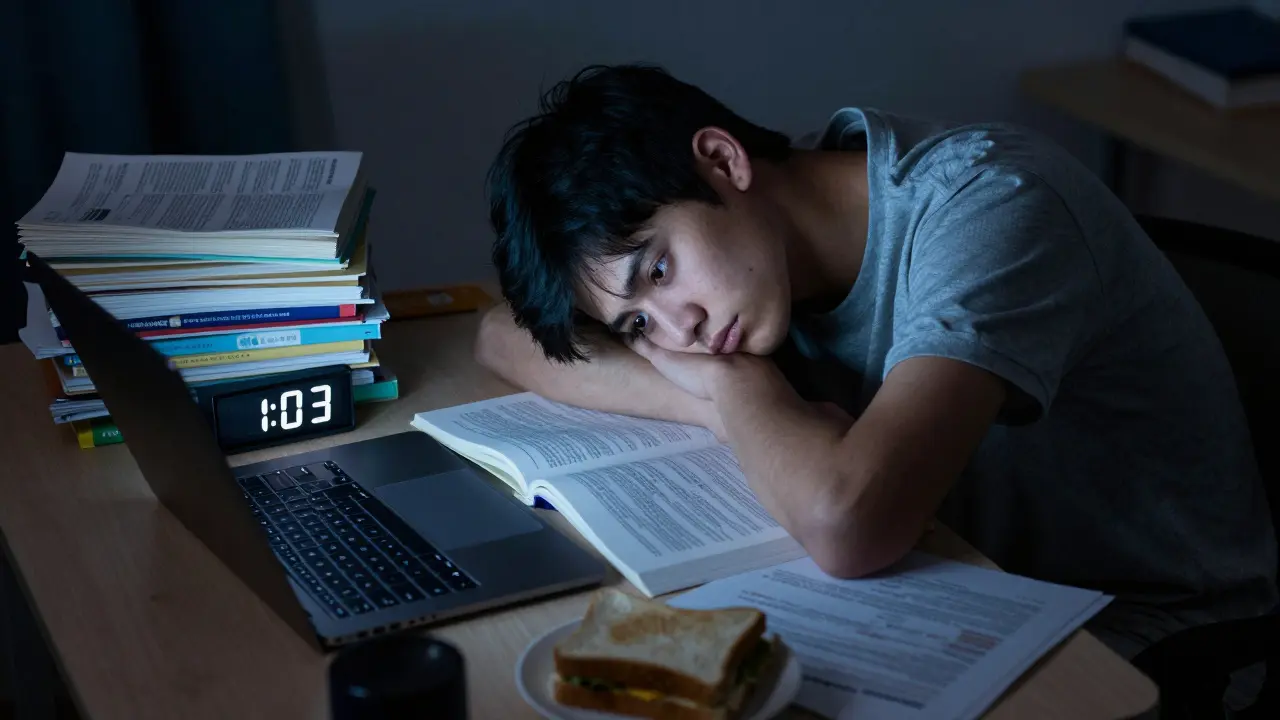
High school students in the U.S. are spending more time on homework than ever before-and it’s not just because they’re trying harder. A 2024 study from the National Center for Education Statistics found that the average high schooler gets 10.2 hours of homework per week. That’s more than one full school day spent outside of class, just on assignments. But that number varies wildly depending on the school, the student’s course load, and even the state they live in.
What’s the Real Average?
Let’s cut through the noise. The 10.2-hour average sounds manageable until you break it down. That’s about 2 hours per school night, plus 3 to 4 hours on weekends. But that’s just the average. Students in honors, AP, or IB programs often hit 15 to 20 hours a week. In some suburban districts in Illinois, California, and New Jersey, it’s not unusual for a junior to have 25 hours of homework in a single week.
Why so much? It’s not just teachers piling on work. It’s the structure. A student taking five core classes-English, math, science, history, and a foreign language-might get 1 to 2 hours of homework per class each night. Multiply that by five, and you’re already at 7 to 10 hours. Add in projects, lab reports, college prep essays, and extracurricular deadlines, and the pile grows fast.
How Homework Breaks Down by Subject
Not all subjects are created equal when it comes to homework. Math and science tend to be the heaviest hitters because they require practice. A typical math assignment might include 20 problems, each taking 5 to 10 minutes. That’s 2 hours right there. Science labs often come with 2- to 3-page write-ups, which can take just as long.
English classes pile on reading. A novel like To Kill a Mockingbird might require 40 pages a night. At 15 minutes per page, that’s over an hour just for reading-before you even start on discussion questions or essays. History classes add another layer: primary source analysis, document-based questions, and research papers that can take days to complete.
Foreign language homework? Daily vocabulary drills, grammar exercises, and listening practice add up quickly. And don’t forget electives. A student in AP Art might spend 3 hours on a single portfolio piece. A student in computer science could be coding for hours on end.
State-by-State Differences
Homework isn’t the same everywhere. In Illinois, where I’m based, the average is around 9.5 hours per week. But in states like New York and Massachusetts, it’s closer to 12 hours. Why? Higher academic standards, more college-bound students, and pressure from parents and administrators to maintain high test scores.
On the other end, states like Texas and Florida have pushed back. Some districts there have capped homework at 1.5 hours per night per class, with exceptions only for AP or IB. The goal? Reduce burnout and make time for sleep, part-time jobs, and family.
It’s not just policy-it’s culture. In affluent communities, homework often doubles as a status symbol. Parents expect rigor. Schools respond. The result? A cycle where students are measured by how much they can handle, not how well they understand it.

What Students Say
Survey data from over 10,000 high schoolers in 2025 shows a clear pattern: 68% say they feel overwhelmed by homework. Nearly half report regularly skipping sleep to finish assignments. One 11th grader from Evanston, Illinois, told researchers: “I’m up until 1 a.m. most nights. I don’t have time to eat dinner with my family. I don’t have time to breathe.”
It’s not just about stress. It’s about equity. Students who work part-time jobs, care for siblings, or don’t have access to quiet study spaces at home are at a disadvantage. Homework assumes a level of stability that not everyone has. A student who gets home at 7 p.m. after a shift at a grocery store and has to help with younger siblings might not have 2 hours to spare.
Is All This Homework Necessary?
Here’s the uncomfortable truth: not all of it is. Research from Stanford’s Graduate School of Education shows that after about 2 hours of homework per night, the benefits plateau. More doesn’t mean better. In fact, too much can hurt performance. Students who do more than 3 hours a night show higher rates of anxiety, depression, and physical symptoms like headaches and stomachaches.
Effective homework isn’t about quantity-it’s about quality. A single well-designed math problem that makes a student think deeply is worth ten repetitive drills. A short, focused reading reflection is more valuable than a 10-page summary.
Some teachers are catching on. More are assigning “choice boards,” where students pick one of three assignments to complete. Others are using flipped classrooms, where students watch short videos at home and do problem-solving in class. These models reduce workload while improving understanding.
What Parents and Students Can Do
If you’re a student drowning in homework, here’s what actually works:
- Track your time for one week. Use a simple notebook or phone app. You might be surprised how much time you’re wasting scrolling or getting distracted.
- Set boundaries. If you’re spending more than 2.5 hours a night on homework and it’s not AP or IB, talk to your teacher. Ask: “Is this assignment helping me learn, or just filling time?”
- Group study sessions help. Working with classmates can cut time in half-especially for projects and review.
- Protect your sleep. Losing even one hour of sleep per night for five nights straight lowers your memory retention and focus. No assignment is worth that.
Parents can help by asking the right questions: “What’s the goal of this assignment?” instead of “Did you finish your homework?” They can also advocate for change at school board meetings. Many districts are starting to review homework policies-and they need to hear from families.
The Bottom Line
High school homework isn’t going away. But it doesn’t have to be overwhelming. The average is 10 hours a week-but that’s just a number. The real question is: Is this work helping you grow, or just wearing you down?
The best homework is intentional, not excessive. It’s meaningful, not busywork. And it respects your time, your health, and your life outside school.
If you’re a student, don’t accept overload as normal. If you’re a parent, don’t assume more work means better grades. The goal isn’t to do more. It’s to learn more-with room to breathe, to rest, and to be a kid.
How many hours of homework should high school students have per night?
The National Education Association recommends no more than 10 minutes per grade level per night. That means a 9th grader should have about 90 minutes, and a 12th grader up to 120 minutes. But many students exceed this, especially in advanced courses. Consistently going over 2 hours a night is a red flag for burnout.
Is homework really necessary for college success?
There’s no strong evidence that more homework leads to better college outcomes. What matters more is how students manage their time, think critically, and engage with material. Colleges look for depth of understanding, not the number of pages written. A student who completes one thoughtful essay is better prepared than one who cranks out five rushed ones.
Do AP and IB students get more homework?
Yes. AP and IB students typically spend 15 to 20 hours per week on homework, sometimes more. These programs are designed to mimic college-level work, so assignments are heavier and more complex. But even in these courses, excessive busywork doesn’t improve performance-strategic, focused tasks do.
Can homework affect mental health?
Absolutely. A 2023 study in the Journal of Adolescent Health found that students who did more than 3 hours of homework per night were twice as likely to report high stress levels, sleep problems, and symptoms of anxiety. The pressure to keep up isn’t just academic-it’s emotional. Sleep deprivation from homework is now a documented public health concern in U.S. high schools.
What should I do if my child is crying over homework?
First, listen. Don’t jump to fix it. Ask what’s making it hard-is it too much, unclear instructions, or lack of support? Then, contact the teacher. Many educators don’t realize how much work they’re assigning across all classes. Schools are starting to track cumulative homework load per student. You’re not alone-and your concern matters.
John Fox
December 26, 2025 AT 04:2410 hours a week? That’s nothing. My sister does 20 and still finds time to play video games and eat dinner. Just manage your time better.
Tasha Hernandez
December 28, 2025 AT 01:09Oh wow, so now we’re romanticizing burnout like it’s some noble rite of passage? Kids are crying over math problems while their parents post Instagram stories about how ‘proud’ they are. The system isn’t broken-it’s designed this way to keep kids docile and exhausted. Wake up.
Anuj Kumar
December 29, 2025 AT 18:44This is all fake. Homework is a government plot to keep kids off the streets. In India we do 4 hours and still get into IIT. You Americans just lazy.
Veera Mavalwala
December 30, 2025 AT 09:53Let’s be real-this isn’t about homework, it’s about the collapse of the American family. Parents who can’t afford tutors or quiet spaces, teachers who are overworked and underpaid, schools that treat kids like data points in some standardized test spreadsheet-it’s all connected. And nobody wants to fix the root because fixing it would mean admitting the whole system is built on sand.
My cousin in Bangalore does three hours a night and sleeps eight hours. She’s not a genius, she’s just not drowning in busywork. Why do we think more work equals more learning? It’s not pedagogy, it’s performance theater.
And don’t get me started on AP classes. They’re not college-level-they’re college-pretend-level. Half the assignments are fluff wrapped in fancy jargon. Kids spend hours writing essays on topics they don’t care about just to check a box. That’s not education. That’s compliance training.
Meanwhile, the kids who actually need support-those working after school, caring for siblings, living in chaotic homes-are the ones getting left behind. Not because they’re lazy, but because the system assumes every kid has a parent who can proofread their essay at 11 p.m.
And yet we keep doubling down. More homework. More tests. More pressure. Like if we just make them suffer enough, they’ll somehow magically become successful adults. That’s not motivation, that’s cruelty dressed up as rigor.
It’s not about reducing homework. It’s about reimagining learning. What if we trusted students to learn deeply instead of forcing them to churn out pages? What if we valued curiosity over compliance? What if we stopped measuring worth by how many hours you sacrifice?
I’m not saying eliminate homework. I’m saying kill the myth that more equals better. The data’s clear. After two hours, it’s all noise. And we’re drowning kids in noise.
sampa Karjee
December 30, 2025 AT 09:53Anyone who thinks homework is the problem hasn’t seen what real discipline looks like. In my country, students wake up at 4 a.m. to study. They don’t complain. They don’t ask for limits. They just do it. That’s how you become successful. Not by whining about sleep.
Patrick Sieber
January 1, 2026 AT 01:27Interesting read. I’ve taught in both Ireland and the US and the difference in homework culture is stark. Here, we assign targeted tasks-maybe 45 minutes max per night. Focus on quality, not volume. The kids actually retain more. Also, they sleep. Who knew that helped?
Kieran Danagher
January 1, 2026 AT 10:41Yeah, 10 hours sounds reasonable until you realize most of it’s busywork. My nephew spent 6 hours last weekend rewriting a lab report because the teacher said his font wasn’t ‘academic enough.’ That’s not education. That’s tyranny with a rubric.
OONAGH Ffrench
January 3, 2026 AT 05:57Homework should serve a purpose-not fill time. The 10-minute rule makes sense. But when teachers across five subjects all assume their assignment is the only one that matters, it becomes a perfect storm. The real issue isn’t homework. It’s coordination-or lack thereof.
poonam upadhyay
January 4, 2026 AT 17:11Ugh, this is so typical-everyone’s so sensitive now! Kids these days can’t handle a little pressure? I did 5 hours a night in 9th grade and I turned out fine! And you know what? I didn’t have a fancy phone to scroll on! I had to read by candlelight! And I still got into Harvard! You’re all just weak!
And why do you think it’s ‘equity’? Maybe if they stopped wasting time on TikTok and actually did the work, they wouldn’t be overwhelmed! It’s not the homework-it’s their attitude! And don’t even get me started on parents who baby their kids instead of making them tough!
Also, why are we even talking about sleep? Sleep is for people who don’t have ambition! My brother pulled three all-nighters before his IIT exam and he’s now a CEO at 28! So stop whining and get to work!
Shivam Mogha
January 6, 2026 AT 05:13Two hours max. That’s it.
mani kandan
January 7, 2026 AT 05:57I’ve seen this in my own school. One teacher assigns 30 math problems. Another gives a 10-page essay. Another requires a 2-hour video project. Nobody talks to each other. The result? A student with five classes ends up with 12 hours of work. It’s not malice-it’s silence. And silence is the real problem.
Rahul Borole
January 8, 2026 AT 19:59It is imperative that educational institutions recalibrate their pedagogical frameworks to align with empirical research on cognitive load and adolescent development. Excessive homework undermines neuroplasticity, impairs executive function, and exacerbates psychological distress. A strategic reduction in volume, coupled with enhanced quality and alignment with curricular objectives, is not merely advisable-it is an ethical imperative.
Sheetal Srivastava
January 9, 2026 AT 07:41Let’s be honest-most of this homework is just a performance metric for middle-class parents who want to feel like they’re raising prodigies. The real issue is credential inflation. Kids aren’t learning-they’re gaming the system. And the teachers? They’re just checking boxes because they’re told to. It’s all theater. A performative ritual of overwork disguised as rigor. The only thing it proves is that we’ve lost touch with what learning even means.
Bhavishya Kumar
January 10, 2026 AT 09:18The article contains numerous grammatical inconsistencies. For example, the phrase '10.2 hours' should be written as 'ten point two hours' in formal prose. Also, the use of em dashes without proper spacing is incorrect. Furthermore, the term 'busywork' is colloquial and inappropriate in an academic context. The data presented is valid, but the presentation lacks scholarly rigor.