How Many Hours Should a High School Student Study?
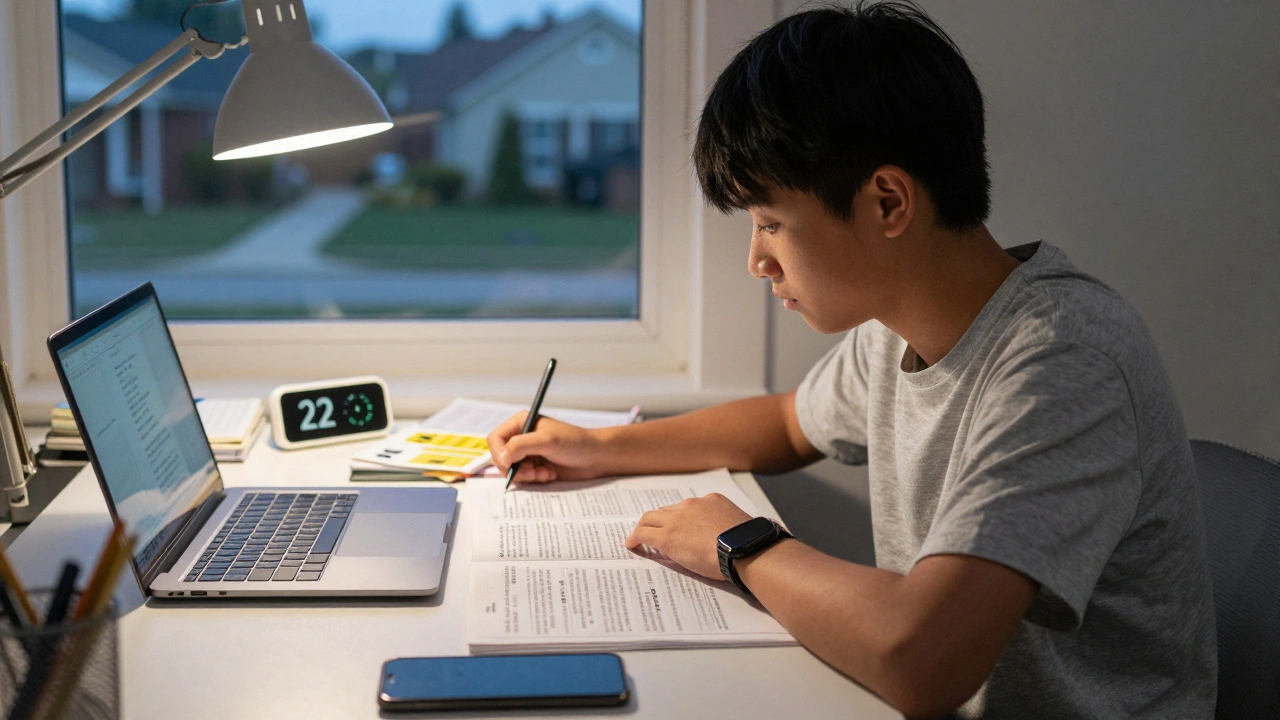
There’s no magic number for how many hours a high school student should study - but there is a range that works for most students who want to stay sane and still get good grades.
Most high school students need 2 to 4 hours of study time per night
That’s the sweet spot for most students juggling five or six classes, extracurriculars, part-time jobs, and sleep. It’s not about cramming for six hours on Sunday night. It’s about consistent, focused work every day. A 2023 study from the National Center for Education Statistics found that students who studied between 2 and 4 hours daily averaged higher GPAs than those who studied less than an hour or more than five.
Why does this range work? Because it matches how the brain learns. Spaced repetition - reviewing material over several days - beats marathon sessions. If you have a math test on Friday, spending 45 minutes each night from Monday to Thursday beats studying for three hours on Thursday night. Your brain actually retains more when it gets small, repeated doses.
It’s not about time - it’s about focus
Two hours of distracted scrolling between textbook pages isn’t the same as two hours of real work. A student who studies 90 minutes with zero phone use and full attention will outperform someone who spends three hours with their phone buzzing every 10 minutes.
Here’s how to make your time count:
- Use the Pomodoro method: 25 minutes of work, 5-minute break. After four rounds, take a 20-minute break.
- Turn off notifications. Put your phone in another room.
- Start with the hardest subject when your brain is freshest - usually right after school or after a short snack break.
- Review notes within 24 hours of class. This cuts study time in half later.
One senior from Charlotte, North Carolina, cut her study time from 5 hours to 3 hours a night - and raised her GPA from 3.1 to 3.8. How? She stopped re-reading textbooks and started quizzing herself with flashcards. Active recall beats passive reading every time.
How much time should you spend on each subject?
Not all classes need the same amount of attention. Here’s a simple breakdown:
| Subject Type | Weekly Study Time | Why |
|---|---|---|
| Math, Physics, Chemistry | 6-8 hours | Skills-based. You learn by doing problems, not reading. |
| History, English, Social Studies | 4-6 hours | Memory and analysis. Use summaries and flashcards. |
| Foreign Language | 4-5 hours | Requires daily practice. Even 20 minutes a day helps. |
| Electives (Art, Music, PE) | 1-2 hours | Usually project-based. Focus on deadlines, not daily drills. |
If you’re taking AP or honors courses, add 30-60 minutes per class per week. But don’t just add time - add strategy. AP Biology isn’t harder because of the volume - it’s harder because of the depth. Focus on understanding processes, not memorizing terms.
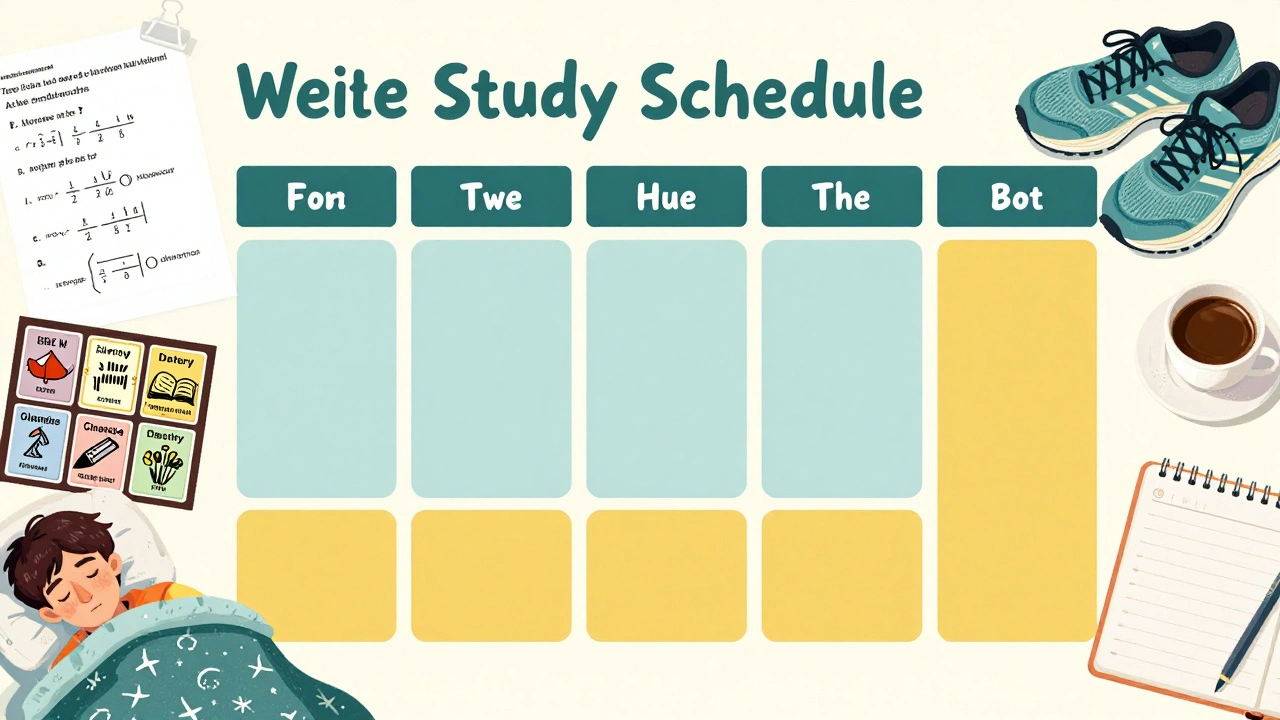
Weekends: Use them wisely
Weekends aren’t for catching up - they’re for reinforcing. If you spent 3 hours a night during the week, you don’t need to study 8 hours on Saturday. Instead:
- Saturday morning: Review weak spots from the week. Do 10 practice problems or rewrite one set of messy notes.
- Saturday afternoon: Take a break. Go for a walk, hang with friends, play a game.
- Sunday evening: Plan the week. Write down your study goals for each class. Set alarms for your Pomodoro sessions.
Students who treat weekends like a reset button - not a punishment - perform better long-term. Burnout is real. And it doesn’t come from studying too much. It comes from studying the wrong way, every day.
What about college-bound students?
If you’re aiming for top colleges, you might think you need 6+ hours a night. That’s a myth. Colleges care more about how you use your time than how long you sit at a desk. A student who leads a club, volunteers 10 hours a month, and studies 3 hours a night with high focus will look better than someone who studies 5 hours but has no real interests.
What colleges actually look for:
- Consistent grades in challenging courses
- Depth over breadth - mastery in 2-3 areas, not participation in 10 clubs
- Self-direction - can you manage your time without being nagged?
That’s why 3 focused hours a night, with clear goals and no distractions, beats 6 hours of half-hearted effort every time.
Signs you’re studying too much
It’s possible to study too much - and it hurts more than it helps. Watch for these red flags:
- You’re falling asleep in class because you stayed up past midnight.
- You’re skipping meals, exercise, or time with family.
- You feel anxious every time you open a textbook.
- Your grades aren’t improving, even though you’re putting in more hours.
If any of these sound familiar, you’re not being productive - you’re just busy. Take a step back. Cut your study time by 30 minutes a day for a week. Sleep more. Move your body. See what happens to your focus.

What if you’re falling behind?
If you’re behind and panicking, don’t try to do everything at once. Pick one class. One week. One goal.
Example: You’re failing Algebra. Here’s your 7-day plan:
- Day 1: Find the last topic you understood. Watch a 10-minute YouTube video on it (Khan Academy is free).
- Day 2: Do 5 practice problems. No notes. Just try.
- Day 3: Review what you got wrong. Write down why.
- Day 4: Do 5 more problems. Same rules.
- Day 5: Ask your teacher one specific question: “I keep mixing up these two formulas - can you show me the difference?”
- Day 6: Do a mini quiz - 10 problems, timed.
- Day 7: Celebrate. Even if you didn’t ace it, you rebuilt your confidence.
That’s 1-1.5 hours total over the week. Not 10. Not 15. Just enough to get back on track.
Final thought: Quality beats quantity - always
High school isn’t a race to see who can stay up the latest. It’s a training ground for how to learn, manage stress, and take care of yourself. The goal isn’t to study more. It’s to study smarter.
Two focused hours a night, five days a week, with good sleep and real breaks, will get you further than five hours of stress and distraction. And it’ll leave you with something more valuable than a higher GPA - the ability to manage your time, stay calm under pressure, and keep learning long after high school ends.
Is 1 hour of studying enough for high school?
One hour might be enough if you’re in mostly elective or low-workload classes and you’re highly focused. But for students taking math, science, or AP courses, 1 hour is usually not enough. Most students need 2-4 hours per night to keep up and retain information. The key isn’t just the time - it’s whether you’re actively engaging with the material, not just reading it.
Should I study on weekends?
Yes - but not to catch up. Use weekends to review what you’ve learned during the week. Spend 30-60 minutes going over notes, doing a few practice problems, or quizzing yourself. Avoid cramming. If you’ve been consistent during the week, you won’t need long weekend sessions. Use the rest of your weekend to rest and recharge.
How many hours should I study for AP exams?
Start studying 6-8 weeks before the exam. Aim for 1-2 hours per week per AP subject, increasing to 3-4 hours per week in the final two weeks. Focus on past exam questions and your weak areas. Don’t just re-read your textbook. Practice writing essays, solving problems, and explaining concepts out loud. Students who use active recall and timed practice score higher than those who just read notes.
Can I study too much?
Yes. Studying more than 5-6 hours a night, especially if you’re sacrificing sleep, meals, or mental health, leads to burnout. Your brain needs rest to consolidate learning. If your grades aren’t improving despite long hours, you’re likely fatigued. Try reducing study time by 30 minutes a day for a week. You might be surprised how much your focus improves.
What if my school assigns too much homework?
Homework isn’t always the same as studying. If your assignments are taking 5+ hours a night, talk to your teachers. Ask: “Is this assignment helping me learn, or just filling time?” Prioritize the work that builds skills - problem sets, essays, lab reports - and cut the busywork. If you’re overwhelmed, focus on one class at a time. It’s better to do one thing well than to rush through everything poorly.
How do I stay motivated to study every day?
Motivation comes from progress, not discipline. Set tiny goals: “Today, I’ll understand one concept.” Track it. Use a simple checklist or app. Celebrate small wins - finishing a tough problem, remembering a formula you forgot last week. Also, study with a friend. Even just talking through a problem out loud makes it stick. And never underestimate the power of sleep and movement. A 15-minute walk before studying can boost focus more than another 30 minutes of sitting at your desk.
Next steps
Start tonight. Don’t wait for Monday. Pick one subject. Set a timer for 25 minutes. Close your phone. Work on one thing. Then take a break. Repeat. You don’t need to change everything at once. Just start with one small habit. That’s how real change happens.
Gareth Hobbs
December 4, 2025 AT 19:572-4 hours?! Are you kidding me?! In my day, we studied 6 hours MINIMUM and liked it! Now kids think they can just scroll TikTok and still get into Harvard? Pathetic. The system’s broken, and it’s all because of these soft, screen-addicted generations. No wonder Britain’s falling behind-no discipline, no grit. You want results? Wake up at 5 AM, study till midnight, no breaks, no excuses. And turn off that phone-yes, I’m talking to YOU, you lazy blob.
Zelda Breach
December 5, 2025 AT 08:21Let me guess-you’re the type who thinks ‘spaced repetition’ is a new yoga trend. The study cited? Probably funded by some edtech startup trying to sell you a $99 app. Real students don’t need Pomodoro timers-they need structure. And if you’re studying less than 5 hours a night and calling it ‘focused,’ you’re deluding yourself. The top 1% of students? They study 6-8 hours. Period. Your GPA isn’t rising because you’re not suffering enough.
Alan Crierie
December 7, 2025 AT 05:28I really appreciate how this post breaks things down without shaming anyone. I’ve seen so many teens burn out trying to match impossible standards. The key isn’t hours-it’s presence. I tutor high schoolers, and the ones who thrive are the ones who pause, breathe, and ask themselves: ‘Did I understand this, or did I just copy it?’ One student I worked with started using flashcards for 20 minutes after dinner-no phone, no music-and her anxiety dropped by half. Small steps matter. You’re not behind if you’re moving forward, even slowly.
Nicholas Zeitler
December 8, 2025 AT 05:14YES. YES. YES. This is the real deal. I’m a high school teacher, and I’ve watched students collapse under the weight of ‘study more’ culture. The 25-minute Pomodoro trick? It works. The phone-in-another-room rule? Non-negotiable. One kid I had went from D’s to A’s in 6 weeks-just by cutting his study time from 4 hours to 2.5 and adding 10 minutes of walking before each session. Your brain isn’t a muscle you can overwork-it’s a garden. Water it, don’t flood it.
Teja kumar Baliga
December 9, 2025 AT 09:23Love this. In India, we think studying 10 hours means you’re serious. But my cousin in Bangalore studied only 2 hours a day with flashcards and got into IIT. Focus beats force. Also, sleep is not lazy. It’s your secret weapon. 🙌
k arnold
December 11, 2025 AT 04:17Wow. A whole article about how to study less. What a revolutionary concept. Next you’ll tell us we should breathe air instead of oxygen. I’m sure the lazy teens reading this are high-fiving right now. Keep it up, genius. Maybe next you’ll write ‘How to Win the Lottery Without Buying a Ticket’.
Tiffany Ho
December 11, 2025 AT 10:20I just wanted to say thank you for saying this. I’ve been trying to tell my little sister that it’s okay to take breaks. She was crying because she thought 2 hours wasn’t enough. She started using the Pomodoro method last week and actually smiled while doing math. That’s the win. No need to be perfect. Just show up.
michael Melanson
December 12, 2025 AT 22:53My daughter used to study 5 hours a night and hated it. We cut it to 2.5 with focused blocks and added a 20-minute walk before dinner. Her GPA went up. Her mood improved. She started playing guitar again. Sometimes the most productive thing you can do is step away. This post gets it.