How Technology Is Changing High School Education Today
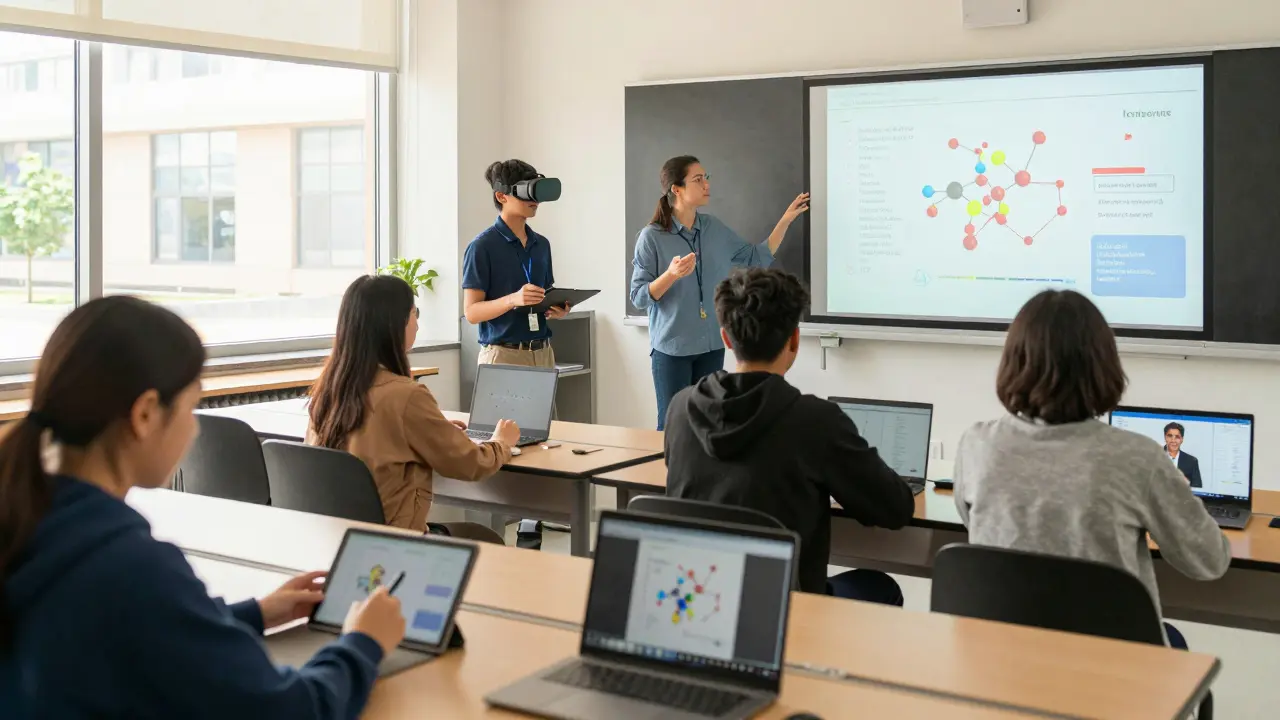
When you walk into a high school today, you won’t just see desks and chalkboards. You’ll see students using tablets to take quizzes, teachers projecting real-time data from science experiments, and entire classes collaborating on shared documents-even if they’re not in the same room. Technology isn’t just an add-on in high schools anymore. It’s the backbone of how students learn, how teachers teach, and how schools operate.
Classrooms Are No Longer Bound by Walls
Before 2020, blended learning was a buzzword. Now, it’s standard. Students in rural Tennessee can join a live chemistry lab led by a teacher in Atlanta. Kids in Detroit can debate history with peers in Seattle using video conferencing tools built into their school’s learning platform. Platforms like Google Classroom, Canvas, and Schoology let teachers post assignments, give feedback, and track progress-all in one place.
It’s not just about convenience. It’s about access. A student who missed school because of illness can catch up without falling behind. A student who learns better by watching videos can replay a lesson on quadratic equations until it clicks. Schools that use these tools report fewer absences and higher completion rates.
Personalized Learning Isn’t a Fantasy Anymore
One-size-fits-all teaching doesn’t work-and technology finally lets us fix that. Adaptive learning platforms like Khan Academy, IXL, and DreamBox adjust difficulty in real time based on how a student is doing. If a student struggles with fractions, the system gives them extra practice. If they master algebra early, they get advanced problems.
A 2024 study by the National Center for Education Statistics found that high schools using adaptive tech saw a 22% increase in math proficiency over two years compared to those using traditional methods. It’s not magic. It’s data. The system tracks every click, every wrong answer, every time a student rushes through a question-and uses that to tailor what comes next.
AI Is Helping Teachers, Not Replacing Them
Some fear AI will take over teaching. The truth? It’s making teachers more effective. Tools like Gradescope and Turnitin now auto-grade multiple-choice quizzes and even spot patterns in essay writing. That saves hours of grading time. Teachers use those hours to work one-on-one with students who need help.
AI tutors like Khanmigo help students with homework without replacing human guidance. A student stuck on a physics problem can ask the AI for hints, not answers. The AI doesn’t give the solution-it asks leading questions: “What force is acting here?” “Have you tried drawing a free-body diagram?” That’s how real learning happens.
Teachers still decide what’s taught, how it’s taught, and who needs extra support. AI just gives them the tools to do it better.
Hands-On Learning Got a Tech Upgrade
Science labs used to mean beakers, Bunsen burners, and risky experiments. Now, many schools use virtual labs from PhET or Labster. Students can simulate a DNA extraction, run a chemical reaction with dangerous substances, or explore the solar system-all safely from their laptops.
In career and technical education (CTE) programs, students are learning welding using VR headsets that simulate heat and pressure. Automotive tech students diagnose engine problems with AR apps that overlay wiring diagrams onto real car parts. These aren’t gimmicks. They’re training tools that reduce cost, increase safety, and give students experience they’d never get otherwise.
One high school in Ohio replaced its entire auto shop curriculum with VR simulations for the first semester. Student pass rates on certification exams went up by 31%.
The Digital Divide Is Still Real
Not every student has a reliable internet connection. Not every family can afford a laptop. In 2025, the U.S. Department of Education estimates that 14% of high school students still lack consistent access to devices or broadband at home.
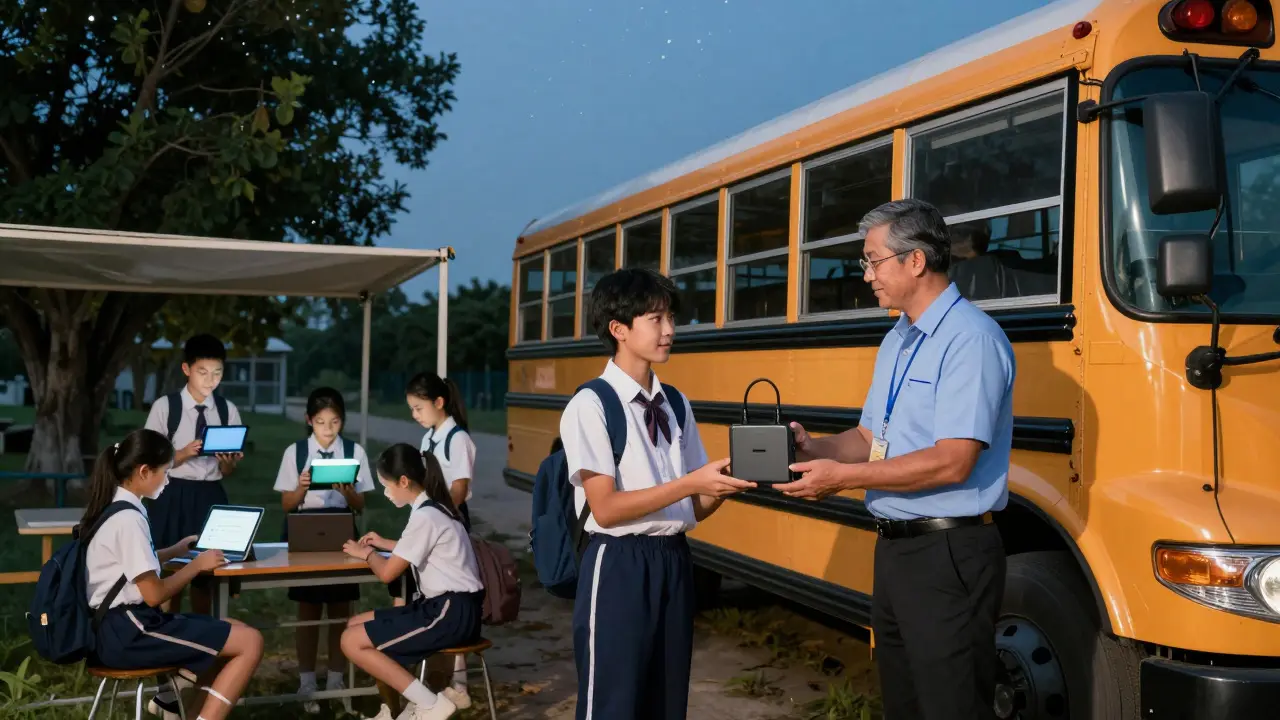
Schools are trying to fix this. Some districts give every student a Chromebook. Others partner with local libraries to offer free Wi-Fi hotspots. Some even loan out mobile hotspots that work like cell phones but connect to the internet.
But access isn’t enough. Students need training too. A student with a tablet but no guidance on how to use learning apps won’t benefit. Schools that pair device distribution with digital literacy programs-teaching students how to navigate platforms, avoid scams, and manage screen time-see the biggest gains.
Assessments Are Changing, Too
Standardized tests are still around, but they’re no longer the only measure of success. Many high schools now use digital portfolios. Students collect their best work-essays, videos, coding projects, lab reports-and reflect on what they learned. Teachers assess growth over time, not just a single score.
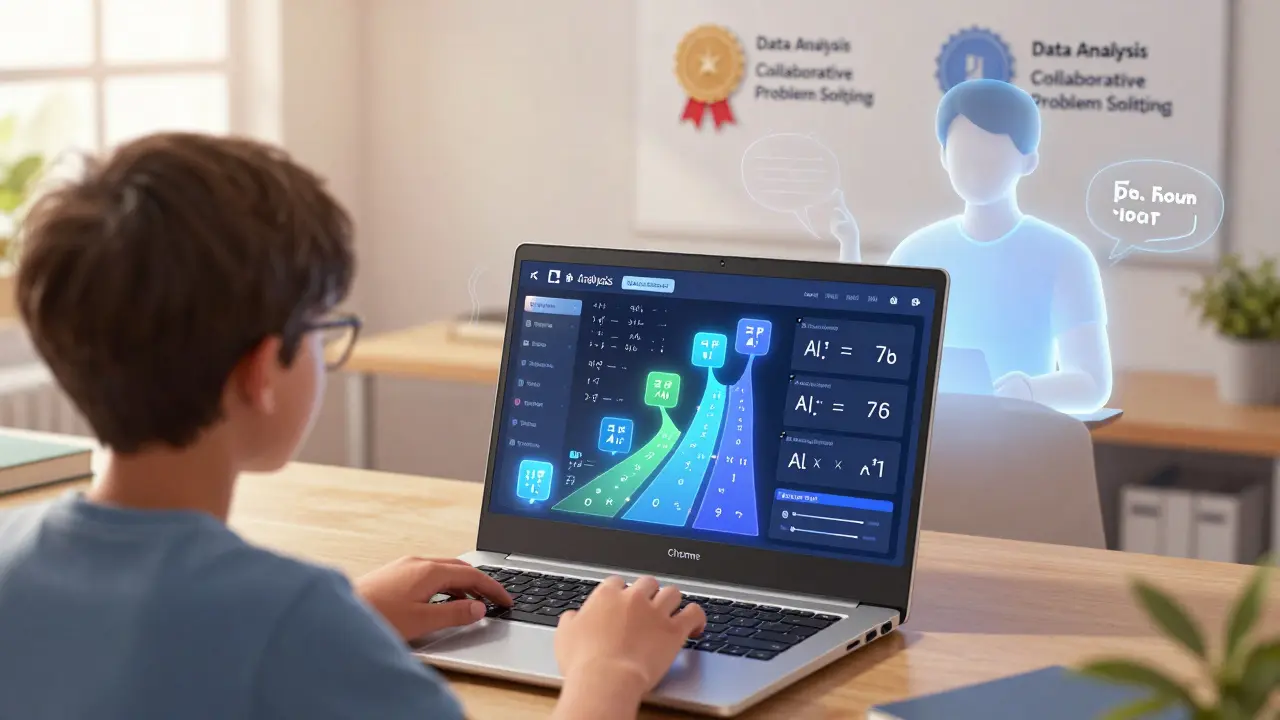
Some schools use digital badges to recognize skills like “Data Analysis,” “Collaborative Problem Solving,” or “Ethical Tech Use.” These badges show up on student profiles and can be shared with colleges or employers. They’re becoming as important as GPAs in some places.
A college admissions officer in North Carolina told us last year that they now review digital portfolios from 40% of applicants. “We see who’s curious,” they said. “Who builds things. Who solves problems. That’s more telling than a test score.”
What’s Next for High School Tech?
Augmented reality field trips are coming. Imagine walking through the Roman Colosseum in AR while studying ancient history. Or using AI to simulate the effects of climate change on your own town’s weather patterns.
Blockchain is being tested for secure, tamper-proof transcripts. Some schools are piloting AI-driven career counselors that match students with internships based on their project history and interests.
But the biggest shift isn’t about gadgets. It’s about mindset. Schools are moving from “What do we teach?” to “How do we prepare students for a world that’s changing faster than we can predict?”
Technology won’t fix bad teaching. But it can amplify good teaching. It can give every student, no matter where they live or what their background is, a chance to learn in a way that works for them.
The future of high school isn’t just digital. It’s personal. It’s flexible. And it’s already here.
How is technology improving student engagement in high schools?
Technology boosts engagement by making learning interactive and relevant. Students respond better to videos, simulations, and gamified quizzes than static textbooks. Tools like Kahoot! turn review sessions into games. Virtual labs let students experiment without risk. When students can see immediate results and control their learning pace, they stay focused longer and feel more invested in their progress.
Do students rely too much on technology in high school?
Some students do, but that’s usually because they haven’t been taught how to use tech responsibly. Schools that integrate digital citizenship into their curriculum-covering focus, screen time, and critical thinking online-see fewer dependency issues. The goal isn’t to eliminate tech, but to teach students when to use it and when to step away. Balance is key.
Can technology help students with learning disabilities?
Yes. Text-to-speech tools help students with dyslexia. Speech-to-text software supports those with writing challenges. Visual organizers and screen readers make complex material more accessible. Many platforms now include built-in accessibility features like adjustable font sizes, color contrast modes, and captioning. These aren’t optional extras-they’re essential tools for equitable learning.
What’s the biggest challenge schools face when adopting technology?
Training teachers. Many educators know how to teach-but not how to use new platforms effectively. Without proper PD (professional development), tech tools sit unused. The most successful schools invest time and money in ongoing training, peer mentoring, and tech coaches who work directly with classrooms.
Are digital grades and portfolios accepted by colleges?
More than ever. Colleges are moving beyond GPAs and SAT scores. Many now review digital portfolios, project showcases, and skill badges. Institutions like MIT, Stanford, and the University of Michigan explicitly encourage applicants to submit multimedia portfolios. These show creativity, initiative, and real-world application-qualities standardized tests can’t measure.
How can parents support tech use at home?
Parents don’t need to be tech experts. They just need to be involved. Ask your child what they’re working on. Check in on their learning platform. Set boundaries for screen time. Encourage them to use tech for creation-not just consumption. A simple conversation like “What did you build today?” or “What problem did you solve?” goes further than any app ever could.
Technology in high schools isn’t about flashy gadgets or the latest trend. It’s about giving every student the tools to learn in a way that fits them-whether they’re in a city classroom or a remote town with limited resources. The goal isn’t to replace teachers. It’s to empower them. And it’s not about preparing students for a future that’s coming-it’s about preparing them for the world they’re already living in.
Amit Umarani
December 30, 2025 AT 15:20Look, I get the hype, but half these ‘tech solutions’ are just glorified PowerPoint slides with a fancy name. I’ve seen kids spend 20 minutes waiting for a virtual lab to load while the teacher scrolls through memes on their phone. It’s not innovation-it’s distraction with a budget.
And don’t get me started on ‘digital portfolios.’ My cousin’s school made her upload a TikTok-style video explaining photosynthesis. She spent three days editing it. Meanwhile, her math grade tanked because no one checked her homework.
Technology should serve learning, not become the lesson itself.
Noel Dhiraj
January 1, 2026 AT 02:43I’ve taught in rural India for 12 years and I’ve seen kids with no electricity at home crush calculus using offline Khan Academy downloads on a shared tablet. This isn’t about flashy gadgets-it’s about access. The real win is when a girl in Jharkhand solves a problem her brother couldn’t because she watched the video three times. No one’s grading her on how fast she typed it. She learned.
That’s what matters.
vidhi patel
January 3, 2026 AT 00:14It is utterly unacceptable that the author employs the phrase ‘it’s not magic-it’s data’ as if this somehow legitimizes the invasive tracking of student behavior. Every click, every wrong answer, every rushed question-is being harvested, stored, and monetized under the guise of ‘personalization.’ This is not education. This is behavioral surveillance dressed in pedagogical clothing.
Furthermore, the reference to ‘adaptive platforms’ is misleading. These systems are not adaptive-they are predictive, and they are built on biased datasets that penalize neurodivergent learners and non-native English speakers. The so-called ‘22% increase in proficiency’ is statistically meaningless without context on sample diversity, control groups, or long-term retention.
And where, pray tell, is the discussion of algorithmic bias? The silence is deafening.
Priti Yadav
January 3, 2026 AT 19:22They’re lying. Everyone knows the government is using these ‘learning platforms’ to track what kids think. The AI tutors? They’re not helping with physics-they’re listening for keywords like ‘revolution’ or ‘dissent.’ I heard a teacher say last year that if a student asks too many questions about ‘why’ something is taught, their profile gets flagged for ‘critical thinking risk.’
And don’t even get me started on the blockchain transcripts. That’s not for colleges-it’s for the state. One day, you’ll try to get a job and they’ll say ‘your high school portfolio shows you questioned climate policy too often.’
They’re turning schools into data mines and calling it ‘progress.’ I’m not buying it.
Ajit Kumar
January 4, 2026 AT 11:18While the article presents a superficially optimistic view of educational technology, it fails to address the fundamental epistemological shift that occurs when cognition is outsourced to algorithmic systems. The notion that ‘AI gives teachers more time’ presupposes that the primary function of pedagogy is administrative efficiency, rather than intellectual cultivation. Moreover, the uncritical celebration of ‘adaptive learning’ ignores the fact that such systems reinforce existing cognitive biases by rewarding speed and conformity over depth and originality.
Furthermore, the assertion that ‘technology amplifies good teaching’ is a tautology devoid of empirical substantiation. What constitutes ‘good teaching’ in this context? Is it the ability to navigate a learning management system? Or is it the capacity to inspire curiosity in the face of uncertainty? The article offers no definition, no critique, and no humility.
It is, in essence, a corporate whitepaper masquerading as educational discourse.
Diwakar Pandey
January 5, 2026 AT 02:33I’ve seen both sides. I taught in a school where every kid had a Chromebook but no one knew how to cite sources. Then we got a tech coach who spent 10 minutes a day showing kids how to use Google Scholar properly. That’s it. No fancy training. Just time.
And yeah, some kids got lost in the apps. But the ones who got helped? They started asking better questions. One kid built a whole website about local pollution using data from the school’s air sensors. No one told him to. He just did it.
It’s not about the tech. It’s about who’s holding the hand while they learn to use it.
Geet Ramchandani
January 5, 2026 AT 11:11Let’s be real. This whole ‘tech revolution’ is just another way for ed-tech companies to profit off public schools while teachers get paid less and kids get more screens. You think the district really cares about ‘equity’? They bought 5,000 Chromebooks because they got a grant-and now they’re forcing teachers to use them even when the Wi-Fi drops every 12 minutes.
And ‘digital badges’? Please. Colleges don’t care about your ‘Collaborative Problem Solving’ badge. They care if you got an A in AP Bio and didn’t get caught cheating on your virtual lab.
They’re selling snake oil and calling it ‘the future.’ Meanwhile, the art teacher got her budget cut again because ‘tech is the priority.’
Pooja Kalra
January 5, 2026 AT 19:40There is a quiet erosion occurring beneath the glittering veneer of innovation. The classroom, once a sacred space of dialogue and contemplation, has been reduced to a data stream-a transactional exchange between algorithm and pupil. The soul of learning-the hesitation, the struggle, the silent epiphany-is being replaced by progress bars and achievement notifications.
What happens when a child learns not to think, but to optimize? When curiosity is quantified and creativity is gamified? We are not preparing students for the future. We are preparing them for a system that demands compliance, not consciousness.
And we call this progress.
Sumit SM
January 7, 2026 AT 15:00Wait-so let me get this straight: AI tutors are now ‘leading questions’ instead of answers? That’s revolutionary? I remember when teachers used to do that… like, in 1998? And now we’re calling it ‘cutting-edge’ because it’s delivered via a chatbot?
And blockchain transcripts? Who’s going to pay for the energy to run that? The carbon footprint of one blockchain transcript could power a rural school for a month.
Also-‘digital portfolios’? My nephew spent two weeks making a Canva slideshow about his ‘personal growth journey.’ He didn’t write a single essay. He just pasted memes with captions like ‘I learned to be resilient.’
This isn’t education. It’s influencer culture with a syllabus.
Jen Deschambeault
January 8, 2026 AT 07:15I work in a Canadian high school with no internet in half the homes. We gave out tablets with offline content. One student, 16, taught himself Python from a downloaded tutorial and built an app to help his mom track her diabetes meds. No teacher helped. Just curiosity.
That’s the real power of tech-not the platform, not the badge, not the AI. It’s the kid who uses it to solve something real.
Let them build. Then help.
Soham Dhruv
January 10, 2026 AT 04:43My brother’s school gave out laptops but didn’t fix the wifi. So kids sat in the parking lot with their tablets trying to submit homework. One kid got suspended for ‘missing assignments’ because his signal dropped at 11:58pm.
And the teachers? They got a 30-minute Zoom training on how to use Google Classroom. No follow-up. No help.
It’s not the tech that’s broken. It’s the system that thinks buying devices = solving problems.
Also, why is everyone so quiet about the fact that these platforms track kids’ mouse movements? That’s creepy.
Bob Buthune
January 10, 2026 AT 17:25I just want to say… this whole thing makes me so sad. I used to love school. I used to sit in class, look out the window, and just think. Now? My daughter comes home crying because her ‘learning dashboard’ says she’s ‘below average’ in ‘engagement metrics.’
She’s 15. She’s not a spreadsheet.
I don’t care if her grades are higher. I care that she doesn’t feel like a robot anymore. I miss the days when a teacher could see you were struggling just by the way you looked at your paper.
They took that away. And no algorithm can bring it back.
I just miss her being a kid.
Jane San Miguel
January 11, 2026 AT 03:17The author’s uncritical embrace of technological determinism is both intellectually lazy and morally irresponsible. The notion that ‘technology empowers teachers’ assumes that pedagogical expertise is a mere logistical bottleneck rather than a deeply cultivated, humanistic discipline.
Furthermore, the citation of ‘MIT’ and ‘Stanford’ as validators of digital portfolios is a classic appeal to authority fallacy-ignoring that elite institutions have resources and support structures unavailable to 99% of public schools.
This is not equity. It is technocratic colonialism disguised as progress.
Kasey Drymalla
January 11, 2026 AT 23:35They’re using AI to spy on kids. That’s it. That’s the whole thing. No one talks about it because they’re scared. But I know. I’ve seen the emails. The school sends ‘behavior alerts’ when a kid searches ‘how to quit school’ or ‘why is life unfair.’
They’re building a dystopia and calling it ‘personalized learning.’
And the worst part? The kids don’t even know.
Wake up.
Dave Sumner Smith
January 12, 2026 AT 09:19They’re not just tracking kids’ clicks-they’re feeding their data to advertisers. You think those ‘free’ learning apps are free? They’re selling your child’s learning patterns to companies that sell supplements, video games, and political ads. The school doesn’t care. They got their grant.
And now your kid’s anxiety levels are being used to target them with ‘mental wellness’ ads for antidepressants.
They’re turning high school into a marketing funnel.
And you’re applauding it because your kid got a ‘badge.’
Pathetic.