Is It Better to Have a Study Buddy? The Real Benefits and Pitfalls for High School Students

Ever sat down to study for a chemistry test and realized you’ve been staring at the same page for 20 minutes, not remembering a single thing? Now imagine someone sitting next to you, asking you to explain the periodic table like you’re teaching a five-year-old. Suddenly, it clicks. That’s the power of a study buddy-not magic, not luck, but science-backed brain chemistry at work.
Why your brain remembers more with a partner
Your brain doesn’t learn well in isolation. When you explain a concept out loud to someone else, you force your brain to organize the information in a way that makes sense. This is called the protégé effect. A 2014 study from the University of Chicago found that students who taught material to others scored 20% higher on retention tests than those who just reviewed notes. A study buddy isn’t just someone who sits quietly beside you-they’re your personal knowledge checker. If you can’t explain it clearly, you don’t really know it yet.It’s not just about repetition. Teaching forces you to fill in gaps. You might think you understand quadratic equations until you try to walk someone through the steps. That moment of panic? That’s your brain saying, ‘I need to go back and fix this.’
Who makes the best study buddy?
Not every classmate is a good fit. The best study buddy isn’t the one with the highest grade. It’s the one who:- Asks questions instead of giving answers
- Shows up on time, every time
- Can explain things simply, not just recite them
- Isn’t afraid to say, ‘I don’t get this either’
Pairing with someone who’s way ahead can make you feel discouraged. Pairing with someone who’s way behind means you’ll end up doing all the work. The sweet spot? Someone close to your level-maybe a few points higher or lower. You challenge each other without overwhelming each other.
One student from Lincoln High in Chicago told me she studied with her lab partner, who got a B+ and she got a B. They’d quiz each other every Tuesday and Thursday after school. By finals, they both jumped to A’s. Why? Because they stopped pretending they knew everything and started admitting what they didn’t.
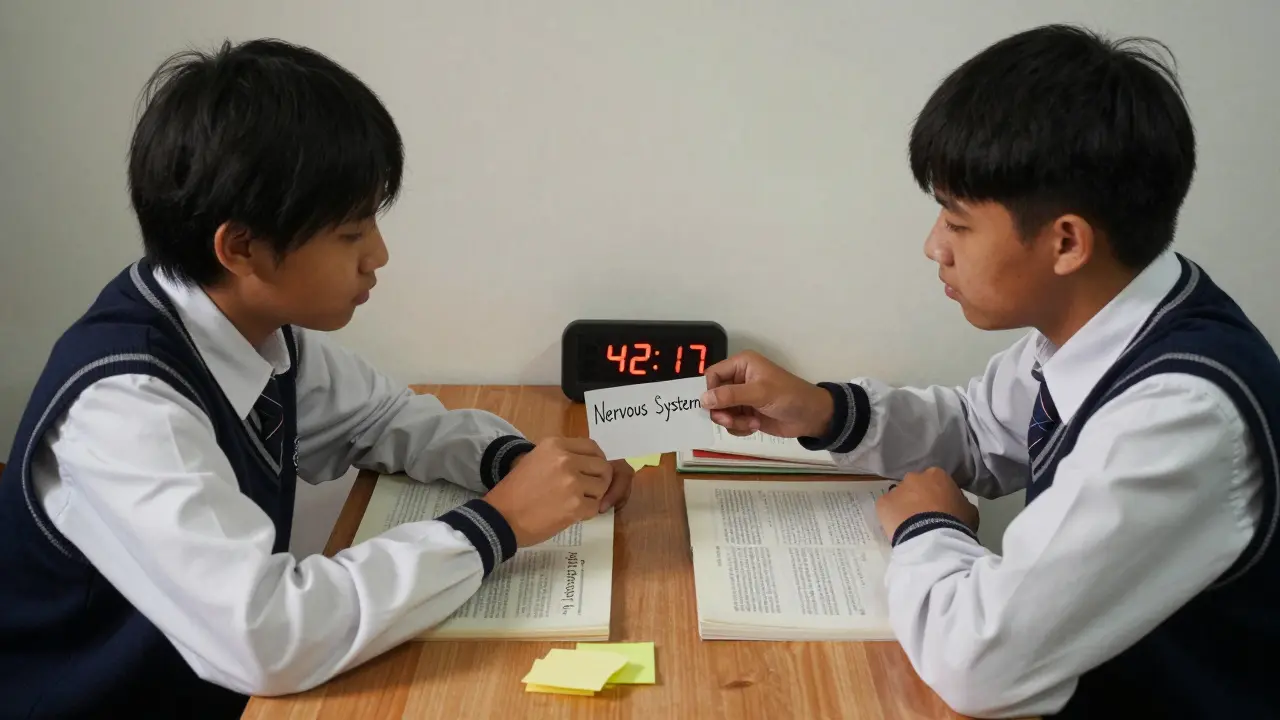
The hidden dangers of group study
It’s not all good. A bad study buddy can waste your time, lower your focus, or even make you feel worse about your progress.Here’s what goes wrong:
- Conversations drift to TikTok, weekend plans, or who asked who to prom
- One person does all the talking while the other just nods
- You start copying answers instead of figuring them out
- You show up late, cancel last minute, or never bring materials
A 2023 survey of 1,200 U.S. high school students found that 41% said their study sessions felt unproductive. The biggest reason? Lack of structure. Without a plan, group study turns into social time with textbooks.
Fix this by setting rules before you start:
- Set a 45-minute timer. No phones during that time.
- Agree on one topic per session-like ‘nervous system’ or ‘Shakespearean sonnets’.
- Take turns teaching. One person explains, the other asks questions.
- End with a 5-minute quiz. Write down three questions and swap answers.
When studying alone is actually better
There are times when you should skip the buddy. If you’re trying to memorize formulas, practice a foreign language pronunciation, or review your own notes from class, solitude works better. Your brain needs quiet time to consolidate information. That’s why top performers often study alone in the morning and with a partner in the afternoon.Try this hybrid approach:
- Monday, Wednesday, Friday: Study alone for 60 minutes. Focus on your weakest subject.
- Tuesday, Thursday: Study with a buddy for 45 minutes. Review what you learned alone.
This way, you’re not relying on someone else to teach you-you’re using them to test yourself. It’s like having a personal trainer for your brain.
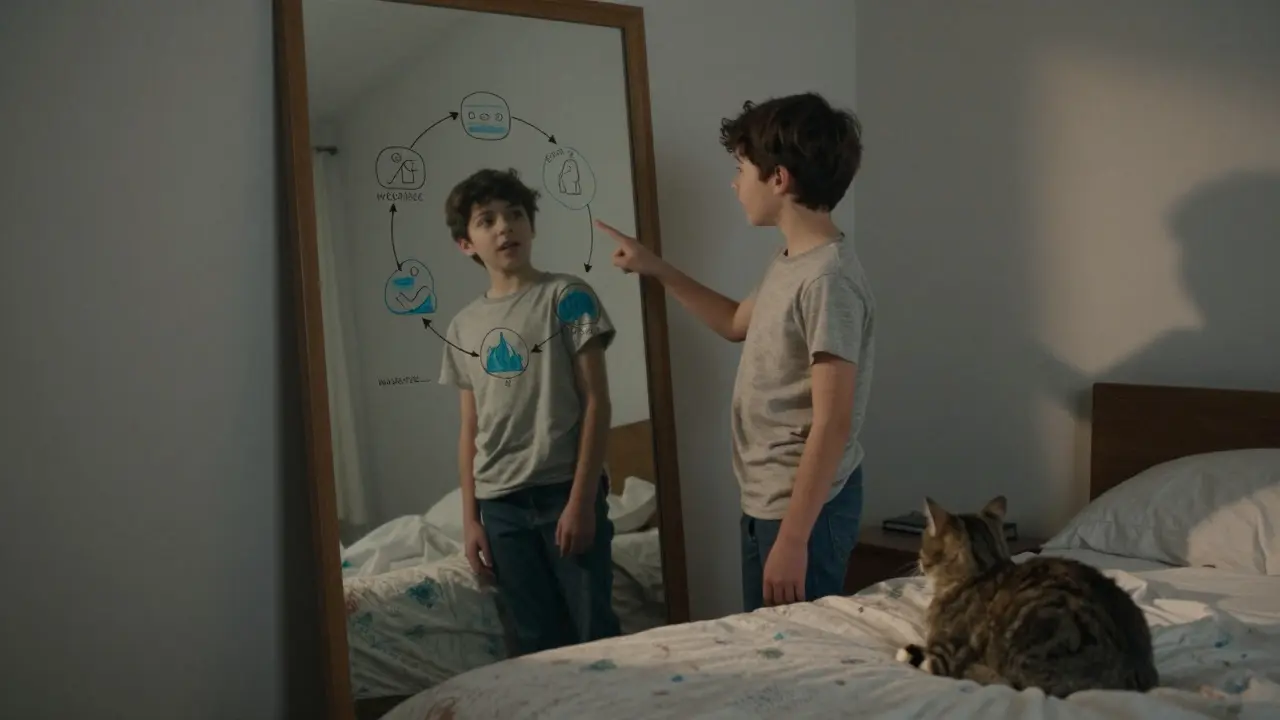
What to do if you don’t have a study buddy
Not everyone has someone to study with-and that’s okay. You can still simulate the experience.Here’s how:
- Record yourself explaining a topic on your phone. Play it back. Do you sound confident?
- Use flashcards with a friend over text. Send one question a day and ask them to reply with the answer.
- Join a school study group. Many high schools now offer after-school peer tutoring sessions. Ask your teacher.
- Teach your pet, your mirror, or a stuffed animal. Yes, seriously. It works.
One student from Oak Park High told me she taught the water cycle to her cat every night. She said the cat didn’t care, but she started remembering the stages without even trying.
Final thought: It’s not about who you study with-it’s about how
Having a study buddy isn’t a magic fix. It’s a tool. And like any tool, it only works if you use it right. The goal isn’t to have someone there to hold your hand. It’s to have someone who makes you think harder, speak clearer, and remember longer.Start small. Pick one subject. Find one person who’s willing to try. Set a time. Stick to it for two weeks. If it helps, keep going. If it doesn’t, try someone else-or go solo. There’s no single right way to study. But if you’re not testing your knowledge out loud, you’re not really learning.
Can a study buddy really improve my grades?
Yes, if you use them right. Students who study with a partner regularly score 15-25% higher on standardized tests, according to a 2022 meta-analysis of 37 high school studies. The key is active teaching, not passive listening. If you’re just copying notes, you won’t see results.
What if my study buddy is distracted or lazy?
Set boundaries. If they’re consistently late, don’t wait. If they bring snacks and phones, say, ‘Let’s try this for 20 minutes without distractions.’ If they still don’t change, find someone else. Your time is valuable. A good study buddy respects that.
Should I study with someone in the same class or a different one?
Same class is usually better. You’re working on the same material, so you can quiz each other directly. But if you’re struggling with math and your friend is great at it-even if they’re in a different grade-it’s still worth trying. The goal is to find someone who can help you understand, not just match your schedule.
How often should I meet with my study buddy?
Twice a week is ideal. Once a week keeps you accountable, but twice lets you build momentum. Don’t overdo it-three or more times a week can lead to burnout. Keep sessions short: 45 to 60 minutes max. Quality beats quantity.
Is it better to study with a friend or a stranger?
Strangers often work better. Friends can be too relaxed. You might feel awkward correcting them, or they might feel awkward saying no to you. A classmate you don’t hang out with outside school tends to stay focused. But if your friend is serious about grades, stick with them. Personality matters more than familiarity.
Anand Pandit
January 7, 2026 AT 00:49I used to study alone until I teamed up with my lab partner last year. We didn't even sit in the same class, but we met twice a week to quiz each other on biology. I used to blank out on mitochondria, now I can explain it while brushing my teeth. The key? No phones, no snacks, just 45 minutes of pure chaos and then a quick quiz. It works.
Don't overthink it. Just find someone who won't let you fake it.
Reshma Jose
January 8, 2026 AT 05:37My study buddy used to be my best friend until she started copying my answers. Now I study with this girl from chem class who doesn’t even know my favorite anime. Best decision ever. She’ll say ‘wait, explain that again’ and I have to actually think. No fluff, no pity. Just pure accountability.
Also, she brings tea. That’s a bonus.
rahul shrimali
January 8, 2026 AT 18:55Study buddy good but only if you dont waste time
45 mins max no talking just teaching and quizzing
if they mess up you move on
Eka Prabha
January 9, 2026 AT 19:16Let’s be real - this entire ‘study buddy’ phenomenon is just a manufactured pedagogical illusion designed to mask systemic failures in curriculum design and teacher accountability. The fact that students need to teach each other to retain information suggests that the educational model is fundamentally broken. The 2014 University of Chicago study? Replicated by whom? Who funded it? And why are we ignoring the cognitive load theory that suggests dual-processing in low-stakes environments leads to superficial encoding?
Also, the suggestion to teach your cat? That’s not a solution. That’s a symptom of a society that’s out of ideas.
Rajat Patil
January 10, 2026 AT 07:46I get what you’re saying about study buddies, but I’ve seen too many kids get discouraged because they compare themselves to someone who’s ‘better.’ It’s not about grades. It’s about whether you feel safe admitting you don’t know something. I had a buddy who was quiet, never talked much, but always asked, ‘Can you show me how you got that?’ That was enough. No pressure. Just quiet learning.
Some people just need space to think. And that’s okay too.
Jitendra Singh
January 11, 2026 AT 11:58My brother and I studied together last year. He’s in 12th, I’m in 10th. We didn’t even study the same subjects. He helped me with math, I helped him with history timelines. We’d draw stupid doodles on the whiteboard. It felt like a game. We both got A’s. Turns out, teaching someone else makes you care more.
Also, he owes me pizza for helping him memorize the French Revolution.
Madhuri Pujari
January 12, 2026 AT 23:52Oh wow, another ‘study buddy’ self-help article. How original. Let me guess - you also recommend journaling, morning affirmations, and drinking 8 glasses of water? The ‘protégé effect’? Please. That’s just cognitive dissonance dressed up as neuroscience. You’re not ‘teaching’ - you’re rehearsing. And if you’re actually learning, it’s because you’re forced to pay attention to avoid looking stupid in front of someone else. That’s not pedagogy. That’s social pressure.
Also, ‘teach your cat’? That’s not a strategy. That’s a cry for help. And the fact that you’re recommending group study in a world where attention spans are 8 seconds? Pathetic.
Sandeepan Gupta
January 14, 2026 AT 15:37I used to think study buddies were useless until I started correcting grammar mistakes in my partner’s flashcards. Turns out, if you’re bad at explaining something, it’s often because you’re using the wrong words. I started pointing out vague phrases like ‘kinda works’ or ‘sorta like that’ and forcing precise language. Suddenly, I understood the material better too.
Grammar isn’t just for essays. It’s the scaffolding for thinking. If you can’t say it clearly, you don’t know it.
Also, if your buddy says ‘I think it’s this,’ tell them to say ‘It’s this because…’ and make them finish the sentence. No shortcuts.
Tarun nahata
January 15, 2026 AT 19:12Study buddy = brain turbocharger. You’re not just reviewing - you’re turning knowledge into a live wire. One time I tried explaining photosynthesis to my buddy while we were stuck in traffic. I ended up using pizza slices as chloroplasts. He laughed. I aced the test.
Don’t wait for the perfect person. Grab whoever’s sitting next to you. Even if they’re weird. Even if they smell like energy drinks. If they’re willing to say ‘I don’t get it,’ you’ve already won.
Also, teach your dog. Dogs don’t judge. They just wag. And that’s the best feedback loop you’ll ever get.
Aryan Jain
January 16, 2026 AT 22:17This whole thing is a distraction. The real problem? Schools don’t teach you how to think - they teach you how to regurgitate. Study buddies? They’re just two people clinging to the same sinking ship. The system is rigged. Teachers are overworked. Parents are distracted. And now we’re being told to fix it by teaching each other? That’s not empowerment. That’s exploitation.
What if the real answer is to burn the curriculum down and start over? But no - we’d rather have you explain the periodic table to your cat than question why it’s even there in the first place.
ANAND BHUSHAN
January 17, 2026 AT 21:24I tried a study buddy once. We sat there for an hour. Didn’t say a word. Just flipped through flashcards. He got a 92. I got a 94. We didn’t even talk after. Just nodded. Best session ever.