Is There a Way to Apply to Colleges for Free?

Applying to college shouldn’t feel like a financial burden. For many students, especially those from low-income families, even a $50 application fee adds up fast-especially when you’re applying to six, eight, or even ten schools. The good news? Free college applications are more common than you think. You don’t need to be a genius or have a perfect GPA to qualify. You just need to know where to look and how to ask.
Colleges That Offer Free Applications
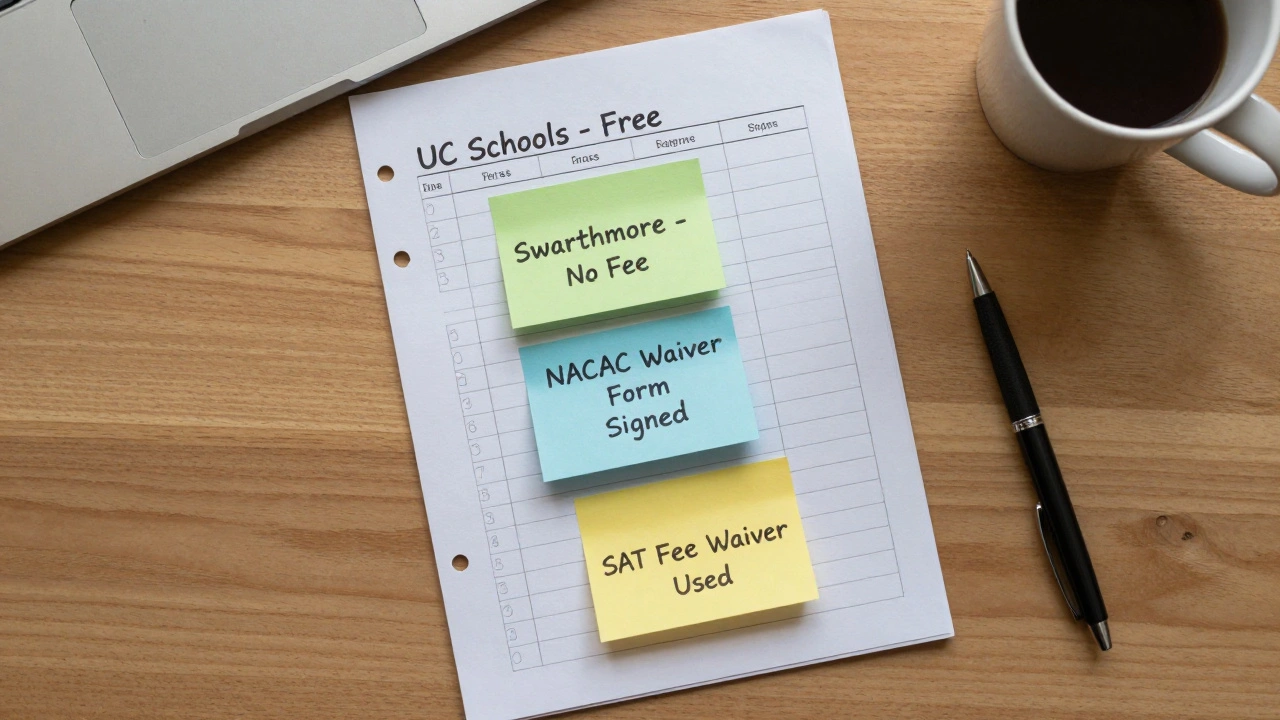
Thousands of colleges and universities in the U.S. have eliminated or waived application fees for certain students. Some do it for everyone. Others have specific eligibility rules. For example, the University of California system has had no application fees since 2021 for all U.S. applicants, regardless of income. That’s 10 campuses-from UCLA to UC Davis-completely free to apply to.
Other public university systems, like the University of Texas and the University of Michigan, also offer fee waivers for students who qualify for free or reduced-price lunch in high school. In 2024, over 1,200 colleges participated in the National Association for College Admission Counseling’s (NACAC) fee waiver program, which lets counselors approve waivers for students who demonstrate financial need.
Private colleges aren’t left out either. Schools like Amherst, Swarthmore, and Bowdoin-known for their generous financial aid-don’t charge application fees at all. Even larger private universities like NYU and Northwestern offer fee waivers on request if you meet income guidelines.
How to Get a Fee Waiver
There are three main ways to get your application fee waived:
- Through your high school counselor-They can request a NACAC waiver form for you if you qualify based on family income, participation in federal assistance programs, or being in foster care.
- Through the Common App or Coalition App-Both platforms have built-in fee waiver options. If you indicate you’re eligible for free or reduced-price lunch, or if your family receives public assistance, the system automatically unlocks free applications to participating schools.
- Directly from the college-Some schools let you email their admissions office and ask for a waiver. All you need to say is: “I’m applying for financial aid and would appreciate a fee waiver.” Many respond within 48 hours.
Don’t assume you don’t qualify. Even if your family makes a little more than the official poverty line, you might still be eligible. The cutoffs are often higher than people think. For example, a family of four earning up to $65,000 a year qualifies for fee waivers at many schools.
What If You’re Not Eligible?
Not everyone qualifies for a fee waiver-but that doesn’t mean you’re stuck paying. Many colleges offer fee discounts, not just full waivers. Some reduce the fee from $75 to $25. Others have rolling deadlines with lower fees for early applications. Check each school’s website under “Admissions” or “Apply” and look for phrases like “application fee reduction” or “financial hardship exception.”
Also, some organizations give out fee waiver codes. The College Board offers up to four free SAT fee waivers per student, and each one includes a college application fee waiver for up to four schools. If you took the SAT and qualified for a fee waiver, you probably already got this benefit-check your College Board account.
Why Fee Waivers Matter
Application fees aren’t just a cost-they’re a barrier. A 2023 study by the National Center for Fair & Open Testing found that students from low-income families were 30% less likely to apply to selective colleges simply because of application fees. When fees were removed, applications from those students increased by nearly 50%.
That’s not just about saving $40. It’s about access. Students who don’t apply to reach schools because of fees miss out on full-ride scholarships, better academic programs, and higher graduation rates. Fee waivers level the playing field.
How to Maximize Free Applications
Here’s how to get the most out of free applications:
- Apply to at least one safety, one match, and one reach school at no cost.
- Use the Common App or Coalition App-they let you apply to 20+ schools with one fee waiver.
- Don’t wait until the last minute. Some schools run out of waiver slots.
- Ask your counselor to help you fill out the waiver form. They’ve done it hundreds of times.
- Keep a spreadsheet: list schools, fees, waiver status, and deadlines. It saves stress.
Also, remember: applying for free doesn’t mean you’re applying to “lesser” schools. Many top-ranked institutions offer free applications. You’re not lowering your standards-you’re removing an artificial barrier.

Common Myths About Free Applications
Let’s clear up some false ideas:
- Myth: Only students with perfect grades get fee waivers. Truth: Income and family circumstances matter more than grades.
- Myth: If you get a waiver, your application gets less attention. Truth: Admissions officers can’t see whether you paid the fee. It’s not tracked in your file.
- Myth: You have to prove poverty with tax documents. Truth: Most schools just ask you to check a box on the application or have your counselor verify.
- Myth: Only public schools offer free apps. Truth: Many elite private colleges don’t charge fees at all.
What to Do Next
Start today. Open your Common App or Coalition App account. Go to the “Fee Waiver” section. Answer the questions honestly. If you qualify, you’ll see a green checkmark next to schools you can apply to for free.
If you’re unsure, talk to your counselor. If your school doesn’t have one, find a local nonprofit-like CollegePoint or First Generation-that helps students with applications. They’ll walk you through it.
And if you’re still nervous? Apply to one school for free. Then another. Then another. Each one is a step closer to a future you can afford.
Can I apply to college for free if I’m not a U.S. citizen?
Most free application programs in the U.S. are only available to U.S. citizens, permanent residents, or eligible non-citizens (like DACA recipients). International students typically pay application fees, though some schools offer fee waivers based on financial need. Check the international admissions page of each college you’re interested in.
Do I have to reapply for a fee waiver every time I apply to a new school?
No. If you get a fee waiver through the Common App or Coalition App, it applies to all participating schools on your list. If you use a NACAC waiver form, your counselor usually gives you multiple copies to use across different applications. Some schools accept digital copies of the waiver form.
What if my counselor won’t give me a fee waiver?
Counselors are required to help students who qualify. If they refuse, ask to speak with the school principal or guidance department head. You can also contact NACAC directly-they can help you get the form approved. Many counselors are overworked, but they’re not allowed to deny a waiver if you meet the criteria.
Can I get a fee waiver for graduate school too?
Yes. Many graduate programs offer application fee waivers for students with financial need, especially those from underrepresented backgrounds. Look for “fee waiver request” links on the program’s admissions page. You’ll usually need to write a short statement explaining your situation or get a letter from a professor or advisor.
Are there apps or tools that help me find free college applications?
Yes. The Common App and Coalition App both have filters that show which schools offer free applications. You can also use College Board’s BigFuture tool, which lets you search colleges by application fee. Some nonprofit sites like ApplyTexas and the National College Access Network also list fee-free schools by state.
Final Thought: You Deserve to Apply
College admissions shouldn’t be a privilege for those who can afford it. The system is designed to help students like you-not to gatekeep opportunity. Free applications exist because someone, somewhere, believed that talent shouldn’t be limited by bank accounts. You don’t need to be the top of your class. You don’t need to have a perfect SAT score. You just need to believe you belong-and then click “apply.”
mark nine
December 2, 2025 AT 20:28Just applied to 8 schools using the Common App waiver. Zero dollars spent. My counselor didn’t even ask for proof. Just checked the box. Done.
Eva Monhaut
December 3, 2025 AT 11:09This is the kind of post that makes me believe in people again. Not everyone gets handed a ladder to climb-some of us have to build our own out of scraps. But if you know where to look, the tools are already there. You don’t need permission to aim high. You just need to click ‘apply’.
Sandi Johnson
December 5, 2025 AT 01:20Wow. So the system actually works sometimes? I thought colleges were just out here selling dreams like overpriced energy drinks. Turns out they’ll give you the drink for free if you’re poor enough to qualify. Who knew?
Ronnie Kaye
December 6, 2025 AT 06:49Let me get this straight-you’re telling me I can apply to Harvard for free if I checked ‘yes’ on a form that asks if I’m broke? And they don’t even know I didn’t pay? That’s either beautiful or terrifying. Probably both.
Rakesh Kumar
December 7, 2025 AT 04:14I’m from India and I cried reading this. Back home, applying to even one foreign university costs more than my mom makes in a week. I didn’t know this existed. Thank you for writing this. I’m printing it out and showing everyone I know.
Bill Castanier
December 7, 2025 AT 08:35Fee waivers are not charity. They’re equity. If you charge a fee, you’re filtering out talent based on zip code, not grades. That’s not admissions. That’s classism.
Ian Maggs
December 9, 2025 AT 05:46It’s fascinating-this entire system, this elaborate architecture of access, hinges on a single checkbox, a single form, a single moment of bureaucratic grace. And yet, we call it ‘merit.’ But merit, it seems, is merely the absence of financial obstruction. How profoundly ironic.
Michael Gradwell
December 10, 2025 AT 03:51Why should I care if someone can’t afford $50? Life’s not fair. If you can’t pay, maybe you shouldn’t be applying. Get a job. Work harder. Stop expecting handouts.
Flannery Smail
December 11, 2025 AT 15:22Wait-so if you’re poor, you get free apps. But if you’re rich, you pay. So… the rich are subsidizing the poor? That’s backwards. Shouldn’t the rich pay more so the poor don’t have to? Or is this just another way to make poor people feel grateful for crumbs?
Chuck Doland
December 13, 2025 AT 04:07The structural inequities embedded in college admissions are not mitigated by fee waivers-they are merely obscured. While the waiver removes a financial barrier, it does nothing to address the disparity in academic preparation, mentorship access, or cultural capital. One must not confuse accessibility with equity.
Tony Smith
December 13, 2025 AT 11:25It is a solemn and profoundly moral imperative that institutions of higher learning remove barriers to entry for those who demonstrate financial hardship. To charge a fee under such circumstances is not merely a fiscal decision-it is a philosophical failure of the educational mission itself.
Emmanuel Sadi
December 13, 2025 AT 22:43Wow. So now we’re rewarding poverty? Next they’ll give free tuition to people who can’t spell. This is how countries collapse. You don’t get a trophy for being broke. You get a trophy for working your ass off. This is why America’s falling apart.
Priyank Panchal
December 15, 2025 AT 04:04You people are naive. This is a trap. Colleges give free apps to get more applicants so they can pick the best and reject the rest. They don’t care about you. They care about their rankings. You’re just a number. Stop believing in fairy tales.