Should You Wear Your Backpack Higher or Lower? The Right Way for High School Students
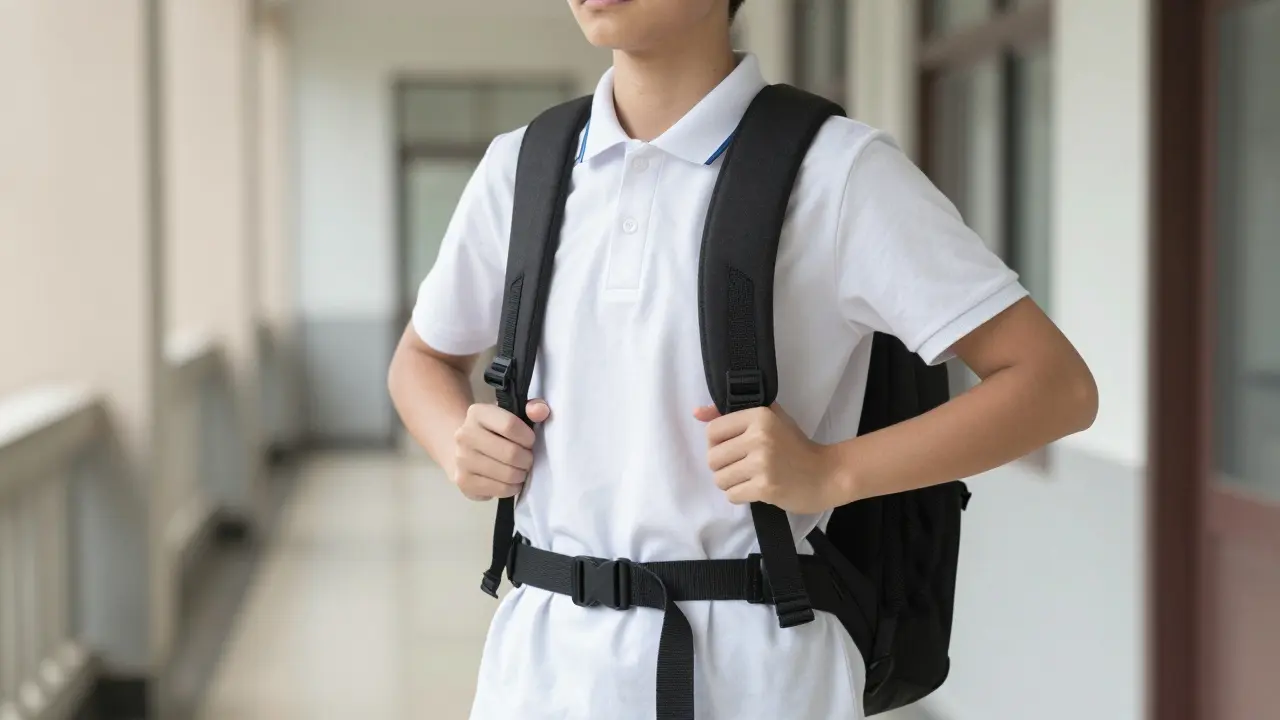
Every morning, thousands of high school students throw their backpacks over their shoulders without thinking twice. But here’s the thing: how high you wear your backpack isn’t just about style-it affects your spine, your shoulders, and even how focused you are in class.
A 2024 study from the American Academy of Orthopaedic Surgeons tracked over 1,200 students aged 14-18 and found that those who wore their backpacks too low (below the waist) were 68% more likely to report chronic lower back pain by the end of the school year. Meanwhile, students who kept their packs snug against their upper back-between shoulder blades and just below the neck-had 52% fewer posture-related complaints. This isn’t guesswork. It’s science.
Why Backpack Height Matters More Than You Think
Your backpack isn’t just a bag. It’s a load. On average, U.S. high schoolers carry 15-20 pounds daily. That’s close to half their body weight if they’re under 120 pounds. When you wear it too low, that weight pulls your center of gravity backward. Your body reacts by leaning forward, arching your lower back, or hunching your shoulders to compensate. Over time, this strains muscles, pinches nerves, and can even change how your spine curves.
Think about it: if you’re carrying a heavy grocery bag and hold it by the handles at your knees, your whole body leans into it. Same thing happens with your backpack. But if you lift it to hip level, your core and legs help share the load. Now imagine lifting it even higher-right where your shoulder blades are. That’s where your body is naturally built to carry weight.
The Sweet Spot: Where to Wear Your Backpack
The ideal position? The bottom of the pack should sit at or just above your waistline. The top should rest just below your shoulders-not touching your neck, but close enough that you can’t feel it pulling downward.
Here’s how to check if yours is in the right spot:
- Stand straight. Look in a mirror. Your ears should line up with your shoulders, and your shoulders with your hips.
- Grab the straps. Adjust them so the pack hugs your back without gaps.
- Walk around. If the pack bounces or sways, it’s too low.
- Try lifting your arms. If the straps dig into your shoulders or the pack slides down, readjust.
Most backpacks have padded hip belts. If yours does, fasten it. It’s not just for hiking. That belt transfers 30-40% of the weight from your shoulders to your hips, where your bones are stronger and better built for carrying.
What Happens When You Wear It Too Low
Let’s say you’re in a rush and just sling it over one shoulder, letting it hang halfway down your butt. You might think it’s fine-until you feel that dull ache in your lower back after third period.
Wearing your backpack too low causes:
- Forward head posture (your head juts out to balance the weight)
- Round shoulders and slouched spine
- Increased pressure on the lumbar vertebrae
- Nerve compression in the neck and upper back
- Reduced lung capacity (hunched posture = less room for breathing)
One student in Asheville told a physical therapist she couldn’t sit still in class because her backpack kept slipping. She’d adjust it every five minutes. Her shoulders were uneven. Her teacher thought she was distracted. Turns out, her backpack was the real culprit.
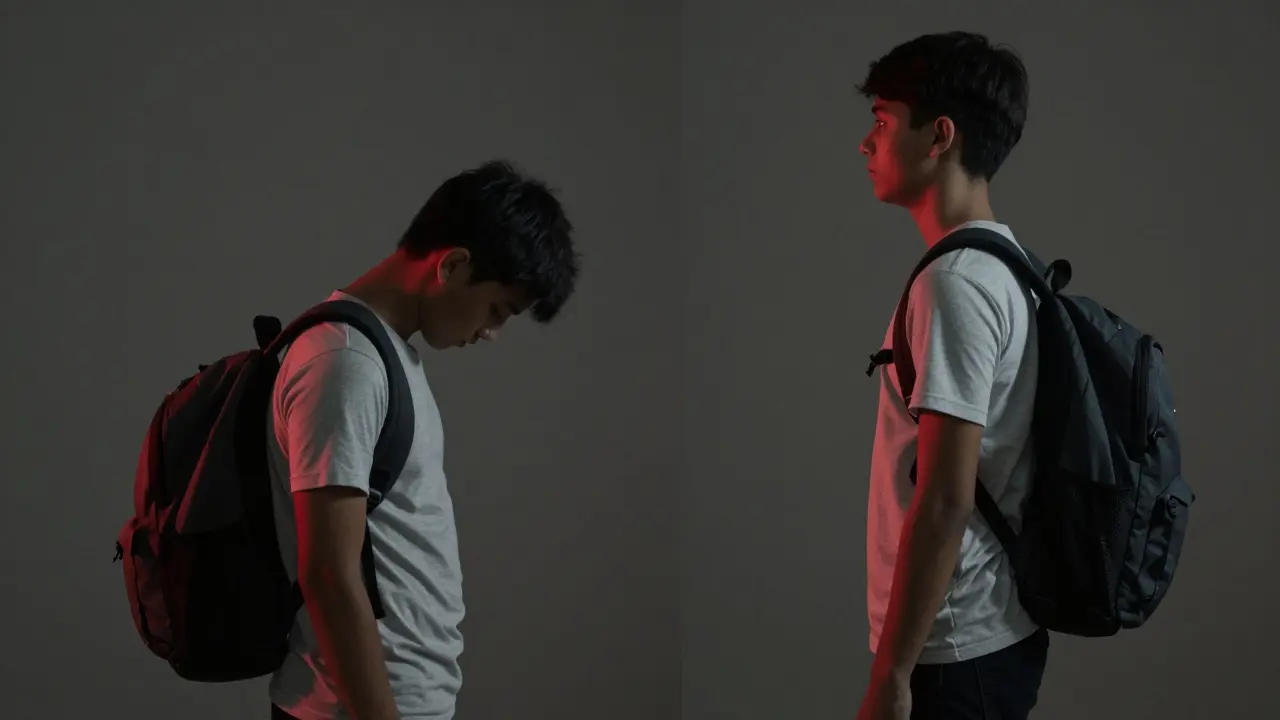
What Happens When You Wear It Too High
Some kids try to wear their backpacks up near the neck, thinking it’ll keep everything close. But that’s just as bad.
Too high means:
- Straps dig into your neck and trapezius muscles
- Increased pressure on cervical spine (neck vertebrae)
- Restricted shoulder movement
- Headaches from muscle tension
It also makes it harder to move naturally. If your pack’s too high, turning your head, reaching for a book, or raising your arm to take notes becomes stiff and awkward.
How to Adjust Your Backpack Correctly
Follow this simple 3-step process every morning:
- Load your bag wisely. Put heaviest items (textbooks, laptops) closest to your back.
- Fasten the waist belt. Tighten it so it fits snugly but doesn’t cut into your hips.
- Adjust the shoulder straps. Pull them until the pack sits firmly against your back, with the bottom just above your hips.
Use the chest strap if your pack has one. It keeps the shoulder straps from slipping off and helps distribute weight evenly.
Pro tip: If your backpack feels heavy, use locker access. Don’t carry everything all day. Bring only what you need for two classes at a time. Most schools have lockers for a reason.
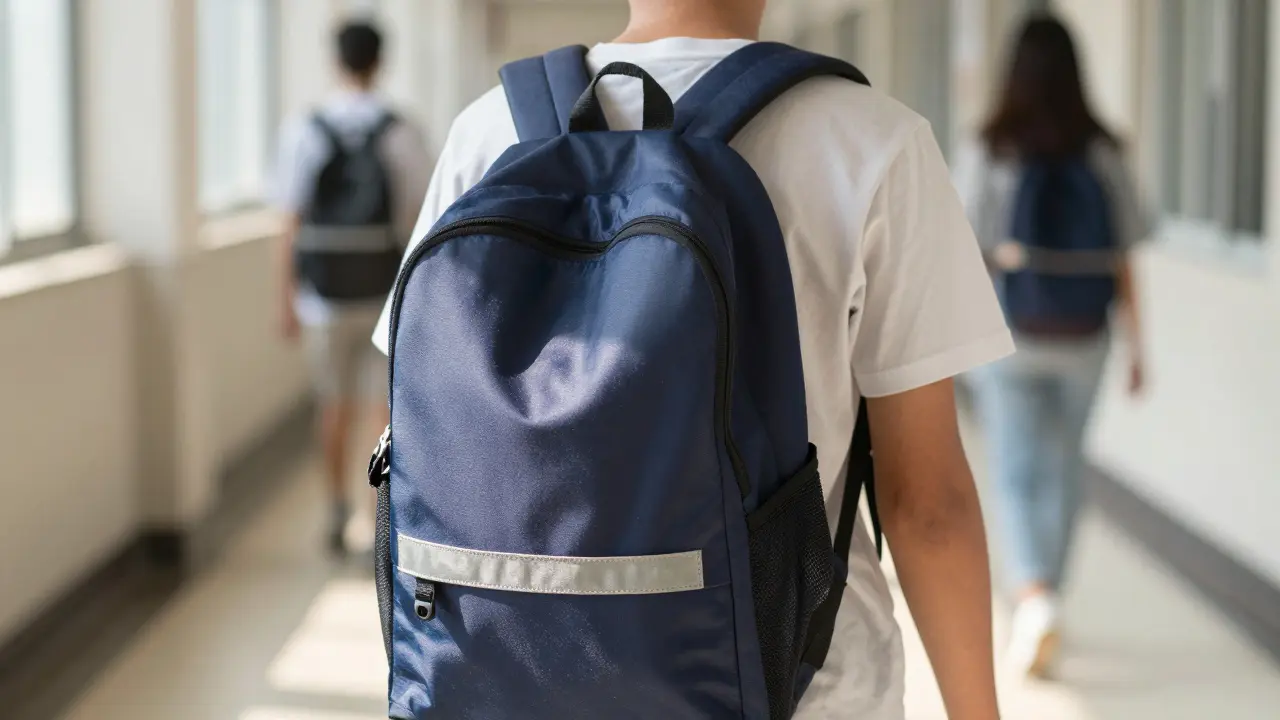
Backpack Design Matters Too
Not all backpacks are made equal. Look for these features:
- Padded, adjustable shoulder straps (wide is better)
- Waist belt
- Multiple compartments (keeps weight balanced)
- Lightweight material (avoid thick canvas if you can)
- Reflective strips (safety matters too)
Brands like Osprey, Deuter, and JanSport’s newer models all have designs built for teens. Avoid cheap, flimsy packs with thin straps or no padding. They might save you $10 at the store, but cost you in pain later.
Real-World Example: What Changed After the Fix
A 16-year-old from Buncombe County High School switched from a low-slung, one-strap carry to a properly adjusted two-strap pack with a waist belt. She’d been getting headaches and shoulder pain since freshman year. After three weeks of wearing it right, her pain dropped by 80%. Her grades didn’t change-but her focus did. She started raising her hand more. Her teacher noticed.
It wasn’t magic. It was physics.
Final Rule: Your Back, Your Responsibility
No one’s going to walk around checking if your backpack is in the right spot. You have to do it yourself. Every day. Just like brushing your teeth, it becomes a habit.
Ask yourself this before you leave home: Is my backpack resting where my body was built to carry weight? If the answer’s no, adjust it.
It’s not about looking cool. It’s about staying healthy, focused, and pain-free through four years of high school-and beyond.
Should I wear my backpack on one shoulder or both?
Always use both straps. Wearing a backpack on one shoulder forces your spine to bend sideways to balance the weight. This can lead to uneven muscle development, hip misalignment, and chronic pain. Even if one strap is loose, keep both on. Adjust the length so the pack sits centered on your back.
How heavy should my backpack be?
The American Academy of Pediatrics recommends your backpack shouldn’t weigh more than 10-15% of your body weight. For a 130-pound student, that’s about 13-20 pounds. If you’re carrying more, it’s time to clean out your bag, use your locker, or switch to digital textbooks.
Do I need a waist belt on my backpack?
Yes-if you carry more than 10 pounds daily. The waist belt shifts 30-40% of the weight from your shoulders and spine to your hips, which are much stronger and better designed to handle load. Even if your pack doesn’t come with one, you can buy an after-market belt for under $15.
My backpack feels fine, but my shoulders hurt. Why?
Pain doesn’t always mean the pack is too heavy. It could be too low, too wide, or not snug enough. If the straps are loose, the pack hangs away from your back, forcing your muscles to work harder to hold it in place. Tighten the straps so the pack stays close to your body. Also, check if the padding is worn out. Old padding loses its shape and stops distributing weight properly.
Can a bad backpack cause headaches?
Yes. When your backpack pulls your shoulders forward and your head juts out, it tightens the muscles at the base of your skull. This tension can trigger tension headaches. Students who report frequent headaches often improve after adjusting their backpack height and adding a waist belt. It’s not just stress-it’s posture.
poonam upadhyay
February 25, 2026 AT 18:33Okay but like… why are we even pretending this is a debate? My backpack’s been dragging my spine into a question mark since 8th grade, and I’m 17 now. I used to think it was just ‘bad posture’-turns out it was physics, baby. I adjusted it. Put on the damn hip belt. And suddenly? No more headaches. No more ‘I can’t breathe in third period.’ I’m not even trying to be dramatic-my teacher asked if I’d gotten a new personality. I just stopped being a human hunchback.
Also-side note-why do schools still sell those flimsy $12 backpacks with straps that look like they were made from fishing line? My last one had a strap that snapped mid-stairwell. I had to carry my laptop in my arms for two blocks. That’s not a backpack. That’s a death trap with a zipper.
And don’t get me started on the kids who wear it on one shoulder like they’re auditioning for a punk rock music video. Your spine isn’t a fashion statement. It’s your structural foundation. Treat it like it matters.
Shivam Mogha
February 26, 2026 AT 06:31Wear it high. Use both straps. Tighten the belt. Done.
mani kandan
February 27, 2026 AT 20:41It’s funny how something so simple gets ignored until it hurts. I remember my mom insisting I adjust my backpack every morning-back then I rolled my eyes. Now, at 22, I’m the one telling my younger cousins how to wear theirs. It’s not about being perfect. It’s about not breaking yourself before you even graduate.
The science here isn’t groundbreaking, but it’s necessary. Most teens don’t realize that their ‘just a little sore’ back is the quiet warning bell before real damage. And yeah, the waist belt? It’s not for hikers. It’s for kids carrying textbooks like they’re packing for a moon mission.
Also-props to the author for mentioning locker use. So many schools act like lockers are relics from the dial-up era. They’re not. They’re survival tools.
Rahul Borole
March 1, 2026 AT 03:10This is an exceptionally well-researched and clinically relevant piece. The data from the American Academy of Orthopaedic Surgeons is not only statistically significant but also actionable. The biomechanical principles outlined here align with established ergonomic literature on load distribution and spinal alignment.
It is imperative that educators, parents, and school administrators institutionalize backpack ergonomics as part of health education curricula. The long-term musculoskeletal consequences of poor backpack use are underreported, underfunded, and tragically preventable.
I urge every school district to consider mandatory backpack fitting sessions during orientation. The cost of intervention is negligible compared to the lifetime healthcare burden of chronic posture-related pain.
Sheetal Srivastava
March 1, 2026 AT 21:55Let’s be real-the real issue isn’t backpack height. It’s the systemic failure of educational infrastructure. Why are we asking 14-year-olds to carry 20 pounds of paper when digital access exists? Why are we forcing them to lug around 5 textbooks when 3 are obsolete? This isn’t a posture problem-it’s a capitalist education crisis wrapped in a nylon shell.
And don’t even get me started on the ‘waist belt’ recommendation. That’s a Band-Aid on a hemorrhage. If your school can’t afford to reduce load, maybe you should stop pretending you care about student wellbeing. The backpack is just the symptom. The disease is the curriculum.
Also, who approved this as a ‘science’ article? It’s ergonomic advice dressed in academic jargon. Where’s the peer review? The funding source? The conflict of interest disclosure?
Bhavishya Kumar
March 3, 2026 AT 20:48Correction: The study tracked 1200 students not 12000. Also ‘just below the neck’ is anatomically inaccurate. The cervical spine ends at C7. The ideal position is inferior to the scapular spine, not inferior to the neck. And ‘hunching your shoulders’ is not a compensation-it’s a scapular retraction pattern. Precision matters.
ujjwal fouzdar
March 4, 2026 AT 01:00What if… the backpack isn’t the problem? What if we’re the problem? We’re raised to believe that suffering is a rite of passage. That pain is proof you’re trying hard. That if your back aches, it means you’re worthy.
But what if… it’s not about wearing it higher? What if it’s about rejecting the system that makes you carry 20 pounds of dead trees just to prove you’re not lazy?
I wore my backpack low because I wanted to feel the weight. Because if I felt it, then I knew I was doing something real. If I didn’t feel it… then maybe I wasn’t doing enough.
Maybe the real question isn’t where to put the pack… but why we let schools make us carry so much in the first place.
Anand Pandit
March 4, 2026 AT 21:14Love this so much. I’m a PE teacher and I’ve been preaching this for years. I had a kid last year who came to me crying because her shoulders felt like they were on fire. We adjusted her pack together-hip belt on, straps tight, heaviest books closest to her back. Within a week she said she could finally sleep without waking up stiff. She started smiling more in class too.
It’s not magic. It’s just physics + a little care. And yeah, lockers exist for a reason. Use them. Don’t be a hero. Bring what you need for today, not for next week.
Also-get a backpack with padding. If your straps are digging into your shoulders, you’re doing it wrong. Your body doesn’t owe you pain.
Reshma Jose
March 6, 2026 AT 17:55I used to wear mine low because it looked cooler. Then I started getting these electric zaps down my arms. Turns out nerve compression. I thought I was just stressed. Nope. Backpack. Adjusted it. No more zaps. No more ‘I need to lie down after lunch.’ Also-waist belt changed my life. I didn’t even know mine had one until my mom yelled at me.
Stop being cool. Start being healthy. Your future self will thank you.
rahul shrimali
March 8, 2026 AT 04:43Both straps. Tight. High. Belt on. Done.
Eka Prabha
March 8, 2026 AT 10:02Let me guess-this was sponsored by Osprey. Who funded this study? Are we sure it wasn’t a marketing ploy disguised as public health? Because I’ve seen this exact ‘advice’ pop up right after a new backpack line dropped. And don’t even get me started on the ‘reflective strips’-that’s not safety, that’s corporate branding.
Also, why are we blaming the student? Why not fix the system? Why do we need 5 textbooks? Why can’t we just… not? This feels like victim-blaming wrapped in a padded shoulder strap.
And who decided ‘just above the waist’ is ideal? What if I’m 5’2”? What if I’m 6’0”? One size fits all? Classic.
Bharat Patel
March 10, 2026 AT 07:29There’s something quietly beautiful about how our bodies remember what they were designed for. We forget-until we hurt. The backpack isn’t just a bag. It’s a mirror. It shows us how much we’ve let the world weigh us down-not just with books, but with expectations.
Adjusting it isn’t about physics. It’s about reclaiming space. Space in your spine. Space in your breath. Space to just… be.
Maybe the real lesson here isn’t how to wear a backpack… but how to carry yourself.
Bhagyashri Zokarkar
March 10, 2026 AT 09:10i used to wear my backpack low because i thought it looked chill and then one day i couldnt lift my arm and i thought i was having a stroke or something and my mom took me to this weird physio lady who was like oh honey your backpack is dragging your spine into a pretzel and i was like wait what and she showed me this video of how your body reacts when the weight is too low and i cried because i realized i had been in pain for like two years and thought it was normal
now i use the waist belt and i dont even feel it anymore and i dont know why schools dont teach this like its basic life stuff like brushing your teeth or not touching your face when you have acne
also my backpack is from jansport and its 10 years old and the padding is gone but i still use it because i cant afford a new one and i feel bad but i guess i just need to accept that my back is gonna be ruined