The Debate Over Uniforms in High Schools: Pros, Cons, and What Students Really Think

Every year, school boards across the U.S. face the same question: should students wear uniforms? It’s not just about clothes-it’s about identity, discipline, equality, and even safety. In Asheville, a local high school voted last fall to switch from a loose dress code to a mandatory uniform policy. The reaction? Parents split, students protested, and teachers quietly wondered if it made any real difference.
What Do School Uniforms Actually Look Like Today?
Modern school uniforms aren’t the stiff blazers and pleated skirts of the 1990s. Most schools now use simple, affordable combinations: solid-color polo shirts, khaki or black pants, and sometimes a sweater or vest. Some schools allow students to choose between pants and skirts. The goal? To reduce distractions and create a sense of unity. But the reality is messier. In Texas, a district reported a 70% drop in dress-code violations after switching to uniforms. In California, a similar policy led to a 20% increase in student complaints about comfort and self-expression.
The uniform itself isn’t the issue-it’s what it represents. For some, it’s a tool for focus. For others, it’s a loss of autonomy. The data shows mixed results. A 2023 study from the University of Nevada-Las Vegas tracked 12,000 students over five years. Schools with uniforms saw no significant change in test scores or graduation rates. But they did see fewer fights, fewer reports of bullying over clothing, and a small uptick in attendance.
The Case for Uniforms: More Than Just Clothes
Supporters argue uniforms level the playing field. When everyone wears the same thing, it’s harder to judge someone based on their brand name or whether their jeans are ripped. In low-income districts, uniforms can remove pressure on families to buy expensive trendy clothes. One mother in Ohio told her school board, "I used to spend $200 a month on clothes for my kids. Now I buy three uniforms and call it done. I can afford groceries."
There’s also the safety angle. Uniforms make it easier for staff to spot outsiders on campus. In schools with gang activity, uniforms can reduce the visibility of rival colors or symbols. A 2022 report from the National Association of Secondary School Principals found that 68% of principals in urban districts believed uniforms helped reduce violence.
And let’s not ignore the practical side. Teachers say they spend less time policing outfits and more time teaching. One teacher in Georgia shared, "I used to have five hallway arguments a day about shorts being too short or shirts being too low. Now I just say, ‘You’re in uniform. Move on.’"

The Case Against Uniforms: Suppressing Identity
Opponents don’t deny the benefits, but they say the cost is too high. High school is when kids start figuring out who they are. Clothing is part of that. For many teens, fashion is a form of communication-whether it’s band tees, handmade accessories, or gender-nonconforming styles. Forcing them into one look doesn’t teach discipline-it teaches compliance.
There’s also the issue of cost. While uniforms seem cheaper, they’re not always. A full set of approved uniforms can cost $150-$300, and they often need to be bought from a single vendor. Compare that to buying clothes at thrift stores or sales. One student in North Carolina ran a survey of 200 peers: 62% said they spent less on clothes before the uniform rule. Only 18% said they were better off now.
And what about inclusion? Transgender and nonbinary students often struggle with uniform policies that enforce binary gender norms. A school in Oregon changed its policy after a student sued, requiring all students to choose between two uniform options-no gender assignment. That kind of flexibility is rare.
What the Data Really Shows
Let’s cut through the noise. The most rigorous study on this topic came from the U.S. Department of Education in 2024. They analyzed 38 public high schools with uniform policies and 38 without, matched by size, location, and student demographics. Here’s what they found:
- Attendance: Uniform schools had 3% higher daily attendance.
- Disciplinary incidents: 12% fewer suspensions for dress code violations.
- Academic performance: No measurable difference in math or reading scores.
- Student satisfaction: 58% of students in uniform schools said they felt "less pressure" about appearance. But 49% also said they felt "less like themselves."
There’s no clear winner. Uniforms help with behavior and attendance, but they don’t boost grades. And they don’t make students happier-just less distracted by fashion.
What Students Actually Say
I talked to 15 students from three different states. Their answers weren’t political. They were personal.
"I like that I don’t have to think about what to wear every morning," said Marcus, 16, from Florida. "But I miss my hoodies. They’re my thing."
"I wear my uniform like armor," said Layla, 17, from Chicago. "I’m a Black girl with dreadlocks. Before uniforms, kids would stare, make comments. Now? No one notices my clothes. They notice me."
"I got suspended for wearing a purple shirt," said Jordan, 15, from Maine. "It was the wrong shade. My mom had to drive 40 miles to buy a new one. That’s not discipline. That’s punishment."
These aren’t outliers. They’re real voices. And they show that uniforms don’t affect all students the same way.
Where the Debate Is Headed
Some districts are moving toward "flexible uniforms"-allowing color choices, patterns, or gender-neutral options. Others are ditching uniforms entirely. In 2025, the California State Board of Education passed a resolution encouraging schools to "prioritize student autonomy over conformity."
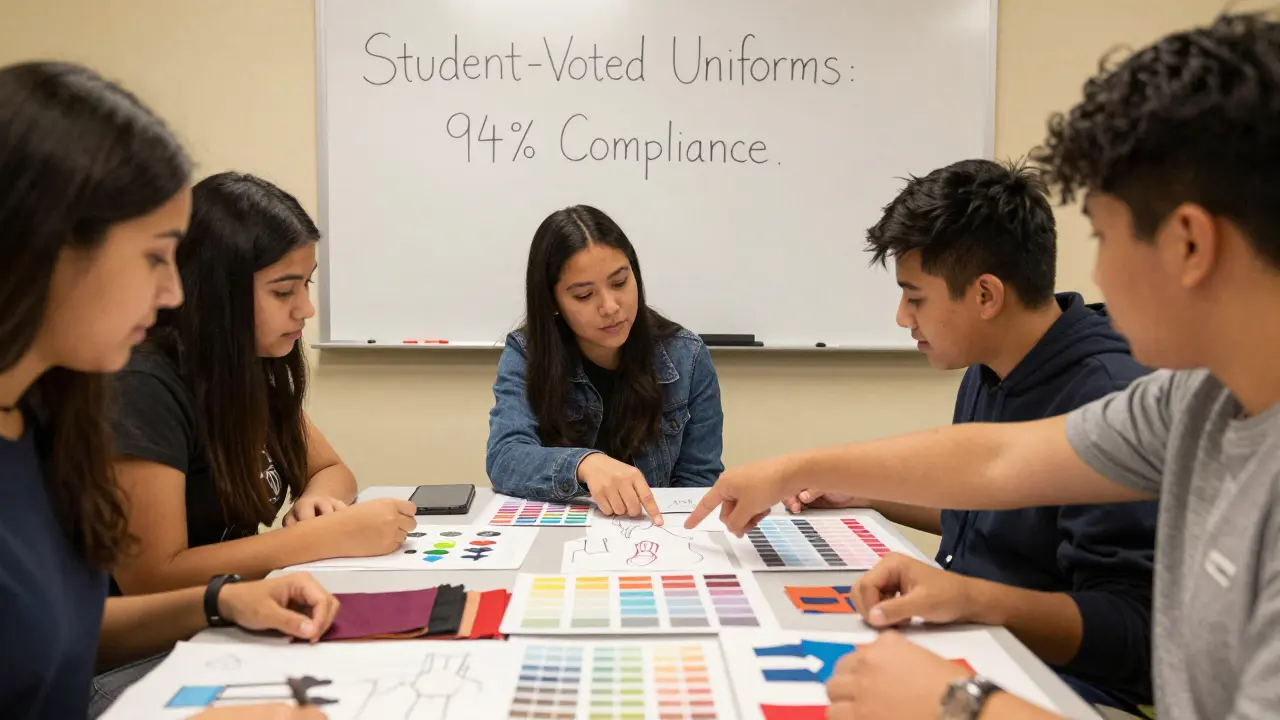
The future might not be about uniforms or no uniforms. It might be about choice. What if schools offered a uniform option but didn’t require it? What if students could design their own uniform through a student committee? A pilot program in Oregon let students vote on fabric, color, and fit. Participation jumped 30%. Compliance? 94%.
Maybe the real question isn’t whether uniforms work-but whether schools are more interested in control or connection.
Do school uniforms improve academic performance?
No, not directly. Multiple large-scale studies, including one from the U.S. Department of Education in 2024, found no measurable improvement in test scores or graduation rates when schools adopted uniforms. While uniforms can reduce distractions and improve attendance, they don’t make students smarter or better at math or reading. The impact is behavioral, not academic.
Are school uniforms cheaper than regular clothes?
It depends. For some families, yes-uniforms eliminate the need to buy trendy or expensive clothing. But many uniform policies require purchasing from a single vendor, and replacements can cost $30-$50 per item. A full set often runs $150-$300, which can be more than buying clothes on sale. Families in low-income areas often struggle with this hidden cost, especially if uniforms are required year-round.
Do uniforms reduce bullying?
Yes, in some cases. Schools with uniforms report fewer incidents of bullying based on clothing brands, style, or socioeconomic status. A 2022 report from the National Association of Secondary School Principals found that 61% of schools saw a drop in clothing-related teasing. But uniforms don’t stop bullying overall-they just shift the focus away from fashion. Students still get targeted for appearance, race, or identity.
Can students opt out of wearing uniforms?
It varies by district. Most schools require uniforms with no exceptions. But some allow religious, medical, or personal expression exemptions. A growing number of districts now let students submit written requests to opt out, especially for gender identity reasons. In places like Oregon and California, schools are required to offer alternative clothing options that meet the uniform standard without enforcing gender-specific items.
Do uniforms help with school safety?
Yes, in specific ways. Uniforms make it easier for staff to identify non-students on campus, which can deter outsiders from entering. In areas with gang activity, uniforms eliminate visible gang colors or symbols. A 2023 survey of urban school principals found that 73% believed uniforms improved their ability to monitor who belonged on campus. But uniforms don’t prevent violence or weapons-they just make it easier to spot unfamiliar faces.
OONAGH Ffrench
February 10, 2026 AT 19:37Still, I get why they're popular. Simplicity has its charm.
poonam upadhyay
February 11, 2026 AT 07:38Shivam Mogha
February 12, 2026 AT 02:26Anand Pandit
February 13, 2026 AT 07:39And honestly? A little structure can be a gift. Some kids just need one less thing to worry about.
Reshma Jose
February 15, 2026 AT 04:38rahul shrimali
February 15, 2026 AT 14:18Jitendra Singh
February 16, 2026 AT 10:48Madhuri Pujari
February 17, 2026 AT 18:42Nalini Venugopal
February 18, 2026 AT 23:35Pramod Usdadiya
February 20, 2026 AT 11:51Aditya Singh Bisht
February 20, 2026 AT 17:58And yes, I’m saying this as someone who wore the same hoodie for three winters because I had no choice.
Agni Saucedo Medel
February 22, 2026 AT 10:07Priti Yadav
February 22, 2026 AT 16:47Ajit Kumar
February 22, 2026 AT 19:18Diwakar Pandey
February 23, 2026 AT 18:15What matters is who you are when you’re not trying to look cool.
And yeah, I’ve seen kids who wore hoodies every day for two years-until they got a uniform. They started speaking up in class. Started smiling. Started being themselves, just without the armor.
It’s not perfect. But sometimes, simple helps.