What Does a Good High School Study Guide Look Like?
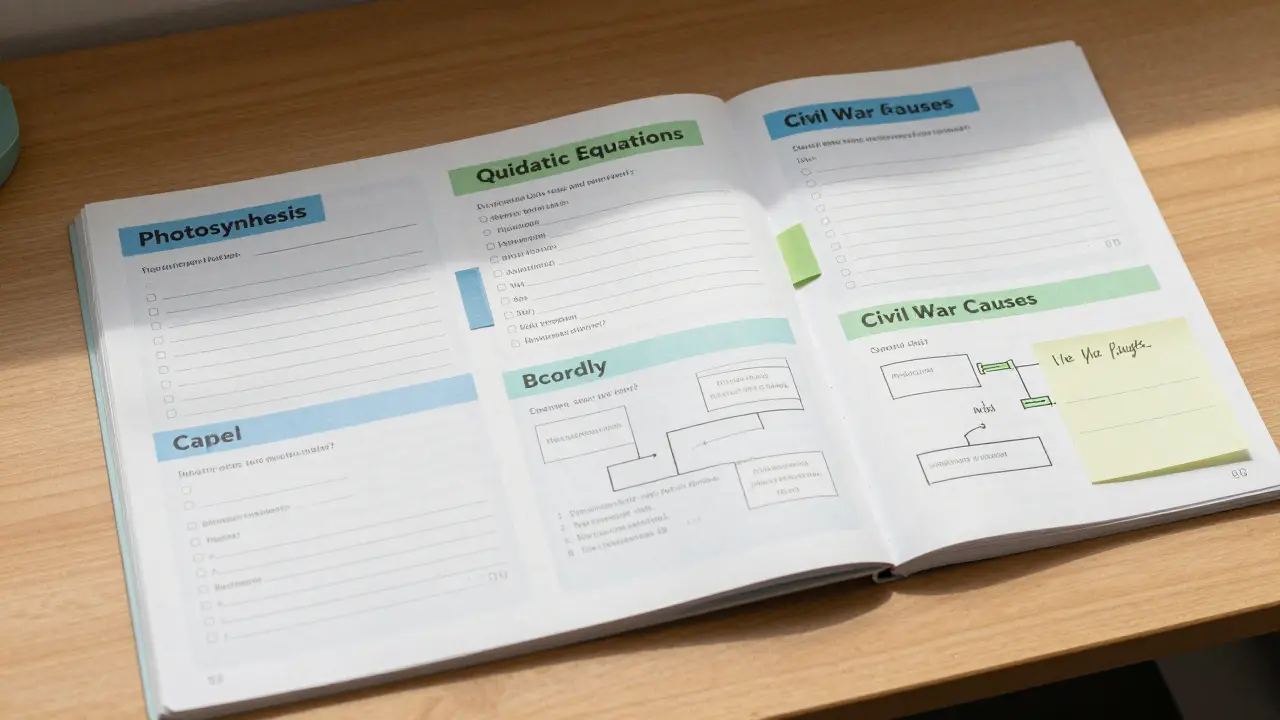
A good high school study guide doesn’t look like a textbook with 300 pages of tiny print. It doesn’t feel like a chore. It doesn’t make you want to close your laptop and nap. A real study guide is simple, clear, and built for your brain-not your teacher’s syllabus.
It’s organized by topic, not by chapter
Most textbooks group content by chapter number. That’s useless when you’re trying to study for a midterm. A good study guide flips that. It groups everything by topic-like ‘Photosynthesis’, ‘Quadratic Equations’, or ‘The Civil War Causes’. You don’t care that Chapter 5 covers three topics. You care that you need to know all three. A smart study guide cuts through the noise and puts related ideas together, even if they’re spread across different chapters.
For example, if you’re studying biology, you won’t find ‘Cell Structure’ in one section and ‘Cell Division’ in another. They’ll be side by side because they’re connected. This helps your brain see patterns instead of memorizing isolated facts.
It uses active recall, not passive highlighting
Highlighting your notes? That feels productive. But it’s not. Studies show it gives you the illusion of learning without actually building memory. A real study guide makes you test yourself. It doesn’t just tell you what to know-it asks you to remember it.
Look for these features:
- Blank spaces where you write answers before checking
- Flashcard-style questions at the end of each section
- Practice problems with space to work them out
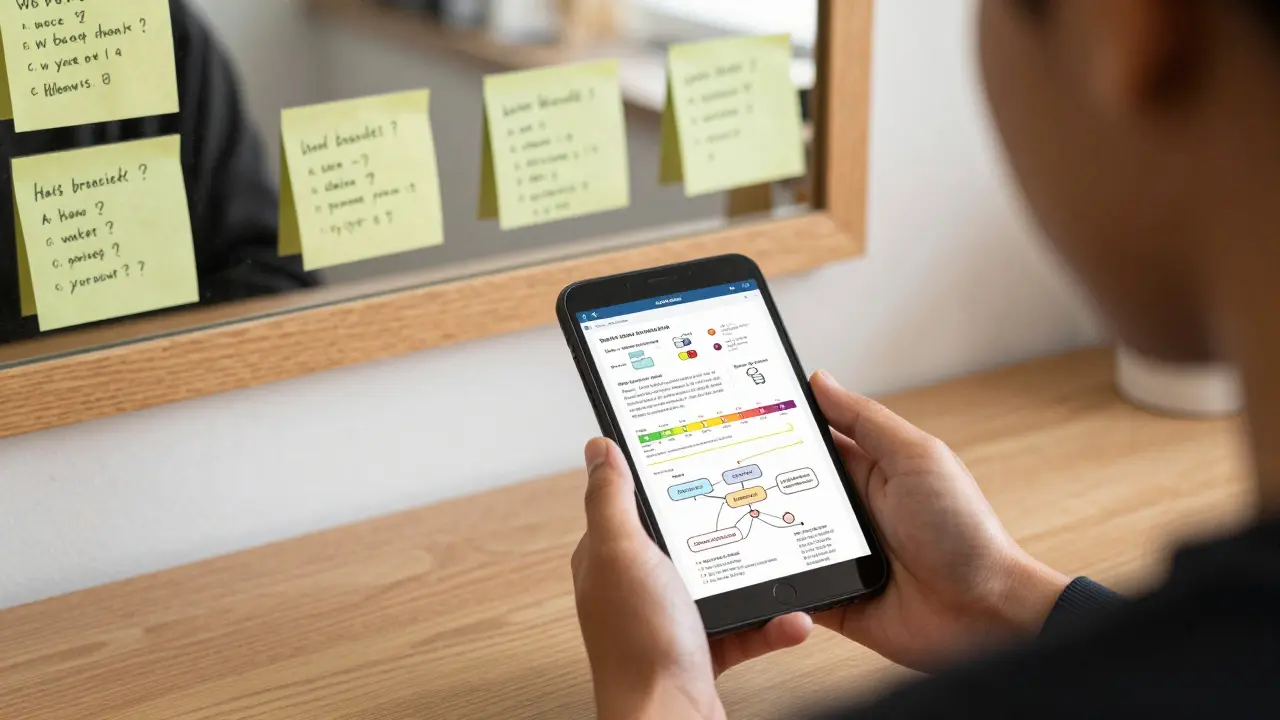
One student I talked to used to just reread her chemistry notes. Her grades stayed at C’s. Then she switched to a study guide with 10 questions per topic. She wrote answers on sticky notes, stuck them on her mirror, and tested herself every morning. In two weeks, her quiz scores jumped to A’s. She didn’t study more. She studied smarter.
It includes real examples, not just definitions
Definitions are easy to memorize. But exams don’t ask for definitions. They ask you to apply them. A good study guide doesn’t just say ‘Mitosis is cell division’. It shows you:
- A diagram of a cell going through each phase
- A real exam question: ‘Which stage shows chromosomes lining up in the center?’
- A common mistake: ‘Students confuse metaphase with anaphase because both involve movement’
When you see how a concept shows up in actual test questions, you stop guessing. You start recognizing patterns. That’s the difference between memorizing and understanding.
It’s visual, not just text-heavy
Your brain remembers images better than paragraphs. A study guide that’s all text is a waste of space. Good ones use:
- Simple flowcharts to show cause-and-effect (like how supply and demand affect prices)
- Color-coded timelines for history events
- Mind maps that connect themes across units
- Icons or symbols to flag key formulas or exceptions
Take math. A study guide that just lists the quadratic formula won’t help. But one that shows you:
- When to use the formula (only when factoring doesn’t work)
- How to spot a problem that requires it (quadratic = x²)
- What the answer means (x-intercepts of a parabola)
That’s useful. That sticks.
It highlights common mistakes and traps
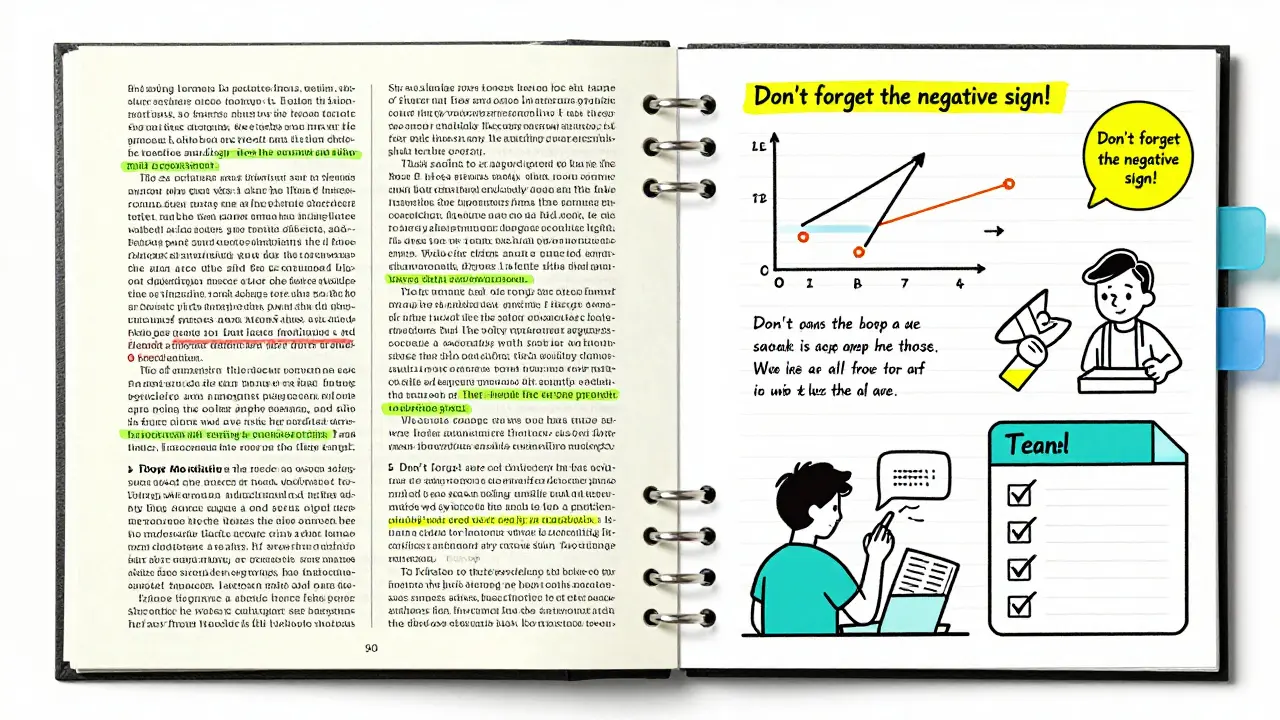
Teachers don’t always tell you what trips students up. A good study guide does. It says things like:
- ‘Don’t forget to distribute the negative sign in -(x - 5)’
- ‘Many students think the French Revolution started in 1789, but the real trigger was the Estates-General meeting in May’
- ‘Watch out-this equation looks like it has two solutions, but one is extraneous’
These aren’t random tips. They’re based on real student errors from past exams. When you know where you’re likely to slip up, you don’t just study harder-you study smarter.
It’s compact enough to use daily
If a study guide is 80 pages long, you won’t use it. You’ll leave it on your desk and feel guilty. A good one is 10-20 pages max. It’s designed for 15-20 minute review sessions, not all-nighters.
Think of it like a playlist: short tracks, high replay value. You open it on your phone during lunch. You flip through it on the bus. You quiz yourself while brushing your teeth. It’s not meant to be read cover to cover. It’s meant to be used.
It includes a self-check checklist
At the end, a strong study guide gives you a simple checklist:
- Can I explain this concept out loud without looking?
- Can I solve three practice problems without help?
- Can I spot a trick question on this topic?
This isn’t fluff. It’s your personal progress tracker. If you can’t answer ‘yes’ to all three, you haven’t mastered it yet. No guesswork. No ‘I think I got it.’ Just clear, measurable steps.
It’s updated for your current class
Not all study guides are created equal. Some are recycled from five years ago. Your teacher might have changed the focus. The exam format might be different. A good study guide matches your class exactly. Check the date. Look at the examples. Do they match what’s on your syllabus? If not, it’s outdated.
Ask your teacher: ‘What’s one topic most students struggle with this year?’ Then make sure your guide covers it.
It doesn’t try to do everything
Some guides claim to cover ‘everything you need for AP Biology’. That’s impossible. A good one focuses on what matters most: the big ideas, the high-weight topics, the questions that show up every year. It leaves out the obscure details your teacher rarely tests.
For example, if your history class spends 3 weeks on the Cold War but only 1 day on the Treaty of Versailles, your study guide should reflect that. Don’t waste time on low-yield topics. Focus on what moves the needle.
It’s made for you, not for the textbook
The best study guides aren’t written by professors. They’re written by students who’ve been there. They know what feels confusing. What feels like a trick. What’s actually on the test. That’s why student-made guides often beat official ones.
Don’t wait for someone else to make the perfect guide. Start building your own. Take your notes. Turn them into questions. Add diagrams. Mark the mistakes you keep making. That’s your real study guide-the one that works.
What’s the difference between a study guide and a textbook?
A textbook explains everything in detail, often in long paragraphs. A study guide cuts to the chase. It focuses on what you need to know for the test-key concepts, common mistakes, and practice questions. It’s designed for active review, not passive reading.
Can I use a study guide for group study sessions?
Yes. The best study guides are made for this. Quiz each other using the practice questions. Explain concepts out loud using the diagrams. Point out mistakes you’ve made. Group study works best when everyone has a clear, focused tool to work from.
Should I buy a study guide or make my own?
Start with a good one from a trusted source-like your teacher’s recommended guide or a popular student-made version. Then customize it. Add your own notes, mark the parts you struggle with, and turn explanations into questions. Your personalized version will be far more effective than any pre-made one.
How often should I use my study guide?
Use it daily for 15-20 minutes, not just before exams. Review one topic each day. Test yourself. Space out your practice. This builds long-term memory. Cramming from a guide the night before won’t stick.
What if my teacher doesn’t recommend a study guide?
That’s okay. Many teachers don’t provide them. Look for guides from reputable sources like Khan Academy, College Board (for AP), or student-run platforms like Quizlet. Then tailor them to your class. Match the topics to your syllabus and focus on what your teacher emphasizes.
Glenn Celaya
January 10, 2026 AT 07:26lol if you think a study guide needs to be visual or have flashcards you’ve never actually taken an AP exam
real study guides are one page of bullet points and a bunch of past FRQs
everything else is just content designed to keep you scrolling
saravana kumar
January 11, 2026 AT 23:32This is the kind of overengineered nonsense that makes students lazy. You don’t need color-coded timelines or mind maps. You need to read the textbook, memorize the key terms, and drill past papers. All this ‘brain-friendly’ jargon is just marketing for overpriced PDFs. Real learning is boring. Get used to it.
Tamil selvan
January 13, 2026 AT 08:41I appreciate the structure and thoughtfulness behind this guide - truly, these are the principles that make studying effective. The emphasis on active recall and mistake analysis is not just helpful, it’s essential. Many students overlook the psychological aspect of learning, and this piece reminds us that retention is not about volume, but about intentionality. I’ve seen students transform their grades simply by adopting these habits, even without expensive resources. Thank you for articulating this so clearly.
Mark Brantner
January 13, 2026 AT 08:46so you’re telling me the secret to acing high school is… not being a robot? wow. groundbreaking. next you’ll tell me breathing helps with running
but honestly? yes. this is the first study guide advice that doesn’t sound like it was written by a textbook company’s intern who got paid in free snacks
also i used sticky notes on my mirror and now my roommate thinks i’m possessed. worth it.
Kate Tran
January 15, 2026 AT 03:28the part about compact guides really hit home - i used to print 50-page pdfs and then never open them. now i keep a 12-page google doc on my phone and review it while waiting for the bus. game changer.
also, the checklist at the end? i started using that and realized i thought i knew half the stuff but couldn’t explain it out loud. yikes.
amber hopman
January 17, 2026 AT 01:12100% agree with the ‘made for you, not the textbook’ point. i took a guide from a Reddit thread last year, added my teacher’s exact phrasing from class notes, highlighted the mistakes i kept making, and turned it into a quizlet set. my grade went from a B- to an A in two weeks. it’s not about the guide - it’s about making it yours.
Jim Sonntag
January 17, 2026 AT 17:01the fact that this guide mentions ‘common mistakes’ is honestly the most useful thing i’ve read all year
my chem teacher never told me that forgetting to balance charges in ionic compounds was a trap - but some random guy on Reddit did
and now i’m the only one in class who doesn’t lose 5 points on every test
also i’m now convinced that study guides should come with a ‘this is what your teacher doesn’t want you to know’ label
Deepak Sungra
January 19, 2026 AT 04:34bro i made a study guide last semester and it was literally just me screaming into a voice recorder while flipping through my notes
then i turned it into a podcast and played it while i walked to class
my friends thought i was crazy but i got an A+
also i cried once during the ‘mitosis’ part and now it’s permanently stuck in my brain
you don’t need fancy charts - you need emotional investment
Samar Omar
January 20, 2026 AT 20:46It’s astonishing, truly astonishing, how the modern educational ecosystem has been so thoroughly corrupted by superficial pedagogical trends - as if learning were a TikTok trend rather than an intellectual discipline. The obsession with ‘visuals,’ ‘mind maps,’ and ‘sticky notes’ betrays a fundamental misunderstanding of cognition. True mastery requires rigorous, disciplined engagement with primary material - not distraction through color-coded diagrams and performative self-testing rituals. The real study guide? A well-worn textbook, a pencil, and the humility to sit with discomfort for hours. Everything else is aestheticism masquerading as efficiency. I’ve tutored students for a decade - none of them ever improved because of a ‘guide.’ They improved because they stopped looking for shortcuts and started doing the work.