What Does 'Guided Study' Mean for High School Students?

Ever sat down to study for a biology test, opened your textbook, and just stared at the same page for 20 minutes? You know you need to learn it, but nothing sticks. That’s where guided study comes in. It’s not magic. It’s not a fancy app or a tutor sitting over your shoulder. Guided study is a simple, proven way to turn chaos into clarity when you’re trying to learn on your own.
What Guided Study Actually Looks Like
Guided study means following a clear plan made for you - not by you. Think of it like a GPS for your brain. Instead of wandering through chapters randomly, you’re given a route: what to read, what to write down, what to test yourself on, and when to take a break. High school study guides that offer guided study usually break big topics into small chunks. For example, instead of saying "Study Chapter 5: Cell Biology," a guided study guide says: "Read pages 112-115. Write out the parts of a plant cell. Draw and label them. Then answer questions 1-5 on page 116. Quiz yourself using the flashcards on page 118. Take a 5-minute walk. Come back and try explaining it out loud without looking."
This isn’t just busywork. It’s designed to match how your brain learns best. Research from the University of Chicago shows that students who use structured study guides improve retention by up to 40% compared to those who just reread notes. Why? Because guided study forces you to engage, not just absorb.
How It’s Different from Regular Studying
Regular studying? You open your notebook. You read. You maybe highlight something. You close it. You feel like you did something - but the next day, you remember almost nothing.
Guided study is different. It’s active. It’s intentional. It tells you exactly what to do next. Here’s the breakdown:
- Regular studying: "I’ll study history." → You open the book. Get distracted by your phone. Read three paragraphs. Stop.
- Guided study: "Read section 3.2. Summarize the causes of the Civil War in three bullet points. Compare them to the causes of the Revolutionary War using the chart on page 89. Write one question you’d ask your teacher tomorrow. Set a timer for 25 minutes. Stop when it beeps."
The second version doesn’t leave room for procrastination. It removes the guesswork. That’s the whole point.
Why High School Students Need It
High school is the first time most students are expected to manage their own learning without constant supervision. Teachers assign homework. You’re told to "study for the test." But no one shows you how. That’s a setup for frustration.
Guided study fills that gap. It’s especially helpful for:
- Students who feel overwhelmed by big projects or exams
- Those who don’t know where to start
- People who study for hours but still get low grades
- Anyone who thinks they’re "bad at studying" - they just haven’t been shown how
It’s not about being smart. It’s about having a system. A 2023 study of 1,200 U.S. high schoolers found that those using guided study guides scored 18% higher on end-of-unit tests than peers who didn’t - even if they studied the same amount of time.

What Makes a Good Guided Study Guide
Not all study guides are created equal. A good one doesn’t just list facts. It leads you through the learning process. Here’s what to look for:
- Step-by-step tasks: Each section should say exactly what to do next - read, write, draw, explain, quiz.
- Self-check points: After each chunk, there should be a quick way to test yourself - a question, a matching exercise, a fill-in-the-blank.
- Time estimates: "Spend 15 minutes here," "Take a 10-minute break after this." It helps you pace yourself.
- Real examples: Not just textbook definitions. Real-world connections. Like how photosynthesis relates to your morning smoothie.
- Space to write: If it’s a printed guide, there should be room to take notes. If it’s digital, it should prompt you to type or record answers.
Bad study guides just copy-paste textbook content. Good ones act like a coach whispering in your ear: "Try this. Now do that. Did it stick? Let’s check."
How to Use Guided Study Guides Effectively
Having a guide won’t help if you just flip through it. Here’s how to actually use one:
- Block out time: Don’t wait until the night before the test. Pick 30-45 minutes, 3-4 times a week.
- Work in silence: Put your phone in another room. No music with lyrics. Just quiet.
- Follow the steps: Don’t skip to the answers. Do the writing. Do the drawing. Do the explaining out loud.
- Review mistakes: If you get a self-check question wrong, go back. Don’t just mark it and move on.
- Teach it: After each session, explain what you learned to someone - even if it’s your pet or a mirror.
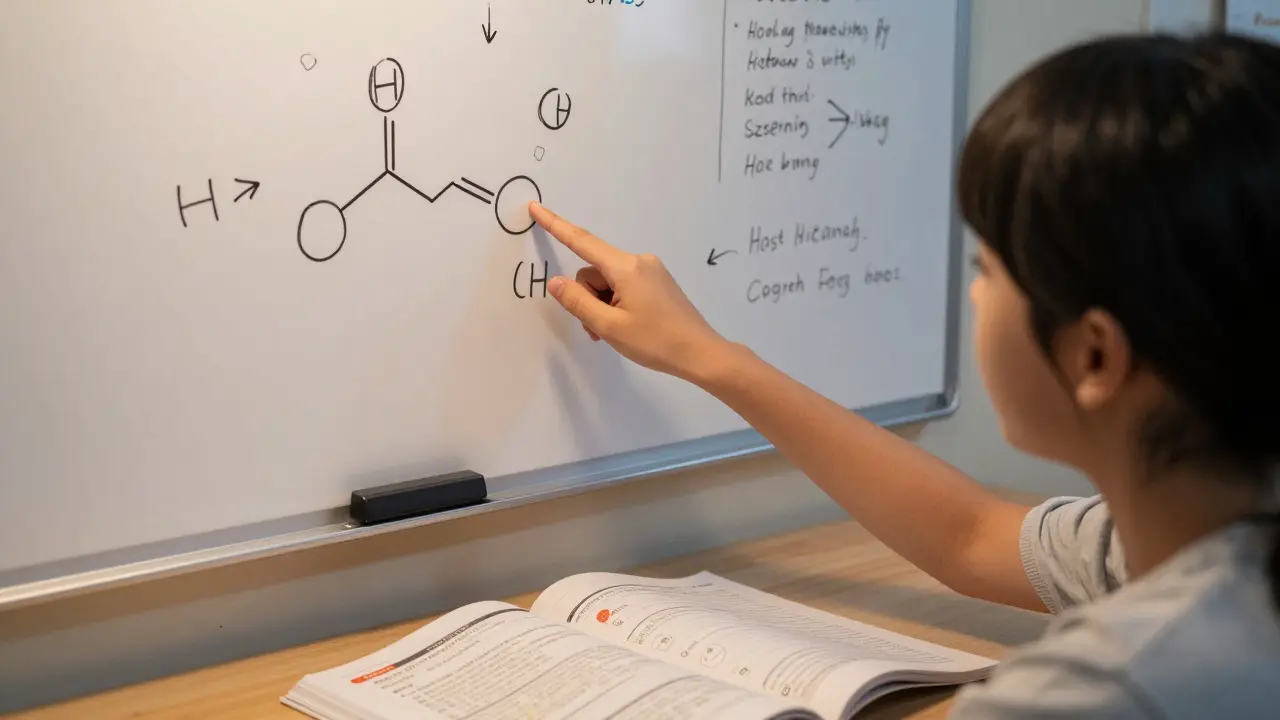
One student in Asheville told me she used a guided study guide for chemistry. She started by skipping the "draw the molecule" part because it felt silly. But when she finally did it, she finally understood why oxygen bonds the way it does. That drawing became her go-to memory trick for the final exam.
Where to Find Good Guided Study Guides
You don’t need to pay for them. Many free, high-quality ones are made by teachers and school districts. Check:
- Your school’s website - look under "Academic Resources" or "Student Support"
- Your state’s Department of Education site - they often publish study guides aligned to state standards
- Public libraries - many offer free access to platforms like Khan Academy or Quizlet with guided study paths
- YouTube channels like Crash Course or Amoeba Sisters - they have structured video lessons that act like guided study
Avoid guides that are just lists of flashcards or 50-page PDFs with no direction. If it doesn’t tell you what to do next, it’s not guided study.
What Guided Study Can’t Do
It’s not a miracle cure. If you’re struggling with a concept because the teacher explained it poorly, a guide won’t fix that. It won’t replace asking questions. It won’t help if you’re sleep-deprived or stressed out.
Guided study is a tool. It works best when you’re ready to use it. You still need to show up. You still need to try. But now, you’re not guessing how.
Start Small. Build the Habit.
You don’t need to overhaul your whole study routine. Pick one subject - maybe the one you dread the most. Grab a guided study guide for it. Spend 20 minutes this week following one section exactly as written. Then ask yourself: Did it feel easier? Did you remember more? If yes, do it again next week.
Guided study doesn’t make you smarter. It just makes your brain work better. And that’s enough to change your grades - and your confidence.
Is guided study the same as tutoring?
No. Tutoring is one-on-one help from a person who answers your questions in real time. Guided study is a self-paced system that gives you clear steps to follow on your own. You can use both - tutoring to clear up confusion, and guided study to practice and reinforce.
Can guided study help with standardized tests like the SAT or ACT?
Yes. Many SAT and ACT prep books are built on guided study principles. They break down each section - reading, math, writing - into daily tasks with practice questions, timing drills, and error logs. The key is following the plan, not just doing random practice tests.
Do I need to buy guided study guides?
No. Many free, high-quality guides are available from your school, public library, or state education websites. Paid guides aren’t better - they’re just marketed better. Look for ones that include step-by-step tasks, not just summaries.
What if I don’t like following a strict plan?
That’s normal. But the point isn’t to be rigid - it’s to stop spinning your wheels. Start with just one subject. Try one 20-minute session. You might find that having a plan actually gives you more freedom - because you’re not wasting time wondering what to do next.
How long does it take to see results with guided study?
Most students notice a difference after two to three weeks of consistent use - even just 30 minutes a few times a week. You’ll start remembering more, feeling less anxious before tests, and needing less last-minute cramming.
Anand Pandit
January 8, 2026 AT 07:37This is exactly what I needed. I used to waste hours staring at my notes and still failing tests. Then I started using a guided study sheet for chemistry - step by step, no guessing. I actually remembered the periodic table trends for the final. No magic, just structure.
Try it with one subject first. Even 20 minutes a day makes a difference. You don’t have to be perfect, just consistent.
Reshma Jose
January 10, 2026 AT 03:59I tried this last semester for biology and it changed everything. I used to think I was just bad at studying, but turns out I was just never told how. The part about explaining it out loud? I did that to my cat. He didn’t care, but I finally got it.
Also, the free guides from our state education site? Way better than the paid ones. Stop spending money on flashy apps - your school already gave you the tools.
rahul shrimali
January 11, 2026 AT 04:52Stop overthinking it. Read write quiz walk repeat. That’s it. No apps no tutors no stress. Just do the steps. I went from D to B in math in 3 weeks. Simple works.
Trust the process. Your brain will thank you.
Eka Prabha
January 12, 2026 AT 01:51Let’s be honest - this is just institutionalized compliance dressed up as learning. The system doesn’t want you to think critically. It wants you to follow instructions. Step-by-step guides are designed to produce obedient test-takers, not independent learners.
And don’t get me started on the ‘free’ guides. They’re all aligned to standardized testing agendas. The real curriculum is being stripped away in favor of robotic recall. You’re being trained, not educated.
Real learning is messy. It’s questioning. It’s arguing. It’s not ticking boxes on a worksheet. This is pedagogy as behavioral conditioning. And the worst part? You’ll thank them for it.
Bharat Patel
January 12, 2026 AT 02:29There’s something deeply human about this. We’re not machines, but we’ve been taught to treat learning like one. We think if we just read more, we’ll understand more. But understanding isn’t about volume - it’s about rhythm.
Guided study isn’t about following rules. It’s about giving your mind permission to breathe between tasks. The breaks. The drawing. The talking out loud. Those aren’t distractions - they’re the moments your brain integrates.
It’s like meditation for the intellect. You’re not cramming facts. You’re creating pathways. And that’s why it works.
Maybe the real miracle isn’t the guide. It’s that someone finally gave us permission to learn slowly.
Rajat Patil
January 13, 2026 AT 00:53I appreciate how this post doesn’t pretend to be a cure-all. It acknowledges that guided study is a tool, not a miracle. And that’s important.
Many students feel broken because they struggle to study on their own. But the problem isn’t them. It’s that no one ever taught them how to learn. This is a gentle, practical way to fix that.
Thank you for writing this with so much care. It feels like someone finally saw us.
deepak srinivasa
January 13, 2026 AT 01:56Wait - if guided study works so well, why isn’t it taught in every classroom? Why do we have to find these guides ourselves? Shouldn’t schools be building this into the curriculum from day one?
Also, what about students with ADHD or dyslexia? Do these guides account for different learning styles? Or is it still a one-size-fits-all approach?
I’m curious if anyone’s adapted these methods for neurodivergent learners. I’d love to see examples.
pk Pk
January 13, 2026 AT 21:07To the person who said this is just compliance - chill. You’re overcomplicating it.
For most students, the problem isn’t that they’re being conditioned. The problem is they’re lost. They don’t know where to start. This gives them a map.
I’ve mentored 12 kids this year. Nine of them were on the verge of dropping out. Three of them used guided study for the first time. All three passed their finals. One even started helping his sister.
You don’t need to revolutionize education to make a difference. Sometimes you just need to give someone a clear next step.
So if you’re reading this and you’re stuck - try it. Just one subject. Twenty minutes. No pressure. You’ve got nothing to lose and everything to gain.