What Is a Good Size for a High School Backpack?
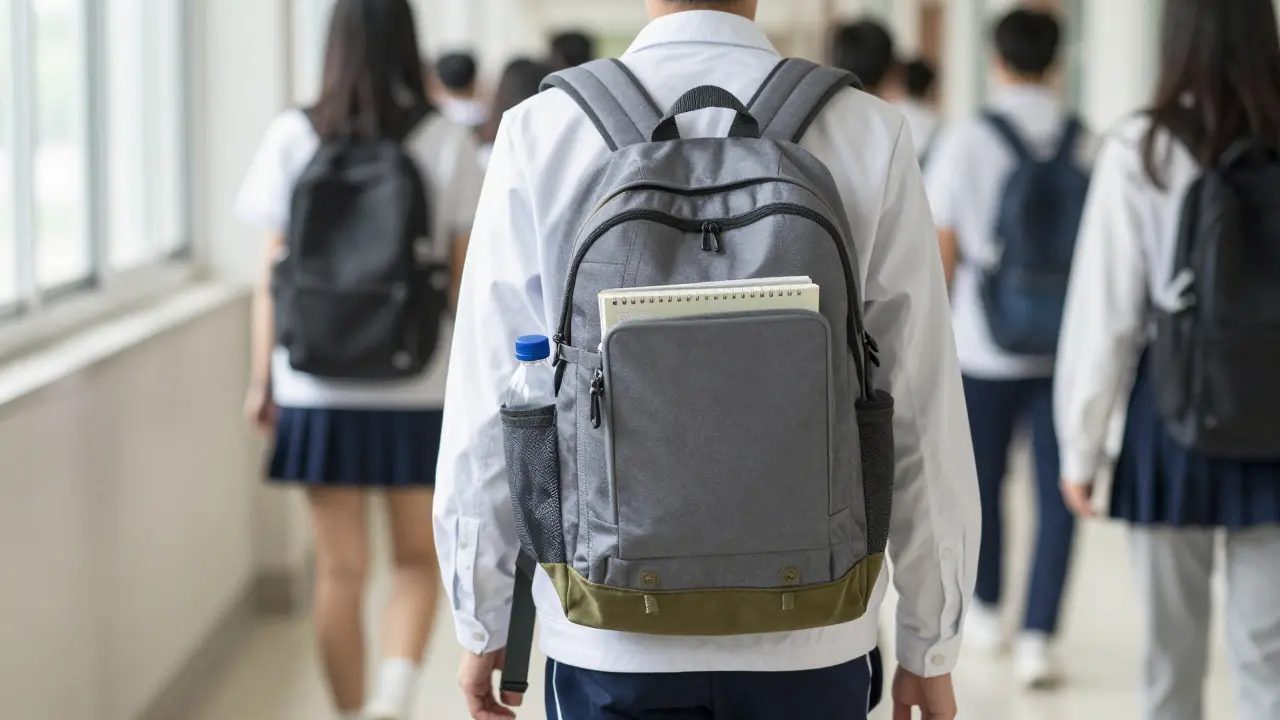
Every year, thousands of high school students drag heavy, awkward backpacks through hallways, up stairs, and onto buses-all because they picked the wrong size. It’s not about looking cool or matching the latest trend. It’s about comfort, health, and getting through the day without aching shoulders or a sore back. So what good size for a high school backpack actually is? Let’s cut through the noise and give you straight numbers, real-world examples, and what actually works.
How Much Should a Backpack Hold?
A good high school backpack should hold between 20 and 30 liters. That’s the sweet spot. Anything smaller than 20 liters won’t fit your textbooks, binders, laptop, lunch, and extra layers. Anything bigger than 30 liters? You’re just inviting overload. Studies from the American Academy of Pediatrics show that students who carry backpacks over 10% of their body weight are at higher risk for back pain and posture problems. For a typical 130-pound student, that’s just 13 pounds. A 30-liter backpack filled with five textbooks, a 4-pound laptop, a water bottle, and a hoodie can easily hit that limit-especially if you’re packing snacks, gym clothes, and a full set of art supplies.
Most backpacks labeled "25L" or "28L" are designed with this in mind. Brands like JanSport, Herschel, and North Face make models that hit this range. Look at the product specs: if it says "capacity: 27L," that’s your target. Don’t be fooled by big-looking packs with empty space inside. The real test is how much you can fit without overstuffing.
What Dimensions Work Best?
Size isn’t just about liters-it’s about shape. A backpack that’s too tall or too wide can throw off your balance. The ideal dimensions for a high school backpack are:
- Height: 15 to 18 inches (fits between shoulder blades and waist)
- Width: 10 to 12 inches (narrow enough to fit through doorways and lockers)
- Depth: 7 to 9 inches (deep enough for books, not so deep it bulges out)
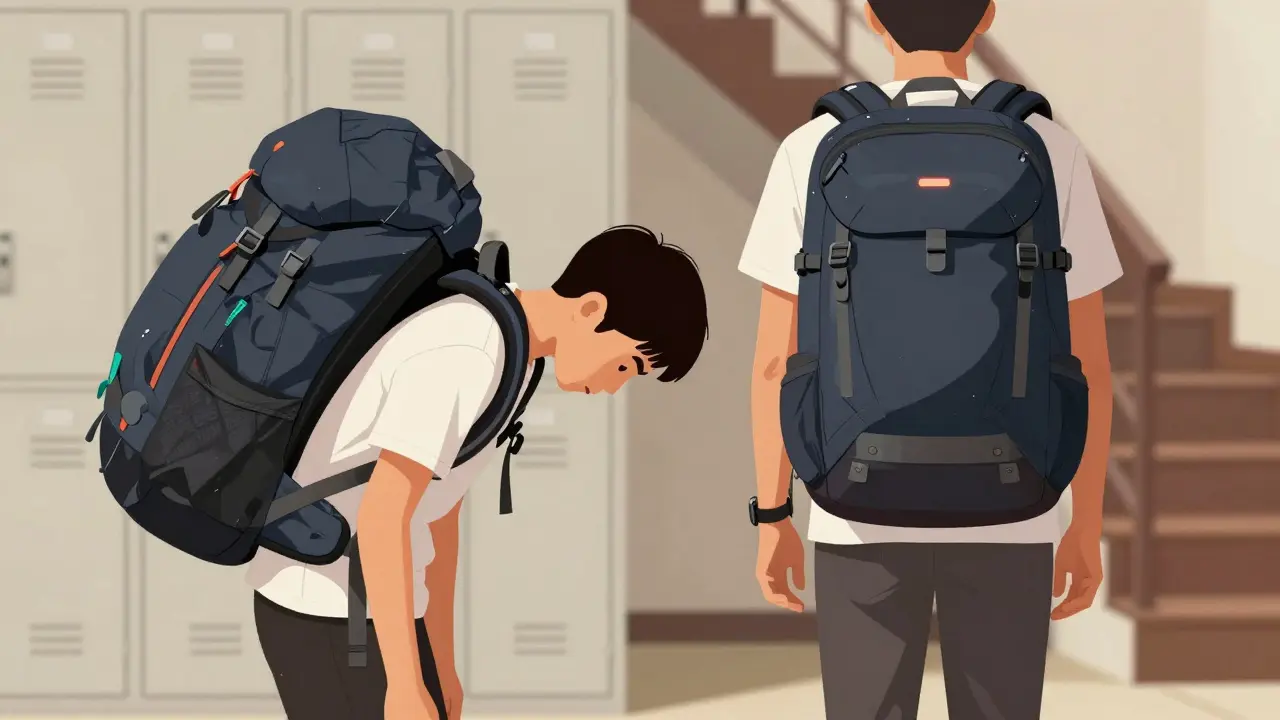
Why does this matter? A backpack that’s too wide forces you to lean forward to compensate. A backpack that’s too tall pushes your center of gravity upward, making you feel top-heavy. The right shape keeps the weight centered on your back, close to your spine. That’s the key to avoiding strain.
Weight Matters More Than You Think
Here’s a hard truth: a 30-liter backpack is useless if you’re stuffing it with 20 pounds of stuff. Schools don’t help-they still expect students to carry heavy textbooks, even when digital options exist. But you can control what goes in.
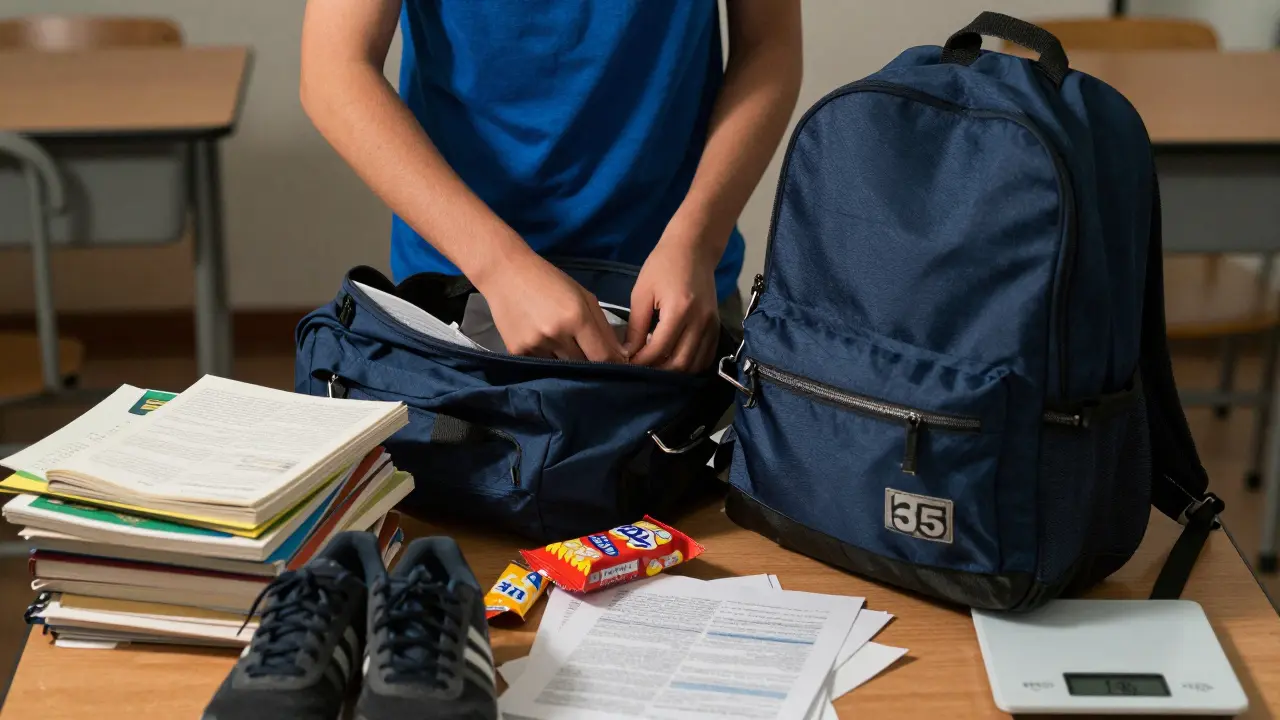
Try this: every night, empty your backpack. Put only what you need for tomorrow in it. Leave behind:
- Extra notebooks you won’t use
- Old homework
- That second pair of shoes
- Snacks you didn’t eat
Most students carry 3-5 pounds more than they need. That’s like carrying a full gallon of milk every day. Over five days, that’s 75 extra pounds. Your spine doesn’t care if it’s "just a little extra." It feels every pound.
Features That Actually Help
Size isn’t everything. A well-designed backpack makes a difference. Look for these features:
- Padded shoulder straps: At least 2 inches wide. Thin straps dig into your shoulders.
- Waist and chest straps: These aren’t for show. They transfer weight from your shoulders to your hips, reducing strain by up to 40%.
- Multiple compartments: A separate laptop sleeve keeps your tech safe and helps balance weight. A front pocket for pens and phone keeps you from digging through your whole bag.
- Water-resistant material: Rain, spills, gym clothes-it all adds up. A waterproof coating or DWR finish saves you from soggy books.
- Back padding: A ventilated mesh back panel reduces sweating and keeps the pack from pressing directly into your spine.
Don’t waste money on flashy designs or LED lights. Focus on function. A simple, sturdy backpack lasts years. A trendy one with thin straps? You’ll be replacing it by sophomore year.
What About Rolling Backpacks?
You’ve seen them-big wheeled bags that look like suitcases. They seem like the perfect solution. But they’re not.
Rolling backpacks are heavy themselves (often 4-6 pounds empty), awkward on stairs, and banned in many schools because they block hallways. They also encourage overpacking since you can roll 40 pounds without feeling it. And if you’re in a school without elevators or ramps? You’re stuck carrying it anyway.
Unless your school is flat, has wide hallways, and allows wheels, skip them. A well-fitted, properly loaded traditional backpack is safer and more practical.
Real-World Examples
Here’s what works for real students:
- Emma, 15: Carries 4 textbooks, Chromebook, lunch, water bottle, and a hoodie. Uses a Herschel Settlement a 25L backpack with padded straps and a ventilated back panel. Weight: 11 pounds. No complaints.
- Jamal, 16: Takes honors classes. Carries 5 hardcover books, lab notebook, laptop, and a full set of art supplies. Uses a North Face Borealis a 28L pack with waist strap and durable fabric. Weight: 13 pounds. Uses the waist strap daily.
- Taylor, 14: Switched from a 40L bag to a 25L one. Dropped 5 pounds of unnecessary junk. Back pain went away in two weeks.
These aren’t lucky breaks. They’re smart choices based on real needs, not trends.
What to Avoid
Don’t fall for these common mistakes:
- Buying a backpack based on color or brand name. A $120 backpack with a logo doesn’t mean it’s better than a $50 one with better padding.
- Choosing a backpack that "grows" with you. If it’s too big now, it’ll be too heavy later. Stick to 20-30L.
- Ignoring weight distribution. Putting heavy books on top makes you lean forward. Keep them low and centered.
- Using one strap. Always wear both. Carrying on one side causes muscle imbalance.
Final Rule of Thumb
Here’s the simplest way to know if your backpack is the right size: Can you walk through the hallway without leaning forward or swaying? Can you sit down in class without the pack digging into your lower back? Can you lift it into a locker without straining?
If the answer is yes to all three, you’ve got it right. If not, it’s too big, too heavy, or poorly designed. Don’t wait until your shoulders ache. Choose wisely now.
Is a 20L backpack too small for high school?
A 20L backpack is the minimum for most high school students, but it’s tight. It works if you only carry a laptop, one textbook, a notebook, and lunch. But if you have heavy books, gym clothes, or multiple classes with supplies, you’ll be crammed. For most students, 25L-30L is safer.
Should I get a backpack with wheels?
Generally, no. Rolling backpacks are heavier, harder to use on stairs, and often banned. They also encourage overpacking. Unless your school is flat, has elevators, and allows wheels, a traditional backpack with good straps is better for your posture and mobility.
How do I know if my backpack is too heavy?
Weigh your backpack. If it’s more than 10% of your body weight, it’s too heavy. For example, if you weigh 130 pounds, your pack shouldn’t exceed 13 pounds. Also, if you feel pain in your shoulders, neck, or back after school, or if you’re leaning forward to balance it, it’s time to lighten up.
Do I need a laptop sleeve?
Yes, if you carry a laptop or tablet. A padded, separate sleeve protects your device and helps balance weight. Without it, your laptop can shift and press into your back, making the pack feel heavier and less stable.
What’s the best material for a high school backpack?
Look for durable polyester or nylon with a water-resistant coating. Canvas is stylish but heavy and doesn’t repel moisture. Avoid thin, flimsy fabrics-they tear easily. Brands like JanSport and Herschel use materials that last through years of daily use.
Jess Ciro
February 18, 2026 AT 07:51saravana kumar
February 18, 2026 AT 11:06Samar Omar
February 19, 2026 AT 14:11chioma okwara
February 21, 2026 AT 05:42John Fox
February 22, 2026 AT 17:45Tasha Hernandez
February 22, 2026 AT 17:49Anuj Kumar
February 23, 2026 AT 05:40Christina Morgan
February 23, 2026 AT 10:43Kathy Yip
February 24, 2026 AT 09:54Bridget Kutsche
February 26, 2026 AT 03:26