Why High Schools Must Teach Financial Literacy

Every year, thousands of high school graduates walk out of their classrooms with diplomas in hand-but no idea how to pay a bill, avoid credit card debt, or save for an emergency. It’s not because they’re lazy or careless. It’s because no one ever taught them. Schools pour hours into algebra, history, and literature, but when it comes to money-something every adult will face every single day-there’s often silence. That needs to change.
Financial literacy isn’t optional-it’s survival
Think about the last time you had to split a restaurant bill, choose a bank account, or figure out why your car insurance went up. Now imagine you’re 18, just got your first paycheck, and have zero experience handling any of that. That’s the reality for most teens. A 2024 study from the National Endowment for Financial Education found that only 24% of U.S. millennials showed basic financial literacy. That’s not a generational flaw-it’s a system failure. High schools are the last place where nearly all teens are gathered under one roof. If we don’t teach them how to manage money here, when will we?
It’s not about turning students into stock traders. It’s about teaching them how to avoid the traps that sink so many young adults: payday loans, maxed-out credit cards, and rent that eats half their paycheck. One 19-year-old from Phoenix told a local news reporter she didn’t know what APR meant until she got a credit card offer in the mail and ended up owing $1,200 in interest after six months. That’s not a mistake-it’s a curriculum gap.
What financial literacy actually looks like in class
Some schools try to cover this with a single 10-minute lesson on saving. That’s like teaching someone to drive by showing them a picture of a steering wheel. Real financial literacy in high school means hands-on learning:
- Creating a monthly budget using real numbers: rent, groceries, phone bills, public transit
- Comparing bank accounts-what fees actually mean, how interest compounds, why overdrafts are dangerous
- Understanding pay stubs: taxes, Social Security, health insurance deductions
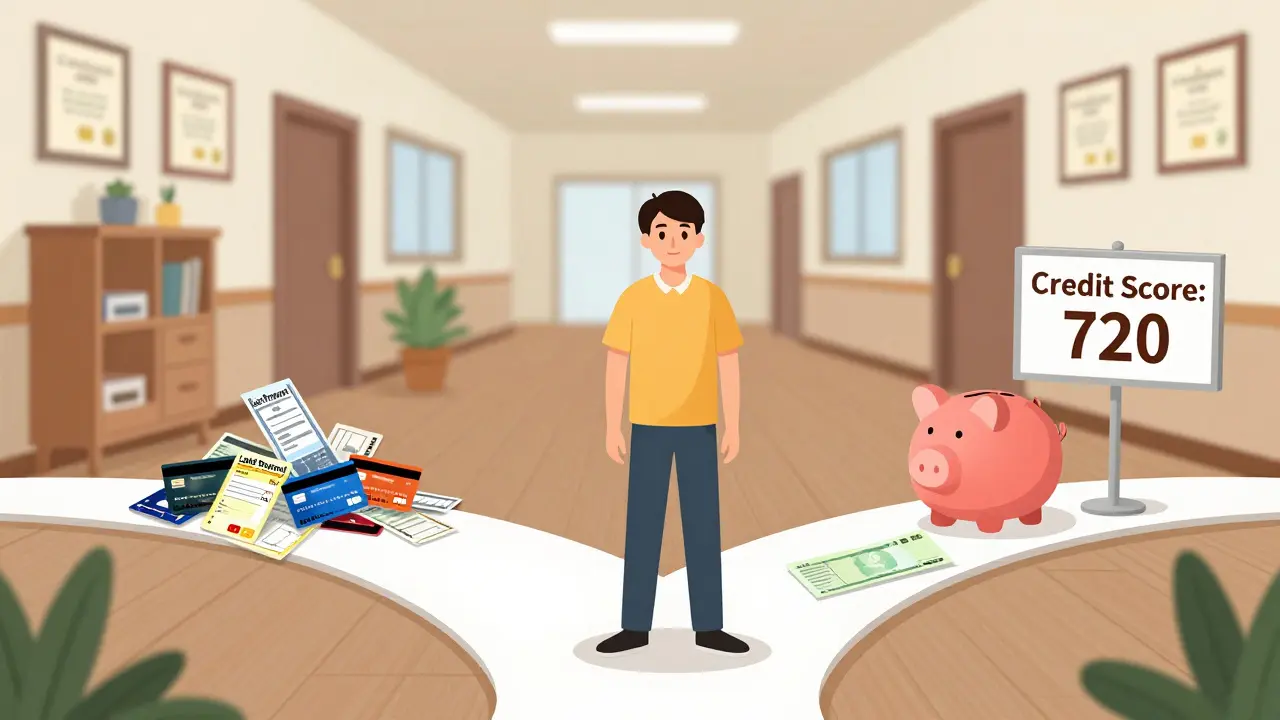
- Simulating credit scores: how late payments, high balances, and applying for too many cards hurt your score
- Debunking myths: "You need to be rich to invest" or "Student loans are free money"
At Roosevelt High in Portland, students spend a full semester running mock households. They’re given fake salaries, rent prices, and unexpected expenses-like a broken washing machine or a sudden doctor’s visit. By the end, 87% of them could correctly identify the cheapest phone plan, calculate take-home pay, and explain why a 20% interest rate on a $500 loan could cost them over $100 in just three months. That’s not theory. That’s real-life armor.
Why parents and teachers can’t do this alone
Many assume parents should handle this. But 61% of U.S. parents say they’re uncomfortable talking about money with their kids, according to a 2025 TIAA survey. Some grew up in households where money was taboo. Others don’t know how to explain compound interest without a calculator. And let’s be honest-many adults are still struggling with debt themselves. Relying on families to fix this is like asking a fire department to put out a blaze with a water bottle.
Teachers aren’t financial experts either. But they don’t need to be. What they need are clear, ready-to-use materials. Programs like Next Gen Personal Finance and Jump$tart Coalition offer free, standards-aligned lesson plans that fit into existing social studies or math classes. No extra training. No budget spikes. Just structured, practical lessons that take 30-45 minutes a week.
The cost of not teaching it
The consequences aren’t just personal-they’re economic. The average American under 25 carries $1,900 in credit card debt. Nearly 40% of young adults say they’ve missed a payment because they didn’t know how much they owed. That leads to damaged credit, higher interest rates for years, and even trouble renting apartments or getting jobs (yes, some employers check credit reports).
And it’s worse for marginalized students. A 2023 Urban Institute report showed that Black and Latino teens were 35% more likely to have no access to financial education at school. That gap doesn’t close on its own. Without intervention, it becomes a cycle: no money skills → debt → limited opportunities → less financial stability for the next generation.
It’s not too late-and it’s not hard
States are starting to act. As of 2026, 24 states require high schools to offer at least one semester of personal finance. Utah requires a full course. Virginia made it part of graduation requirements. These aren’t radical ideas-they’re basic responsibilities.
You don’t need fancy tech or expensive programs. You need:
- A single required course, even if it’s just one semester
- Teachers trained through free online modules (like those from Next Gen Personal Finance)
- Real-world scenarios, not textbook definitions
- Students using their own (fake) money to make real decisions
At Flagstaff High, a teacher started a pilot program last year. She used a free budgeting app and had students track fake income and expenses for six weeks. One student, a 17-year-old working part-time at a gas station, realized he was spending $80 a week on snacks and video games. He cut it to $20 and started saving for a used car. By the end of the semester, he had $450 saved. He didn’t need a financial advisor. He just needed to know how to count.
Financial literacy is the missing graduation requirement
We ask students to pass algebra, write essays, and understand Shakespeare. But we don’t ask them to understand their own paycheck. That’s backwards. Financial literacy isn’t a luxury. It’s the foundation of independence. It’s the difference between living paycheck to paycheck and having the freedom to choose.
If we want students to be ready for adulthood, we have to prepare them for the real world-not just the test. And that means teaching them how to handle money before they leave school. Not after. Not someday. Now.
Gareth Hobbs
March 18, 2026 AT 11:21Zelda Breach
March 19, 2026 AT 00:17Alan Crierie
March 19, 2026 AT 05:06Nicholas Zeitler
March 19, 2026 AT 18:25Teja kumar Baliga
March 21, 2026 AT 05:18k arnold
March 23, 2026 AT 01:42Tiffany Ho
March 23, 2026 AT 22:39michael Melanson
March 25, 2026 AT 16:04lucia burton
March 26, 2026 AT 03:32Denise Young
March 27, 2026 AT 05:32Sam Rittenhouse
March 27, 2026 AT 17:19kelvin kind
March 29, 2026 AT 03:52Ian Cassidy
March 31, 2026 AT 00:09Zach Beggs
April 1, 2026 AT 05:44